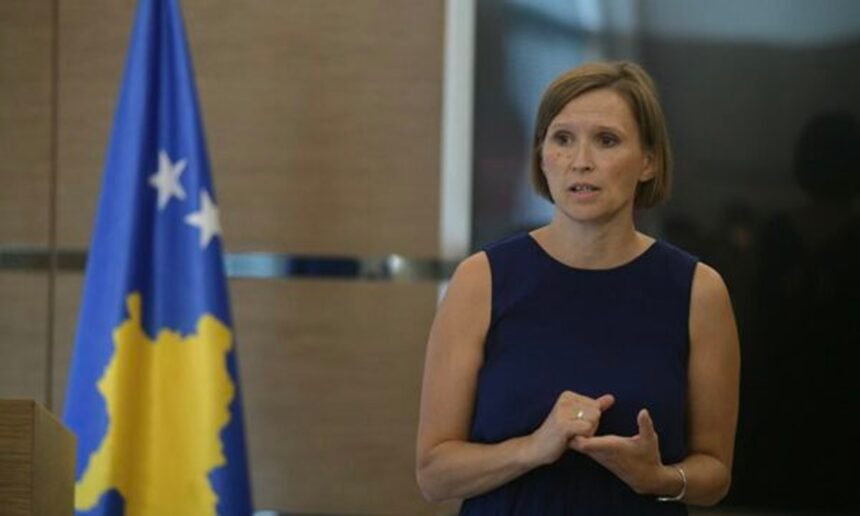
Eva Palatova, Acting Head of the European Union Office in Kosovo, said that €880 million are available for Kosovo under the EU Growth Plan, but stressed the need to accelerate reforms and ensure the full functioning of institutions.
She underlined that developing a strong private sector in the Western Balkans is essential for socio-economic development and regional integration, noting the importance of small and medium-sized enterprises (SMEs) and entrepreneurs as key drivers of inclusive and sustainable growth, job creation, skills development, and innovation.
According to her, discussions on strengthening SME competitiveness and creating a more business-friendly environment are highly important.
“In the framework of the Growth Plan, €880 million over three years are ready to be invested in Kosovo in exchange for reforms. Kosovo has submitted an ambitious reform agenda in the area of private sector development and the business environment,” Palatova said.
She added that the agenda includes seven key reforms and 26 steps aimed at promoting investment and exports, simplifying the regulatory framework, and encouraging innovation and sustainable growth.
Palatova stressed that what is now needed is a significant acceleration of reforms.
“The reform agenda was adopted by the Government of Kosovo at the end of 2024. We are now in the summer of 2026, and we are seeing the expiration of the first period of tolerance, where for the first time we will be able to formally measure what Kosovo has achieved,” she said.
She also emphasized the importance of making institutions fully functional so Kosovo can fully benefit from the Growth Plan’s potential.
OECD: Kosovo’s SME assessment aligned with EU standards
Marzena Kisielewska, Head of the South East Europe Division at the OECD, said that the OECD’s SME assessment is based on European standards and aims to bring the region closer to the European Union.
She explained that the methodology is rooted in the European Small Business Act, combining EU and OECD standards into a unified framework.
“This transformative assessment in a way brings you closer to both organizations,” she said.
Kisielewska added that the OECD has updated its methodology to better reflect real reforms and changes in regional economies over the past 20 years.
She noted that the new approach is more advanced and uses clustering instead of linear assessment to better capture progress in Western Balkan economies.
The report also includes a digital and green transition dimension for SMEs.
“We also have a new dimension reflecting the digital transition of SMEs, as well as sustainability and the green transition,” she said.
She emphasized that SME resilience is the key horizontal theme of the entire process.
Kosovo officials: Private sector development is a key priority
Deputy Minister of Industry, Entrepreneurship, Trade and Innovation, Jeton Mehmeti, said the document presented is an important foundation for the country’s economic development and private sector growth.
He highlighted the role of SMEs as a pillar of Kosovo’s economy and stressed the importance of continued reform efforts.
Mehmeti said the OECD plays an important role in supporting economic and social reforms and improving the business climate in the region.
He reiterated Kosovo’s commitment to aligning its policies with EU and OECD standards.
The ministry, he added, aims to build a more competitive and sustainable economy through innovation, support for SMEs, and stronger economic resilience.