Political blockades and disputes have marked Bosnia and Herzegovina’s political scene over the past two years, leaving the country with limited progress toward European Union and NATO integration.
Following the latest elections, the possibility has emerged of forming a new state-level government involving the Alliance of Independent Social Democrats (SNSD), the Croatian Democratic Union of Bosnia and Herzegovina (HDZ BiH) and the Party of Democratic Action (SDA), three parties that have participated in different governing arrangements over the years.
The potential coalition raises questions about whether Bosnia and Herzegovina can make renewed progress toward European and Euro-Atlantic integration.
SNSD, led by Milorad Dodik, has consistently opposed NATO membership for Bosnia and Herzegovina, while Dodik has also stepped up his criticism of the EU and its current leadership.
HDZ BiH officially supports the country’s European path. SDA, meanwhile, spent the previous state-level mandate in opposition, although its earlier periods in government did not resolve many of the longstanding political and institutional disputes that have slowed EU integration.
None of the three parties responded to questions from Radio Free Europe (RFE/RL) about the positions they intend to take in negotiations over a new government regarding EU integration, NATO membership and relations with Russia.
EU and NATO Call for Institutional Progress
Bosnia and Herzegovina received EU candidate status in December 2022 and was given the green light to open accession negotiations, but much of the required work remains unfinished.
Judicial reform, the fight against corruption, the functioning of state institutions, state property, the Constitutional Court and other political disputes remain unresolved.
EU institutions have also repeatedly warned about malign Russian influence and stressed that Bosnia and Herzegovina is expected to align fully with the EU’s Common Foreign and Security Policy, including its approach toward Russia following the invasion of Ukraine.
The European Parliament has welcomed Bosnia and Herzegovina’s formal alignment with EU sanctions against Russia while warning that political divisions and blockades continue to slow reforms and the country’s European path.
The European Commission has previously said that Bosnia and Herzegovina had failed to implement the required reform measures, leaving the country without access to initial disbursements under the EU’s financial support mechanisms.
On October 6, EU foreign policy chief Kaja Kallas and Enlargement Commissioner Marta Kos called on political actors to form governments at all levels “without delay” and build the necessary consensus for Bosnia and Herzegovina to advance toward EU membership.
They said the EU would continue supporting the country’s European integration as a single, sovereign and territorially integrated state, while urging the new authorities to implement reforms and make use of opportunities offered through the EU Growth Plan for the Western Balkans.
NATO, meanwhile, told RFE/RL that it expects Bosnia and Herzegovina to form functioning institutions and continue cooperation with the Alliance.
“NATO remains strongly committed to the sovereignty and territorial integrity of Bosnia and Herzegovina,” the Alliance said.
Asked about the potential impact of close ties between some election winners and Russia on Bosnia and Herzegovina’s relationship with NATO, the Alliance said a stable and secure Bosnia and Herzegovina and a peaceful Western Balkans remain in its strategic interest.
“NATO supports the European Union’s Operation Althea, implemented under the Berlin Plus arrangements, and we will not allow a security vacuum to emerge in Bosnia and Herzegovina,” NATO said, warning that secessionist threats, internal political disputes and nationalist ideas are destabilizing and dangerous.
The Alliance also stressed that it has cooperated with Bosnia and Herzegovina for more than three decades and continues to support reforms, institutional resilience and the capabilities of the country’s Armed Forces.
Dodik Between Moscow and Washington
Russia’s influence is expected to remain an important issue in negotiations over the formation of Bosnia and Herzegovina’s state-level government.
SNSD leader Milorad Dodik has maintained close political ties with Russian President Vladimir Putin, while authorities in Republika Srpska have opposed imposing sanctions on Russia following its invasion of Ukraine.
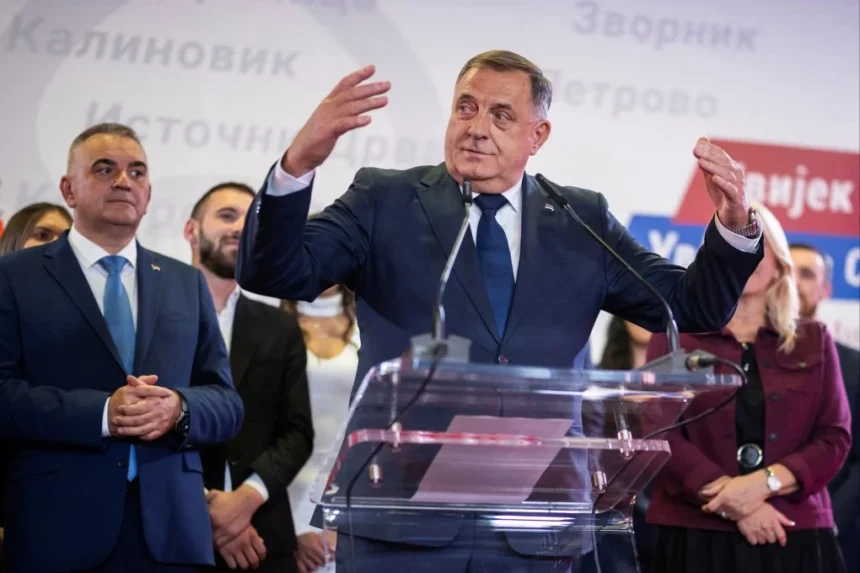
Days before the elections, Dodik traveled to Moscow and met Putin. On election night, he thanked both Putin and U.S. President Donald Trump.
Vedran Džihić, a lecturer at the University of Vienna’s Faculty of Political Science, told RFE/RL that Dodik’s pro-Russian orientation remains a consistent element of his political positioning.
“That pro-Russian dimension is constant and cannot change,” Džihić said, arguing that the position has brought Dodik political support and remains one of the foundations of his political strategy.
He noted that SDA, by contrast, has taken a clear position that Russia is the aggressor in Ukraine and that Russian influence in the region is negative.
The key question, Džihić said, is how HDZ BiH will position itself toward Russia and how it will balance its European orientation with its partnership with SNSD. He also pointed to Croatia’s position, given Zagreb’s alignment with EU sanctions against Moscow.
Political analyst Mladen Bubonjić said developments in Bosnia and Herzegovina would also be affected by international dynamics, including the war in Ukraine and relations between the EU, Russia and the United States.
He argued that Moscow and Dodik share an interest in maintaining political divisions that slow Bosnia and Herzegovina’s Euro-Atlantic integration.
Džihić also said Dodik had benefited politically from changes in U.S. policy after Donald Trump returned to the White House. U.S. sanctions previously imposed on Dodik were lifted last year, which Dodik presented during his political campaign as evidence of a change in Washington’s approach toward him and Republika Srpska.
In recent years, Republika Srpska authorities have also spent millions of euros on lobbying and consulting firms in the United States in an effort to strengthen the entity’s political position and its leadership’s contacts in Washington.
Limited Expectations for EU Integration
Unlike HDZ BiH and SDA, which emphasized Euro-Atlantic integration during the election campaign, SNSD has maintained a significantly more critical position toward the EU.
Dodik has repeatedly criticized the current EU leadership and opposed certain demands from Brussels that he says would transfer additional powers to state institutions.
At the same time, SNSD has supported cooperation with the EU while continuing to oppose NATO membership for Bosnia and Herzegovina and rejecting some EU policies toward Russia.
Džihić said he did not expect the election results to produce a major breakthrough in Bosnia and Herzegovina’s EU integration process.
“I do not see, at least in the near term, any particular chance of moving forward from the current blockade,” he said, arguing that compromises between the three parties would be difficult on questions concerning European integration and strengthening the functionality of the state.
The European Commission identified 14 priorities in 2019 that Bosnia and Herzegovina must address to advance toward membership. They include judicial reform, combating corruption, strengthening institutions, public administration reform and protecting human rights.
Džihić said SNSD and HDZ BiH favor what he described as further ethnic-territorial structuring of Bosnia and Herzegovina and a weaker central state, while SDA and other pro-Bosniak forces advocate a more functional state.
The immediate question, he said, is whether political actors can reach enough pragmatic compromises to allow Bosnia and Herzegovina to continue receiving funding through the EU Growth Plan and other European programs.
NATO Membership Remains Divisive
Bosnia and Herzegovina has been part of NATO’s Partnership for Peace program since 2006, while cooperation with the Alliance has continued through the country’s Reform Program.
However, political consensus on NATO membership has never been reached. Dodik’s SNSD has for years advocated military neutrality for Republika Srpska, while SDA and HDZ BiH support closer integration with NATO.
Džihić said there was unlikely to be a rapid formal path toward NATO membership under the current political circumstances, but he did not expect cooperation with the Alliance to stop entirely.
Denis Hadžović, director of the Center for Security Studies, said there was still room for political agreements despite the deep divisions.
“Ultimately, the willingness of political actors to engage in dialogue and reach compromises will play a key role,” Hadžović said, adding that a government cannot be formed without an agreement among parties that have gained electoral legitimacy.
Unfinished Business From the Previous Government
The state-level government formed after the 2022 elections consisted of SNSD, HDZ BiH and parties grouped around the so-called “Troika.”
Although Bosnia and Herzegovina obtained EU candidate status and approval to open accession negotiations during that period, a number of key reforms were not adopted, slowing the country’s European path.
In 2024, the country was also delayed in adopting the Reform Agenda required to access funding under the EU Growth Plan for the Western Balkans, through which approximately €1 billion was earmarked for Bosnia and Herzegovina.
The previous mandate was marked by disputes over the Constitutional Court, state property and the jurisdiction of state institutions. Authorities in Republika Srpska opposed the appointment of new Constitutional Court judges and the continued presence of foreign judges on the court.
Political tensions also intensified over decisions by Republika Srpska authorities challenging rulings by the Constitutional Court and the High Representative.
Despite being removed from the presidency of Republika Srpska following a final court ruling, Dodik retained his position as SNSD leader and continued to exercise significant political influence.
The new government will therefore face longstanding disputes over state institutions, EU reforms, NATO cooperation and relations with Russia, with the EU and NATO both urging Bosnia and Herzegovina’s political leaders to overcome institutional blockades and resume reforms.