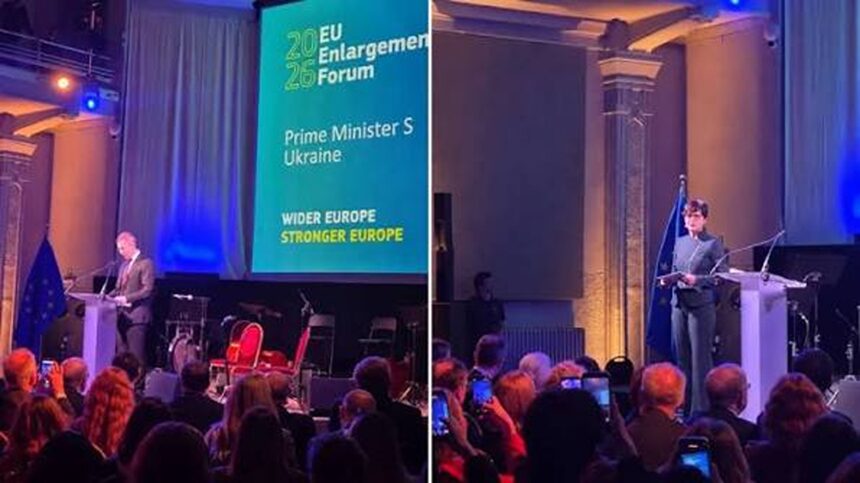
Representatives from various European countries gathered in Brussels on Sunday for the opening evening of the European Commission’s Enlargement Forum.
However, the attention of those present was drawn to the melody of the Serbian nationalist song “Oj Kosovo, Kosovo”.
The Slovenian band “Kapobanda” chose to perform the melody in front of senior political leaders from EU member states. As if the music itself were not enough, the lyrics displayed on the screen also claimed that Kosovo is Serbian land.
University professor Milazim Krasniqi explained the message conveyed by the song.
“The message of those lyrics is deeply rooted in the Serbian myth about Kosovo: Kosovo as the Serbian Jerusalem and as a dream of a vengeful return to Kosovo. From this perspective, it is a scandal, and I am convinced it was not accidental but planned and conceived as a message to Serbia’s new government and the Student List, which has received support and funding from the EU. This certainly shows that we may face many problems in the future, particularly because, in the dialogue process, the EU has never treated Kosovo as an equal party to Serbia,” Krasniqi said.
The Enlargement Forum itself aims to strengthen economic, political and social ties, including among countries aspiring to join the European Union.
However, according to ethnomusicologist Vjosava Munishi, such objectives cannot be achieved if performances of songs carrying these messages are allowed at events of this kind.
“The performance of this song during the EU Enlargement Forum can be seen as an unacceptable form of provocation and the promotion of nationalist messages, regardless of whether this was the organisers’ intention. This is especially problematic at an event intended to bring countries closer together and encourage cooperation, rather than revive narratives that have historically fuelled conflicts between them,” Munishi said.
Analyst Blerim Burjani also described the incident as a scandal, particularly given that the event was hosted by EU Enlargement Commissioner Marta Kos.
“There is political responsibility on the part of the EU, followed by administrative and protocol-related responsibility. I do not think the EU itself was directly involved in the second aspect, but the administrative team made a mistake that may have been technical, yet remains unacceptable to us. Regardless, the EU was the organiser and must provide an explanation and take responsibility for why an incident like this occurred. Allowing a song directed against a state to be played is absurd and an unprecedented scandal within the EU,” Burjani stressed.
EU Enlargement Commissioner Marta Kos blamed the musicians for the incident and expressed regret over what had happened.
Later, a European Commission spokesperson said that the song had been selected by the band itself and had not been approved by the European Commission.