European leaders are preparing to seize the initiative from the United States and assume the leading role in negotiations to end Russia’s full-scale invasion of Ukraine.
Following an emergency quadripartite summit in London late Sunday between the leaders of Germany, France, the United Kingdom, and Ukrainian President Volodymyr Zelenskyy, Berlin confirmed a major strategic reorientation in Western diplomacy. The European push comes as Washington’s focus is increasingly consumed by the rapidly escalating direct military conflict between Israel and Iran.
Shifting the Diplomatic Weight from Washington to Europe
Since early 2025, U.S. President Donald Trump’s special envoys, Steve Witkoff and Jared Kushner, have served as the primary interlocutors attempting to broker a settlement between Kyiv and Moscow. However, those efforts have yielded few tangible results.
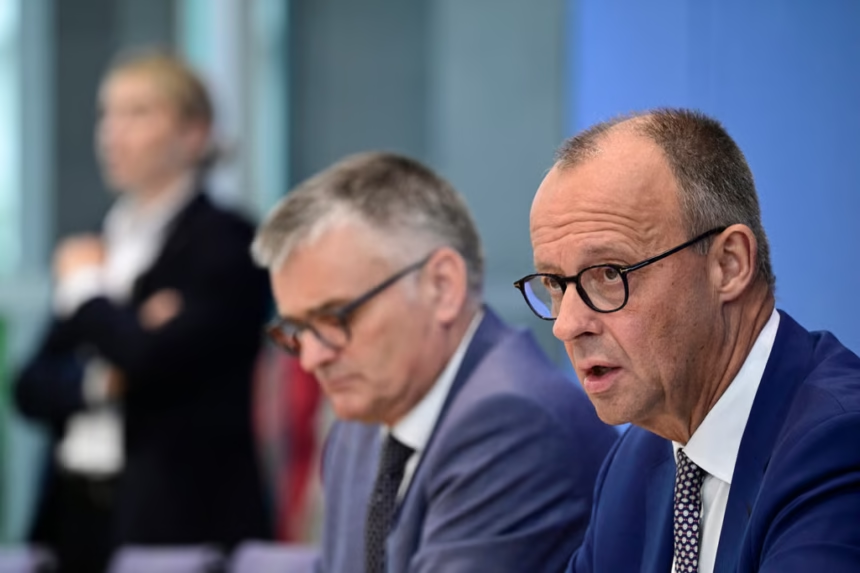
Speaking at a press conference in Berlin on Monday, Stefan Kornelius, spokesperson for German Chancellor Friedrich Merz, announced that Europe is ready to fill the diplomatic vacuum, albeit in lockstep with its transatlantic ally.
“What is new, I believe, is that this process is now gaining new momentum in Europe,” Kornelius told journalists. “Another new development is that we are taking up and continuing the negotiation process that the U.S. has largely led. We are doing this in close coordination with the U.S.”
[The Shift in Mediation Channels]
  2025 – Early 2026:  U.S.-Led Track (Witkoff / Kushner Envoys) ──> Stalled
  June 2026 – Future: European-Led Track (Berlin / Paris / London) ──> Active Preparation
The London Framework: Four Leaders, Five Conditions
In a unified joint statement released late Sunday, Chancellor Merz, French President Emmanuel Macron, British Prime Minister Keir Starmer, and President Zelenskyy called for the immediate establishment of a “direct dialogue between Ukraine and Russia with active U.S. and European participation.”
The European coalition laid out five non-negotiable baseline conditions required to achieve a viable peace framework:
- Immediate Ceasefire: A total and instantaneous halt to all active hostilities.
- The Territorial Starting Point: Negotiations must utilize the current contact line between Russian and Ukrainian forces as the baseline.
- Binding Security Guarantees: Kyiv must be granted “robust and legally binding” international security mechanisms to prevent future Russian aggression.
- Asset Freeze Maintained: Sanctioned Russian state assets will remain frozen across European jurisdictions.
- War Reparations: The Kremlin must fully compensate Ukraine for the cataclysmic infrastructural and economic damage caused by the war before any assets are unfrozen.
Kornelius noted that European leaders intend to iron out the finer details of this unified approach during the upcoming G7 meeting in Evian and the European Council summit in Brussels next week. “We need the broadest possible support from all European partners in order to actually push toward peace,” he emphasized.
Putin’s Defiance and the “Schröder Gambit”
Despite Europe’s diplomatic mobilization, the prospects of bringing Russian President Vladimir Putin to the negotiating table remain bleak. European nations—with Germany at the forefront—have surpassed the U.S. as Kyiv’s primary financial and military lifelines, meaning a European-led negotiation track is highly likely to take a significantly tougher line against Moscow than Washington would.
Putin has consistently rebuffed European overtures:
- The Zelenskyy Appeal: Last Thursday, President Zelenskyy sent an open letter directly to Putin urging a face-to-face summit; the Kremlin casually brushed off the plea the following day.
- The Schröder Distraction: Putin previously floated the Kremlin-friendly former German Chancellor Gerhard Schröder as a potential mediator.
The Schröder proposal was instantly dead on arrival in European capitals. Diplomats widely dismissed the suggestion as a transparent, calculated ploy by Putin to fracture European unity and paint himself as a good-faith actor while offering an unacceptable negotiator.
A Protracted Road Ahead
Berlin is under no illusions that a diplomatic breakthrough is imminent. Kornelius admitted that it “could take weeks or even months” of intense pressure before the Russian president feels compelled to engage with European mediators.
“Only a strong Ukraine and pressure on Russia will persuade Putin to back down,” Kornelius concluded. “We also need to establish a willingness to engage in dialogue and agree on the conditions under which such talks can even take place. All of this is part of the preparation. We are in a phase of reorientation.”