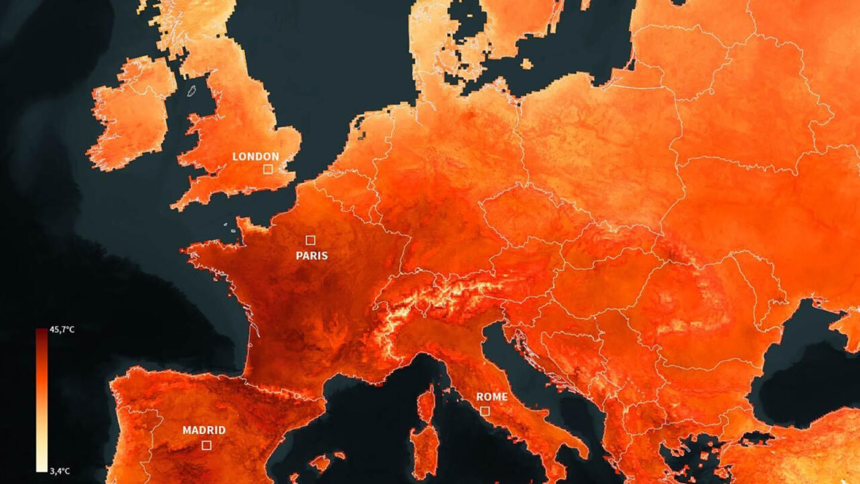
Albania was among the countries in the Western Balkans affected by above-average temperatures during June and July 2026, as Western Europe experienced an exceptional period of heat, according to the Copernicus Climate Change Service.
Data from the ERA5 climate dataset show that temperatures across Albania and parts of the Western Balkans were above the 1991–2020 average. The most severe anomalies, however, were recorded across Western Europe, where prolonged hot and dry conditions also contributed to a higher risk of wildfires.
Western Europe records exceptional temperatures
According to Copernicus, the average land-surface air temperature across Western Europe during June and July reached 21.62°C, which was 2.79°C above the 1991–2020 average.
That represents the highest temperature recorded for the combined June–July period in the region, exceeding the previous record from 2022 by approximately 0.89°C.
France, Germany, Switzerland, England, Ireland, Spain and parts of Italy were among the areas experiencing the strongest temperature anomalies. In several parts of Western Europe, July temperatures were between 3°C and 5°C above average.
For July alone, Western Europe recorded an average temperature of 22.48°C, or 2.53°C above normal, making July 2026 the second-hottest July ever recorded in the region, behind 2006.
Albania also faced severe wildfire conditions
The combination of heat and dry weather has also increased wildfire risks in Albania.
According to data from Albania’s National Civil Protection Agency, 21 fires covering more than one hectare affected a total of 476 hectares during July.
The largest concentration was recorded in Vlora, where eight fires affected approximately 306 hectares, followed by Shkodër, where seven fires affected around 98 hectares.
Fires were also reported in Lezhë, Berat, Dibër, Gjirokastër and Tirana. More recently, major fires have affected areas including Krujë, Lurë, Pukë and Dajt, with damage reported not only to forests but also to homes and businesses.
Europe experienced a sharp west–east divide
Despite the extreme heat in the west, Europe as a whole experienced less dramatic conditions because temperatures were considerably lower across parts of Eastern Europe and Scandinavia.
The average European land temperature in July was 20.49°C, approximately 0.66°C above the 1991–2020 average, making July 2026 the continent’s 11th-warmest July in the ERA5 record.
Copernicus attributed the persistent Western European heat to stable high-pressure systems that produced clear, dry conditions and allowed hot air to remain over the same areas for prolonged periods.
July was also one of the hottest months ever recorded globally
The extreme temperatures were not limited to Europe.
Globally, July 2026 recorded an average surface air temperature of 16.90°C, which was 0.67°C above the 1991–2020 average and 1.47°C above the estimated pre-industrial level.
July 2026 tied with July 2024 as the second-warmest July ever recorded globally, behind July 2023. The difference between 2026 and 2024 was just 0.01°C.
The 12-month period from August 2025 through July 2026 was approximately 1.45°C above the pre-industrial level, according to Copernicus.
Oceans also reach record temperatures
The heat extended into the world’s oceans.
The average surface temperature of the oceans outside the polar regions reached 20.96°C in July, the highest level ever recorded for that month.
The previous July record was 20.89°C, set in 2023.
Copernicus also reported exceptionally warm waters around Europe, particularly in the Atlantic and western Mediterranean.
The climate service noted that part of the unusually high ocean temperatures was associated with the development of El Niño conditions in the equatorial Pacific.
The latest data paint a striking picture: Albania and the wider Balkans are facing increasing heat and wildfire pressure, while Western Europe has experienced one of the most extreme summer heat periods in the modern climate record.