Arben Fetoshi, director of the OCTOPUS Institute, has responded to the letter sent by Serbian President Aleksandar Vučić to NATO Secretary General Mark Rutte regarding the reopening of the Ibër Bridge to vehicle traffic.
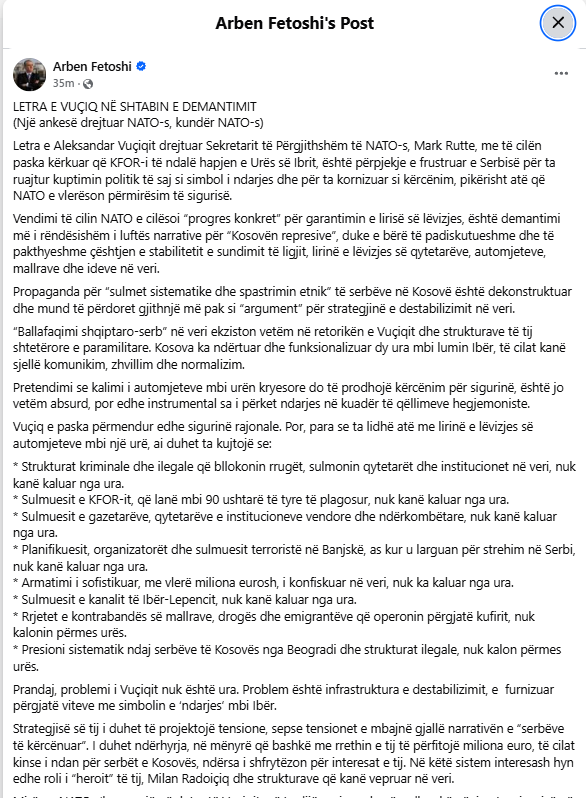
In an analysis titled “Vučić’s Letter at NATO Headquarters – A Complaint to NATO Against NATO,” Fetoshi argues that the Serbian president’s letter represents an attempt to preserve the political significance of the bridge as a symbol of division and to portray as a security threat a process that, according to him, NATO considers an improvement in security.
Fetoshi notes that NATO has described the reopening of the bridge as “concrete progress” toward guaranteeing freedom of movement. He argues that this directly challenges the narrative of a supposedly “repressive Kosovo.”
According to Fetoshi, the reopening also makes it increasingly difficult to use claims of “systematic attacks and ethnic cleansing” against Serbs in Kosovo as a justification for destabilizing the situation in the north.
He argues that claims of an “Albanian-Serb confrontation” in northern Kosovo exist primarily within Vučić’s rhetoric and that Kosovo has built and put into operation two bridges over the Ibër River, contributing to greater communication, development and normalization.
Addressing claims that opening the main bridge to vehicle traffic could pose a security risk, Fetoshi describes the argument as absurd, saying it is ultimately connected to preserving division as part of what he characterizes as hegemonic objectives.
In his analysis, Fetoshi points to a series of security incidents and criminal activities in the north, arguing that those who blocked roads and attacked civilians, institutions and KFOR personnel—as well as individuals involved in the Banjska attack—did not carry out their activities through the Ibër Bridge.
He also refers to weapons seized in northern Kosovo, the attack on the Ibër-Lepenc water canal and networks involved in smuggling, arguing that the security problem does not lie with the bridge but with what he describes as an “infrastructure of destabilization.”
“Therefore, Vučić’s problem is not the bridge. The problem is the infrastructure of destabilization, supplied over the years with the symbol of ‘division’ over the Ibër,” Fetoshi writes.
According to Fetoshi, Vučić’s political strategy relies on maintaining tensions in order to sustain the narrative of “threatened Serbs.” He argues that structures operating in the north, including figures such as Milan Radoičić, form part of this broader system.
Fetoshi further maintains that NATO is aware of the sources of security threats in northern Kosovo, citing attacks against KFOR troops, the Banjska incident and the weapons arsenal seized in the area.
Ultimately, Fetoshi argues that Vučić’s letter seeks to portray normalization as a threat, freedom of movement as a danger, and the integration of northern Kosovo as “terror against Serbs.”
For Fetoshi, this approach only exposes what he describes as a broader strategy of “victimhood as a warning.”