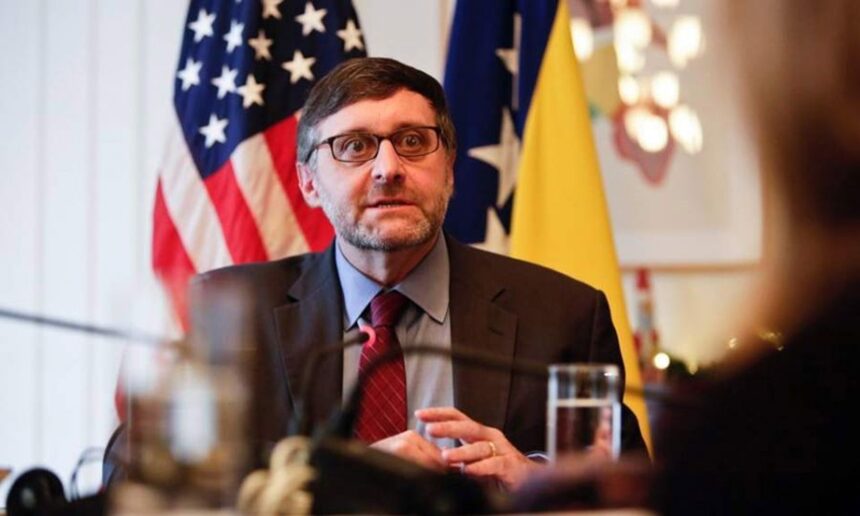
The Western Balkans’ unfinished path toward European and Euro-Atlantic integration is leaving the region vulnerable to Russian influence, according to Matthew Palmer, former US Special Representative for the Western Balkans.
In an interview with FENA, Palmer argued that Moscow is actively searching for political, social and institutional weaknesses that it can exploit to deepen existing divisions.
“100 percent,” Palmer said, pointing to Russia’s efforts to identify “cracks, divisions, gaps and weak points” within European structures and then widen them.
According to Palmer, Russia’s influence extends beyond traditional politics. Moscow is also active in society and increasingly uses the online information space to amplify existing disagreements.
He described the Western Balkans as particularly vulnerable because of its deep internal divisions, warning that Russia has demonstrated both the ability and willingness to exploit those differences.
Palmer: EU and NATO integration is more urgent than ever
Palmer believes the changing European security environment has made the integration of the Western Balkans into the EU and NATO even more important.
He stressed that strengthening Europe’s own defence capabilities should not come at the expense of the transatlantic alliance. Instead, he argued, Europe should become more capable of taking responsibility for its own security while maintaining a strong partnership with the United States.
For the countries of the Western Balkans, he said, the current security environment should provide an additional incentive to deepen their ties with both the EU and NATO.
Bosnia and Herzegovina remains particularly vulnerable
Addressing Bosnia and Herzegovina, Palmer identified internal political divisions and the lack of a shared sense of statehood as among the country’s major challenges.
He called for stronger state institutions, greater efforts against corruption, the rule of law and stronger protection of democratic institutions.
Palmer also emphasized the importance of giving young people a reason to build their futures inside Bosnia and Herzegovina, regardless of ethnic background.
He argued that a stronger economy and better opportunities could encourage young people to remain in the country, build careers and start families there.
Internal weaknesses can become security threats
Palmer warned that Europe’s future security challenges may not necessarily come in the form of conventional conflicts between states. Internal weaknesses—including corruption, weak institutions, political fragmentation and economic instability—can also create openings for outside actors.
His message was clear: the more divided Europe and the Western Balkans become internally, the easier they are to pressure and manipulate from outside.
Palmer is expected to participate in the Sarajevo Security Conference, scheduled for September 4–6, where international officials, diplomats, military representatives and security experts will discuss the evolving security environment in Europe and the Western Balkans.