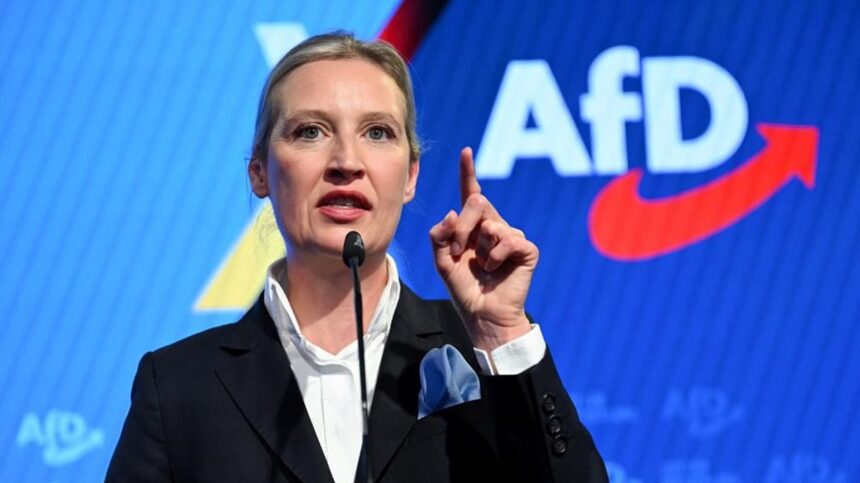
Germany’s far-right AfD is outlining a sweeping political agenda that would significantly reshape the country’s relationship with Europe, including leaving the Schengen Area and the eurozone, tightening border controls and adopting a much tougher immigration policy.
AfD co-leader Alice Weidel, speaking to German broadcaster ZDF, argued that Germany was economically stronger before adopting the euro. She blamed the common currency for weakening Germany’s economy and reducing household wealth.
On migration, Weidel was unequivocal: “We will close the borders and leave Schengen.” She also called for more deportations and fewer naturalizations, including the return of Syrian nationals whose protection status is no longer considered valid.
Weidel simultaneously attacked the CDU for refusing cooperation with the AfD, saying her party intends to first govern in Germany’s federal states and eventually at the national level.
Her comments come as the AfD continues to gain ground in opinion polls. According to the ZDF Politbarometer, the party is currently polling at 27% nationally, ahead of the CDU/CSU bloc at 22%. In Saxony-Anhalt, ahead of the September 6 state election, the AfD is polling at more than 40%.
The party’s growing support comes amid continued controversy over its political classification. In May 2025, Germany’s Federal Office for the Protection of the Constitution (BfV) classified the AfD as a confirmed far-right extremist organization. However, in February this year, the Administrative Court of Cologne temporarily barred the agency from applying that classification while legal proceedings continue.
The court said there are strong indications of anti-constitutional tendencies within the AfD, but that it has not yet been established that such tendencies characterize the party as a whole.
If the AfD eventually enters government, its proposed agenda would represent a major shift in Germany’s migration policy and its position within Europe’s border-free and common-currency systems.