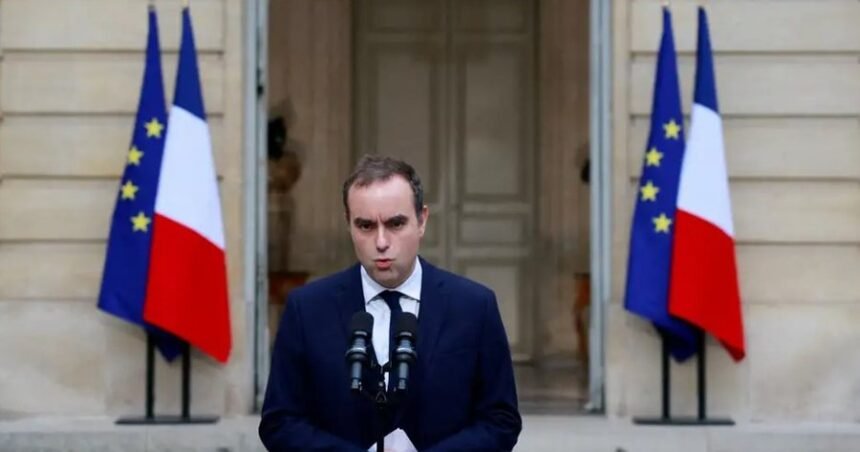
French Prime Minister Sébastien Lecornu has survived two no-confidence votes in the National Assembly today, averting the collapse of his fragile new government and preventing France from sliding deeper into political chaos.
Lecornu’s Government Avoids Collapse
The votes of no confidence, initiated by opposition parties, posed the first major challenge to Lecornu’s leadership. Their failure now allows him to continue working on the 2026 national budget, a process that will test his ability to build consensus in a deeply divided parliament.
Had the government fallen, President Emmanuel Macron would have been forced to either appoint a new prime minister or dissolve parliament and call snap elections — a risky move he took in 2024, which resulted in a hung parliament and months of political deadlock.
Two Motions Fail to Pass
The first motion, filed by the far-left party France Unbowed (LFI), received 271 votes, falling 18 votes short of the 289 needed for a majority.
The second motion, introduced by the far-right National Rally of Marine Le Pen, gathered only 144 votes, supported mainly by her own party, its ally the Union for the Right Republic, and a few independents.
Opposition Divided, Socialists Hold the Balance
Lecornu’s survival largely depended on the Socialist Party’s decision to abstain. With 69 seats, the Socialists could have tipped the balance but chose not to support the motions after Lecornu offered to suspend the unpopular pension reform that raises the retirement age from 62 to 64.
Only seven Socialist MPs voted with the left-wing bloc, while the center-right Republicans (50 MPs) also refused to back the motions.
A Fragile Victory
Despite this short-term success, Lecornu’s position remains highly precarious. His government could still face another no-confidence vote if talks over the 2026 budget break down.
“The situation is still unstable,” said Yaël Braun-Pivet, the President of the National Assembly and a close ally of Macron. “But I am cautiously optimistic about reaching a compromise.”
Economic Challenges Ahead
Lecornu pledged not to use Article 49.3 of the Constitution — a controversial power that allows the government to pass a budget without parliamentary approval. Macron’s administration used this measure in 2023 to force through pension reforms, triggering mass protests nationwide.
Reaching agreement on the new fiscal plan, which includes raising tariffs, cutting public spending, and reducing France’s growing deficit and debt, is expected to be extremely difficult.
France’s political gridlock began after the June 2024 snap elections, which produced no clear majority and left Macron’s centrist coalition weakened. Since then, France has seen a succession of prime ministers struggle to maintain parliamentary stability.