A councillor from the ruling party in Višegrad, eastern Bosnia and Herzegovina, has promoted the Russian ultranationalist organization Rusov, whose members are involved in Russia’s aggression against Ukraine.
As previously reported by Radio Free Europe (RFE), the International Movement of Russian-Slavic Unity and Revival (Rusov) maintains contacts with several far-right groups from Serbia, while the leader of this movement, Andrei Rodionov, has visited countries across the region several times.
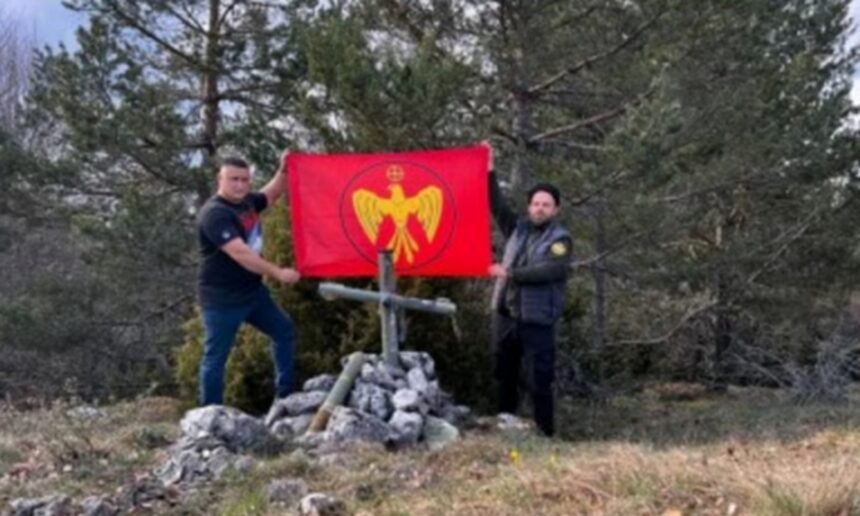
A photograph published in April on the Telegram channel of this group shows Velibor Zeković, a councillor from the Socialist Party of the Republika Srpska in the Višegrad Municipal Assembly, posing with the Rusov flag on Zaglavak Hill near Višegrad.
Standing beside him is Željko Đurović, who around ten years ago presented himself as the head of the Serbian branch of the All-Russian Movement “Kosovo Front”, an organization that Ukrainian authorities have described as an entity involved in recruiting people from the Balkans to fight on the front lines in Ukraine. Đurović is also wearing a jacket bearing the Rusov emblem.
The caption accompanying the photograph states that Zeković and Đurović are “Serbian allies of the Rusov movement” and that they are located “at the place where, in 1993, Russian volunteers fought and shed blood side by side with Serbs for Serbian Bosnia.”
Velibor Zeković did not respond to calls or messages from Radio Free Europe regarding his alleged links with the Rusov movement. The Socialist Party of Republika Srpska has also not commented on the photograph.
RFE also contacted Željko Đurović through the Russian social network VKontakte and by email, but he did not respond.
No response was received from the Rusov movement either.
Bosnia’s Political Links With the Russian Far Right
“It is paradoxical that parties which are nominally called socialist flirt with far-right organizations and have nothing in common with left-wing ideology,” said Đorđe Vujatović, a journalist from Banja Luka who follows issues related to foreign influence in Bosnia and Herzegovina, speaking to Radio Free Europe.
However, he emphasized that contacts between political actors from the Republika Srpska entity of Bosnia and Herzegovina and Russian far-right groups are not an exception, but rather a pattern.
“In the past, we have seen cases where many officials and high-ranking politicians attended events where Aleksandar Zaldostanov, known by the nickname “The Surgeon,” was present. He is the leader of the Russian motorcycle group Night Wolves, and he is on the United States sanctions list,” Vujatović said, adding:
“Almost the entire political establishment is connected with the Russian Federation.”
Vujatović believes that the reasons behind the close ties between leading Republika Srpska parties and Russia are primarily rooted in political opportunism. He says that public opinion in Republika Srpska is largely receptive to Russian narratives and the policies of Russian President Vladimir Putin.
“Political actors have understood that this is useful for gaining power, and everyone is riding this wave of populism, using historical ties with Russia, Pan-Slavism, and Orthodoxy as unifying factors,” he said.
On the other hand, Vujatović added, Russian organizations are mainly interested in spreading their ideas beyond Russia’s borders.
“The Balkans, because of their historical connections, represent the most suitable space for this activity through local representatives and for demonstrating their belonging to what they call a multipolar world,” he said.
Russian-Serbian War Connections
Zeković and Đurović displayed the flag of the Russian organization behind an improvised cross made from empty grenade launcher containers, at a location where, during the 1990s war in Bosnia and Herzegovina, members of the Army of Republika Srpska and Russian volunteers were active.
For years, war veterans’ associations from Republika Srpska have organized commemorations of the so-called “Day of Russian Volunteers.” Unlike previous years, this year the authorities of Bosnia and Herzegovina banned Russian volunteers from entering the country, meaning that the commemoration was attended only by representatives of veterans’ associations from Bosnia’s smaller entity and relatives of volunteers from the Russian Federation.
Among those denied entry into Bosnia and Herzegovina was Aleksandar Kravchenko, a former Russian volunteer in Bosnia and the founder of the Kosovo Front organization, which is also linked to Željko Đurović. His organization was active even before the full-scale Russian invasion of Ukraine, during the conflict in eastern Ukraine’s Donbas region.
Ukrainian authorities have described the Kosovo Front as an organization involved in recruiting volunteers from the Balkans, although Kravchenko denied these allegations in an earlier interview with Radio Free Europe.
Regarding citizens who travel as volunteers to fight in the war in Ukraine, Đorđe Vujatović believes that contacts between Russian and Serbian actors do not currently represent a major threat to Bosnia and Herzegovina’s internal security. However, he stresses that the problem lies in the fact that the state rarely punishes citizens who participate in foreign conflicts.
“Joining foreign battlefields is punishable by law, but the state does not react, partly because some of these people have obtained Russian citizenship,” Vujatović said.
Russian-Serbian ties have remained active even after the Kremlin launched its full-scale invasion of neighboring Ukraine in February 2022.
The exact number of citizens of Bosnia and Herzegovina who have gone as mercenaries to fight in Ukraine is unknown. However, in 2025, Europol announced that among hundreds of identified members of Russian mercenary groups Wagner and Redut, there were also citizens of Bosnia and Herzegovina, without providing further details.
One of the most well-known figures is Davor Savičić, a Bosnian Serb who holds the rank of colonel in the Main Directorate of the General Staff of the Russian Armed Forces, known as the GRU. Ukrainian authorities have initiated criminal proceedings against him for alleged war crimes.
At the beginning of 2023, a video was published on Telegram showing two masked soldiers speaking Serbian and saying that they had joined Russian forces in Ukraine, specifically the Sudoplatov Battalion.
Presented under the code names “Danube” and “Sava,” they described themselves as “Serbian patriots and Russophiles” who had come to help their “Russian brothers.”
Their identities have not been officially confirmed, but media in Bosnia and Herzegovina reported that they were citizens of the country and that Interpol arrest warrants had been issued against them for criminal offenses.
In the video featuring “Danube” and “Sava,” they were seen wearing the emblem of the Rusov movement.
The yellow falcon with the solar cross symbol — widely used in the iconography of far-right groups — is also visible on the flag displayed by Velibor Zeković and Željko Đurović in April 2026.
What Is the Rusov Movement?
Rusov is the symbol of a Russian organization whose official manifesto lists among its main objectives the restoration of a “historical Greater Russia, defender of Slavs, bastion of traditional values, and guarantor of the creation of a socially just society.”
The Rusov movement supported pro-Russian separatists after the outbreak of the conflict in eastern Ukraine in 2014.
According to his own claims, Rodionov founded the Phoenix unit, which fought as part of the Prizrak Brigade, a formation that also included several volunteers from Serbia, as previously reported by Radio Free Europe.
In a photograph allegedly taken in 2015 in the territory of the so-called “Luhansk People’s Republic,” Rodionov is seen wearing camouflage clothing and holding, together with another man, a red flag displaying a far-right symbol known as the “Slavic swastika.”
After the beginning of Russia’s full-scale invasion, Rodionov published photographs of himself on Telegram wearing military uniform and carrying weapons, claiming that in 2023 he joined the Russian Assault Volunteer Corps.
Rusov and the Balkans
The Rusov movement was founded in 2012, while its founder, Andrei Rodionov, has visited the Balkans several times, something he has documented through photographs on his social media accounts.
In an interview with Radio Belgrade in 2020, he stated that members of his movement include “not only other organizations and movements, but also political parties.”
Media outlets in North Macedonia reported that Rodionov had visited the country several times since 2017, while in 2018 he organized a camp near Skopje focused on martial arts training and the teaching of “the spiritual traditions of Ancient Russia.”
In Serbia, Rodionov maintains contacts with the unregistered far-right group People’s Patrol, known for its actions against migrants.
Together with the leader of this group, Damnjan Knežević, Rodionov marked the 100th anniversary of the exodus of Russian monarchists from Russia following the October Revolution in Belgrade in 2021.
Earlier that same year, Knežević had visited Moscow, where, among others, he met with Andrei Rodionov.
Meanwhile, Rusov has also been linked to the group Serbian Falcon, a lesser-known far-right organization that in July 2024 organized a gathering in Novi Sad dedicated to the so-called “liberation of Srebrenica.”
The event referred to the anniversary of the Srebrenica genocide, which was committed in 1995 by forces of the Republika Srpska Army under the command of Ratko Mladić during the capture of the enclave.
Mladić was sentenced to life imprisonment by the International Criminal Tribunal in The Hague for this and other crimes committed during the war in Bosnia and Herzegovina.
In a photograph published in May 2025 on the Instagram profile of the Serbian Falcon group, Andrei Rodionov can be seen posing with three masked individuals wearing uniforms and carrying weapons, while the flags of Rusov and Serbian Falcon are displayed.
The caption accompanying the photograph reads:
“Russian comrades-in-arms with Serbian falcons on the front line of defending Orthodoxy,”
while the location is marked as Donetsk, in eastern Ukraine.
Flags bearing Rusov symbols have also been seen during protests supporting Russia’s invasion of Ukraine, which in several cases were organized by far-right groups in Belgrade.
Russian Influence Networks and Ideological Expansion
The activities of Rusov demonstrate how Russian far-right movements have attempted to build networks beyond Russia by using historical, religious, and nationalist connections in the Balkans.
Through cooperation with Serbian and Bosnian Serb groups, these organizations promote narratives based on Pan-Slavism, Orthodox identity, and support for Moscow’s geopolitical goals.
Analysts warn that these connections create channels for the spread of extremist ideologies and Russian influence in a region already affected by the consequences of the wars of the 1990s and ongoing political tensions.
The Wider Security Concerns
The links between Russian far-right organizations and actors in the Balkans have continued despite Russia’s full-scale invasion of Ukraine in 2022.
Although the exact number of citizens from Bosnia and Herzegovina who have joined Russian forces remains unknown, European security institutions have repeatedly warned about the presence of foreign fighters and recruitment networks connected to Russia.
Experts emphasize that the issue is not only about individuals participating in foreign wars, but also about the broader ideological influence these networks attempt to establish in the region.
According to analysts, groups such as Rusov seek to expand their influence by promoting narratives of Russian dominance, traditionalism, and opposition to Western institutions.
The Balkans remain a particularly attractive area for such activities due to historical ties, unresolved political disputes, and existing nationalist movements.
At the same time, critics point out that weak institutional responses and limited accountability allow some individuals connected to these networks to continue operating openly.
The continued presence of Russian-linked extremist groups in Bosnia and Herzegovina and Serbia raises concerns among security experts about the potential spread of radical ideologies and the use of regional divisions for foreign political objectives.
The activities of the Rusov movement and its contacts with groups in the Balkans illustrate the growing intersection between Russian far-right networks, regional nationalism, and Moscow’s broader influence strategy.
Through symbolic references to historical conflicts, religious identity, and wartime cooperation, these groups attempt to strengthen ties between Russian and Balkan extremists.
While authorities and analysts continue monitoring these connections, concerns remain that such networks could contribute to further destabilization in a region still dealing with the consequences of past conflicts.