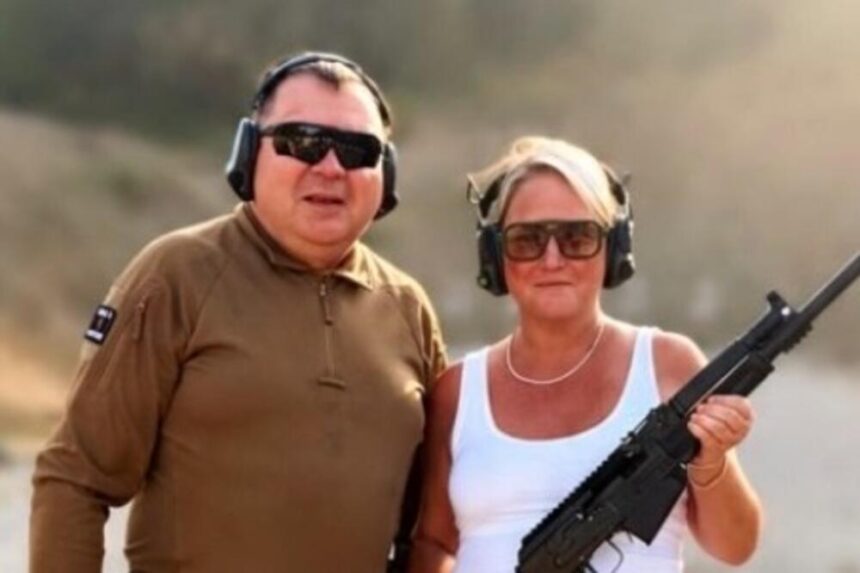
CBS News verifies photo of Katie Wiles posing with a rifle alongside Republika Srpska Interior Minister Željko Budimir
Katie Wiles, the daughter of White House Chief of Staff Susie Wiles, is a partner at a U.S. lobbying and consulting firm that receives $35,000 per month from Bosnia and Herzegovina’s Republika Srpska entity to represent its interests in Washington, the Financial Times (FT) has reported.
The revelations have raised questions about business relationships between individuals connected to U.S. President Donald Trump and the political circle surrounding Milorad Dodik, the leader of Republika Srpska’s ruling Alliance of Independent Social Democrats (SNSD).
Katie Wiles is a partner at Washington-based Continental Strategy, which signed a lobbying agreement with Republika Srpska in February. Documents filed with U.S. authorities show that the contract provides for monthly payments of $35,000, equivalent to $420,000 annually.
Her mother, Susie Wiles, is one of the most influential figures in the Trump administration, serving as White House chief of staff and overseeing the president’s schedule and coordination of his senior political team.
Continental Strategy confirmed that Katie Wiles visited Republika Srpska in August but said she was there on behalf of another client and had never contacted U.S. officials regarding the firm’s lobbying work for the entity.
Photo shows Wiles posing with Republika Srpska minister
CBS News has independently verified a photograph showing Katie Wiles holding a rifle and posing alongside Željko Budimir, Republika Srpska’s interior minister.
The image was shared on X by Evi Kokalari, an Albanian-American conservative activist. CBS journalists subsequently verified the identities of the individuals pictured and the location, identified as the RIS shooting range in northern Republika Srpska.
According to CBS, the photograph was taken during the summer and appears to have initially been posted on Wiles’ private Instagram account with a caption referring to work and leisure.
The photograph establishes that Wiles visited the area and was pictured with a senior Republika Srpska official. It does not, by itself, demonstrate that she participated in lobbying activities on behalf of the entity.
A spokesperson for Continental Strategy told CBS that Wiles spent two days in Bosnia and Herzegovina in mid-August accompanying a U.S. company that had been invited to prepare a feasibility study for a project. The spokesperson said Wiles had provided strategic communications services to that company for more than two years.
Continental Strategy maintained that Alejandro Garcia was the only representative of the firm who contacted U.S. authorities regarding Republika Srpska. Garcia previously served as deputy political director of Trump’s 2024 presidential campaign and is registered as a lobbyist for the entity.
The firm said Garcia’s contacts with U.S. institutions were properly disclosed under the Foreign Agents Registration Act (FARA).
The White House has also said that Susie Wiles does not discuss business matters with her daughters.
Susie Wiles met Dodik ally Željka Cvijanović
The FT report also highlighted a September meeting at the White House between Susie Wiles and Željka Cvijanović, the Serb member of Bosnia and Herzegovina’s tripartite Presidency and a close political ally of Dodik.
Following the meeting, Cvijanović said she had discussed the political situation in Bosnia and Herzegovina and the wider region with Trump’s chief of staff.
According to White House officials, the meeting was arranged at the request of Alejandro Garcia, the Continental Strategy lobbyist.
The meeting has raised questions about potential conflicts of interest because the company in which Katie Wiles is a partner has a paid lobbying contract with Republika Srpska, while a business associate of hers helped arrange a meeting between a senior politician from the entity and her mother.
The White House has rejected suggestions of improper influence. The information reported so far does not establish that Katie Wiles participated in arranging the meeting.
Trump-linked political advisers also worked for Republika Srpska
The revelations follow reporting by The New York Times about the involvement of two prominent political operatives associated with Trump in work for Republika Srpska.
Chris LaCivita, one of the leading strategists behind Trump’s successful 2024 presidential campaign, and James Blair, a former deputy White House chief of staff, travelled to Republika Srpska ahead of elections held on October 4.
U.S. media reports said the two received hundreds of thousands of dollars for consulting work connected to the elections.
Trump responded by saying he had not been aware of all their clients and indicated that he would end their relationship with him if conflicts of interest were established. He later softened his response, describing LaCivita and Blair as independent consultants who did not work directly for him and saying he did not believe their engagements constituted a conflict of interest.
The case attracted attention within Republican circles as the United States approached congressional elections, when experienced political advisers were particularly valuable to Trump’s allies.
Millions spent seeking access to Trump’s political circle
The lobbying contracts form part of a broader effort by Republika Srpska’s leadership to strengthen its political connections in Washington.
According to U.S. media reports citing filings with the U.S. Department of Justice, Republika Srpska has spent more than $4 million since early 2025 on lobbyists and political operatives connected to Trump’s political network.
Key objectives reportedly included securing the removal of U.S. sanctions against Dodik and his associates and promoting discussions about revisiting the Dayton Peace Agreement, which established Bosnia and Herzegovina’s postwar constitutional framework.
The Trump administration lifted sanctions against Dodik and several associates in October 2025, following years of U.S. pressure over actions Washington viewed as undermining Bosnia and Herzegovina’s constitutional order.
The administration presented the decision as part of efforts to support stability in the Balkans. Critics have questioned the political and business circumstances surrounding the move.
However, the available information does not establish that lobbying payments were the reason the sanctions were lifted.
Energy project adds to scrutiny of Trump-linked business ties
CBS News has also reported on a separate energy project worth more than $1.5 billion that has drawn attention to business connections involving people associated with Trump and Bosnia and Herzegovina.
The project involves U.S. company AAFS Infrastructure & Energy. Individuals connected to the company include Jesse Binnall, a former personal attorney to Trump, and Joseph Flynn, the brother of Michael Flynn, Trump’s former national security adviser.
CBS reported that Michael Flynn had previously worked as a paid lobbyist for Republika Srpska, receiving $100,000 for his engagement.
Democratic lawmakers have raised concerns about the potential overlap between political decision-making and private business interests. The White House has rejected allegations that its policy toward Dodik was driven by favoritism toward Trump’s associates.
The reports have brought renewed attention to the relationships between Republika Srpska’s lobbying operations and individuals with connections to the U.S. president and his administration.
The central question raised by the revelations is how effectively Republika Srpska is using public funds allocated for lobbying to secure access to influential figures within Trump’s political network—and whether those relationships create potential conflicts of interest.