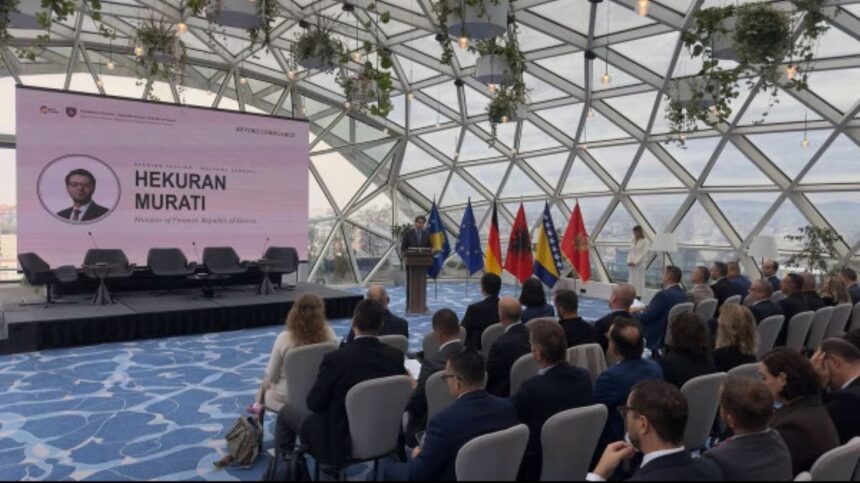
Kosovo’s Finance Minister Hekuran Murati has stressed that adopting legislation and meeting international standards are not sufficient to guarantee financial integrity unless authorities can demonstrate that the rules are effectively implemented in practice.
Speaking at an event organized by the Ministry of Finance under the theme “Beyond Compliance – Building Sustainable Economies Through Financial Integrity,” Murati outlined measures Kosovo is taking to prevent illicit financial transactions, improve transparency and strengthen oversight of economic activity.
He said one of the key measures has been restricting cash payments, which are often difficult to trace and can be exploited to finance illegal activities.
“Having the right laws and meeting international standards is important, but laws on paper do not show whether the system actually works. The real test lies in what happens afterward,” Murati said.
He explained that Kosovo had lowered the limit for cash payments between businesses from €500 to €300. For transactions between businesses and consumers, the cash payment limit is €2,000. Payments exceeding the applicable limits must be conducted through traceable transactions at licensed financial institutions in Kosovo, he said.
Murati also highlighted developments in the cryptocurrency sector, noting that the Central Bank of Kosovo has taken steps to regulate and license cryptocurrency exchange operators.
According to the minister, bringing more transactions into traceable digital channels can improve transparency, support fair competition and encourage businesses to operate within the formal economy.
However, he emphasized that tackling illicit financial flows requires international cooperation because illegally obtained funds can cross borders with relative ease.
“No single measure, no institution and, even less, no country can do this alone,” Murati said, calling for effective cross-border cooperation to combat financial crime.
Montenegro’s Ambassador to Kosovo, Bernard Çobaj, also addressed the event, describing financial integrity as more than a technical issue. He said it was an economic and security necessity, as well as a prerequisite for European integration.
Çobaj highlighted the Berlin Process as an important platform for advancing shared regional priorities, including inclusive economic growth, competitiveness, security, resilience and the green transition. He also referred to these priorities in the context of Montenegro’s chairmanship of the initiative.
Meanwhile, Germany’s Deputy Ambassador to Kosovo, Silke Bellmann, said effective efforts to combat illicit financial flows require transparency, innovation and stronger partnerships.
Bellmann identified three key priorities: closing legal loopholes that allow criminals to conceal their identities behind anonymous shell companies, improving transparency over beneficial ownership, and using advanced data analysis and artificial intelligence to detect irregularities and track criminal networks.
She also called for closer cooperation between public institutions and the private sector, alongside stronger information-sharing across national borders.
The speakers emphasized that preventing illicit financial flows requires not only effective laws and regulatory oversight, but also practical implementation, technological tools and sustained international cooperation.