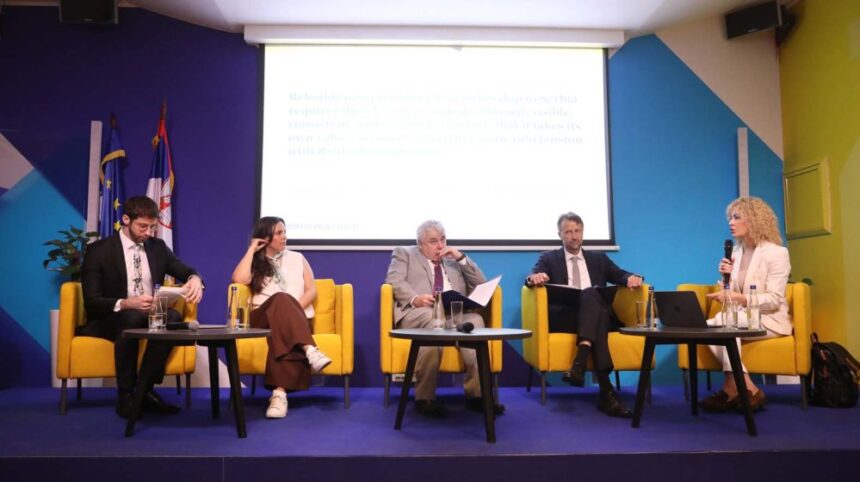
The newly appointed Head of the EU Delegation to Serbia, Ambassador Andreas von Beckerath, issued a direct appeal to Serbian authorities on Monday, June 1, 2026, demanding greater state accountability in counteracting anti-EU media narratives.
Speaking at a panel discussion organized by the Center for European Policy (CEP) in Belgrade, von Beckerath emphasized that fostering objective public opinion regarding European integration is a shared constitutional responsibility, rather than a task for Brussels alone.
The Disinformation Challenge and “Color Revolution” Tropes
Ambassador von Beckerath voiced deep concern over the systemic spread of unverified, politically motivated narratives within mainstream Serbian media. He specifically called out recent coordinated press reports alleging that European member states were orchestrating a “color revolution” to destabilize the government in Belgrade.
“This has obviously had an impact on public opinion, and we expect the Serbian authorities to take greater responsibility in fighting this disinformation,” von Beckerath stated. “We expect the authorities to do more to promote and present an objective, fact-based picture of how much EU membership would bring to the citizens of Serbia.”
While noting a minor upward trend in pro-EU sentiment among younger demographics via experiential programs like Erasmus+ and DiscoverEU, the Ambassador stressed that the bloc cannot remain satisfied with current alignment metrics given the immense economic benefits on the table.
The Reality of Serbian Public Opinion
The EU Delegation’s warnings coincide with the release of the latest comprehensive public opinion poll conducted by the CEP. The data reveals a highly polarized and transactional view of the European Union among the Serbian electorate.
| Response / Perception | Percentage Share | Core Analytical Driver |
| Support EU Membership | 39.8% | Driven primarily by economic aspirations and youth mobility. |
| Oppose EU Membership | 33.8% | Fueled by sovereignist media framing and regional disputes. |
| Neutral / Undecided | 26.4% | A critical swing demographic vulnerable to media narratives. |
Cynicism Among Pro-European Liberals
The panel highlighted a troubling shift in the composition of Serbian Euroscepticism. Milena Mihajlović Denić, Program Director at CEP, revealed that traditionally cosmopolitan, liberal-minded citizens—who theoretically align closest with Western values—are experiencing profound disillusionment with the EU in practice.
“These are the citizens who notice the most when the EU sacrifices its core values for geopolitical and economic interests in Serbia,” Mihajlović Denić explained. “They see a discrepancy between proclaimed values and practice… viewing the EU as less credible.”
The CEP research highlighted several prominent perceptions fueling public cynicism:
- The Russia vs. Democracy Trade-off: 44% of respondents believe that Brussels prioritizes forcing Belgrade to implement sanctions against Russia over fostering a developed Serbian democracy.
- The Kosovo Stability Priority: More than a third of those polled believe the EU is actively willing to tolerate dynamic democratic backsliding in Belgrade, provided President Aleksandar Vučić continues to cooperate in the normalization of relations with Prishtina.
- The Lithium Extraction Narrative: 41.8% of respondents view the EU’s enlargement drive as a predatory attempt to secure monopoly access to Serbia’s raw lithium deposits—a perception CEP Senior Researcher Marko Todorović labeled as factually incorrect, noting that critical raw materials are entirely separate from the formal Chapter accession metrics.
Upcoming Irish Presidency to Prioritize Western Balkan Expansion
Supporting the call for structural alignment, Irish Ambassador to Serbia Kevin Colgan reminded the panel that no “shortcuts” exist regarding the foundational pillars of the EU: transparency, media freedom, and the rule of law.
Ireland, which officially takes over the rotating Presidency of the Council of the European Union on July 1, 2026, will formally announce its strategic roadmap in two weeks. Colgan confirmed that Western Balkan expansion will be a central priority of the Irish tenure, mirroring Dublin’s historical oversight of the landmark 2004 enlargement wave.
To bridge the psychological gap between the Western Balkans and Brussels, the CEP report concluded by urging the EU to advance its proposed “phased accession model,” allowing citizens to experience tangible, sector-by-sector economic benefits of the single market long before formal, full-member ratification occurs.