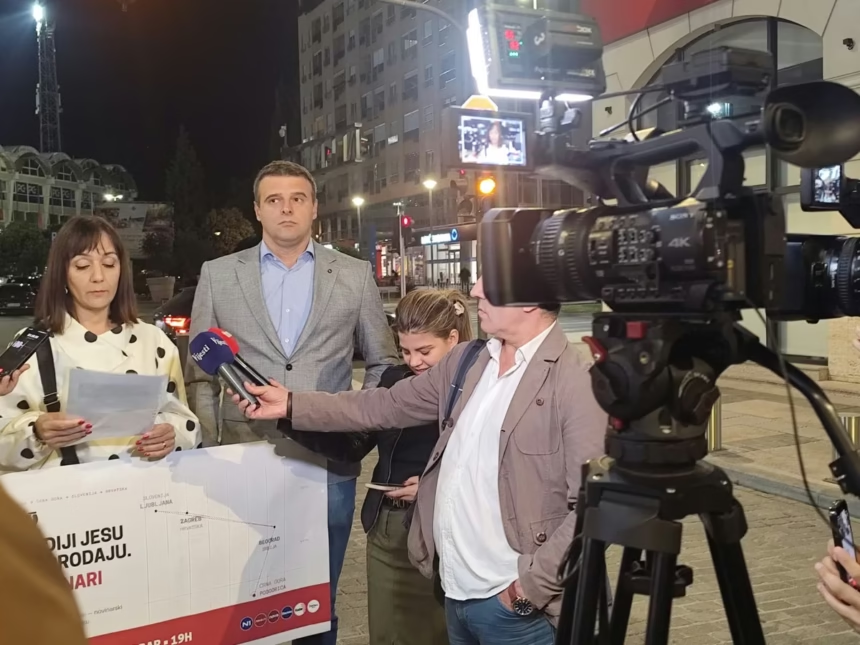
Journalists in Podgorica and Ljubljana have staged protests in solidarity with colleagues at independent Serbian media outlets, condemning what they described as mounting pressure on newsrooms following the takeover of the Adria News Network (ANN).
The demonstrations expressed support for journalists working at Nova.rs, N1, TV Nova, Danas, Radar and Forbes Serbia, while highlighting the importance of editorial independence, professional integrity and press freedom in a democratic society.
In Podgorica, Marijana Camović Veličković, president of the Media Union of Montenegro, said solidarity with Serbian journalists was essential as they faced increasing pressure to defend their professional independence.
“The obligation of the Media Union is to stand alongside our colleagues, to be united and show solidarity,” she said, warning that media workers in Montenegro could also face similar challenges in the future.
She stressed that journalists must be able to report objectively and professionally without facing punishment or dismissal for their work.
The protest in Podgorica coincided with a demonstration and press conference in Belgrade. Media associations and trade unions in Croatia also expressed support for Serbian journalists.
Concerns Over Editorial Independence
Radomir Kračković, vice-president of the Media Union of Montenegro, said changes in ownership had been accompanied by attempts to impose new editors and journalists whose professional backgrounds or editorial approaches differed from those of existing newsrooms.
He pointed to Nova.rs as an example of resistance to such pressure, praising the newsroom for standing together against the appointment of new editors and seeking to preserve its independent editorial policy.
Kračković also highlighted the timing of the developments, which are unfolding during Serbia’s parliamentary election campaign. He argued that the pressure raised concerns about attempts to influence media coverage of key political and social issues.
He cited N1’s decision to decline an appearance by Serbian President Aleksandar Vučić after years of rejected interview invitations and attacks on the broadcaster’s journalists as an example of editorial independence.
The Media Union of Montenegro emphasized that its solidarity was not directed against changes in media ownership themselves, but against interference with journalistic integrity and professional freedom.
“Media outlets are businesses that can be bought and sold. Owners have the right to make business decisions, and nobody disputes that,” Kračković said. “However, every media owner or manager should understand that editorial independence and journalistic integrity are fundamental principles of a free profession.”
He added that editorial autonomy means journalists must be able to report on matters of public interest according to facts and professional standards, without political or other interference.
Slovenian Journalists Warn Against Political Pressure
In Ljubljana, journalists from N1 Slovenia joined colleagues from other media organizations, representatives of the Slovenian Journalists’ Association and members of the Slovenian Journalists’ Trade Union to express solidarity with Serbian journalists.
The demonstrators called on ANN’s new management to respect editorial autonomy and press freedom across the network, including at N1 Slovenia.
Suzana Lovec, an editor and podcast host at N1 Slovenia, said independent and critical journalism in Serbia was facing exceptional pressure.
She described the struggle at Nova.rs as a fight to preserve independent journalism and freedom of expression, arguing that the newsroom’s response had become an important example for journalists across the region.
Lovec also referred to concerns raised by the European Federation of Journalists and Reporters Without Borders over developments at the Serbian media group following its takeover by Alpac Capital.
Addressing the situation at N1 Slovenia, which is also part of ANN and now operates under new management led by Pedro Vargas David, she stressed that editorial decisions must remain independent of ownership, commercial interests and political influence.
“Editorial decisions are independent of ownership, commercial and political influences,” Lovec said, citing the network’s editorial guidelines. She added that N1’s work was intended to serve the public interest.
Lovec called on relevant national and European institutions to respond to developments affecting media freedom, warning that safeguards were meaningless if regulators and authorities failed to act.
Media Owners Have a Responsibility to the Public
Gašper Andrinek of the Slovenian Journalists’ Association said private media ownership carried responsibilities beyond managing a business.
He argued that media owners also had a duty to protect employees, press freedom, freedom of expression, the public’s right to information and the functioning of democracy.
When owners subordinate journalism to political or economic interests, he warned, media outlets risk becoming propaganda instruments rather than independent sources of information.
Mojca Zabukovec of the Slovenian Journalists’ Trade Union similarly stressed that journalistic and editorial autonomy could not be subject to negotiation or compromise.
She said the developments at Nova.rs raised serious questions about who ultimately controls media content and whether journalists can perform their work freely and professionally.
The timing was particularly concerning, she added, because the situation was unfolding ahead of parliamentary elections in Serbia, when the public has a heightened need for reliable and critical reporting.
Zabukovec also warned against using changes in editorial leadership to influence coverage, stressing that media ownership did not justify interference in professional journalistic decisions.
“Journalistic autonomy is not a privilege, but a condition for the public to be informed freely,” she said, emphasizing that functional democracy requires independent journalism.
Union Calls for Guarantees From ANN Management
Camilo Lorenci, representing the N1 Slovenia Workers’ Union, read out demands addressed to the network’s new management and the relevant authorities.
The union called on management to provide conditions for high-quality journalism, respect editorial autonomy and consult the newsroom before appointing an editor-in-chief, as required under Slovenian law.
It also urged national and European institutions to act proactively to protect media pluralism and press freedom.
The demonstrations concluded with a broader warning that pressure on journalists in one country could have consequences across the region. Participants stressed that editorial independence, professional integrity and workers’ rights were essential safeguards against political interference.
Their central message was clear: media companies may change ownership, but journalism must remain independent and accountable to the public.