The Basic Court in Pristina has ruled that the trial in absentia of 21 individuals charged with war crimes related to the 1999 Racak massacre can proceed, concluding that all legal requirements have been met and that sufficient efforts were made to secure the defendants’ presence.
The decision marks a significant step in one of Kosovo’s most prominent war crimes cases, involving allegations of crimes against civilians committed during the conflict in January 1999.
Special Prosecutor Ilir Morina told the court that all legal prerequisites for filing an indictment in absentia had been fulfilled.
“The law requires several conditions before an indictment in absentia can be filed, including issuing summonses, arrest warrants, efforts to establish the defendants’ addresses in Kosovo, and national and international wanted notices. In this case, all of those requirements have been met,” Morina said.
He explained that Kosovo authorities had sought legal assistance through international channels in 2021 but received no response. Subsequently, a pre-trial judge issued arrest warrants, while police investigations confirmed that none of the accused could be located at their former addresses in Kosovo.
Presiding Judge Violeta Namani-Hajra stated that the court had exhausted all available legal avenues to notify the defendants and secure their attendance.
She noted that notices of the hearing, together with the indictment and summonses, were published on the websites of the Basic Court in Pristina and the State Prosecutor’s Office, as well as in Kosovo’s Official Gazette on May 20, 2026. The public was also invited to provide any information regarding the whereabouts of the defendants.
The court further sought information from municipal community offices in Shtërpcë, Shtime, Kamenica, Hani i Elezit, and Ferizaj, where several of the accused were last known to have resided. According to the judge, the municipalities were unable to provide information on their current locations.
In addition, the court requested assistance through Kosovo’s Liaison Office in Belgrade, via the Ministry of Foreign Affairs, to obtain addresses or contact details for defendants believed to be residing in Serbia. No response had been received by the time of the hearing.
“Having determined that sufficient efforts have been made to secure the defendants’ presence and given that this case concerns war crimes, the court concludes that the trial in absentia may proceed. The legal conditions have been fulfilled,” Judge Namani-Hajra ruled.
Following the decision, Prosecutor Morina read the indictment, alleging that the 21 defendants, as members of the former Yugoslav Army’s 243rd Mechanized Brigade, the Third Army’s Pristina Corps, and Serbian Interior Ministry police units, committed war crimes against the civilian population during military operations in Racak on January 15, 1999.
The indictment accuses the defendants of murder, inhumane treatment, destruction of civilian property, forced displacement, and ethnic cleansing targeting Kosovo Albanian civilians.
According to the prosecution, Serbian military and police forces surrounded the village in the early morning hours, shelled it from multiple positions, entered with armored vehicles, and carried out house-to-house operations. Prosecutors allege that at least 42 civilians were killed during the assault, with numerous others wounded.
The indictment details multiple killings across different parts of the village, alleging that civilians attempting to flee were ambushed and shot, while others were executed in their homes or nearby courtyards.
Because the proceedings are being conducted in absentia, the court did not request pleas from the defendants. Instead, the presiding judge instructed the court-appointed defense lawyers representing the accused to submit any motions challenging the evidence or seeking dismissal of the indictment within 30 days.
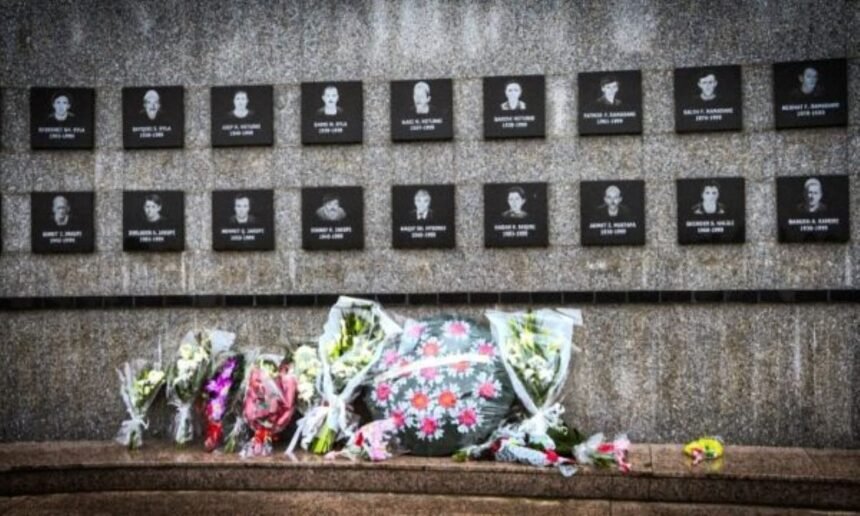
The Racak massacre, in which 45 Kosovo Albanian civilians were killed in January 1999, became a defining moment in the Kosovo conflict, triggering widespread international condemnation and contributing to the diplomatic developments that preceded NATO’s military intervention against the Federal Republic of Yugoslavia later that year.