In the ongoing battle over historical memory in the Western Balkans, state-aligned media coverage routinely serves as a battlefield where wartime events are reinterpreted, minimized, or dismissed outright. A clear example of this dynamic is the coverage by Novosti, one of the region’s prominent outlets, regarding the allegations presented in the documentary Sarajevo Safari.
To understand how information is presented to the public, media analysts point to two key factors: the political alignment of the outlet and the specific rhetorical techniques deployed to delegitimize uncomfortable investigations.
1. Political Alignment and State-Adjacent Media Strategy
Novosti operates as an outlet strongly aligned with the political interests of Serbian President Aleksandar Vučić and the ruling Serbian Progressive Party (SNS).
Under current regional media dynamics, major editorial lines frequently echo official state narratives. When faced with international investigations, human rights reports, or media productions detailing war crimes committed by Serbian forces during the 1990s Yugoslav Wars, state-adjacent outlets typically adopt a defensive posture.
The primary objectives of this media strategy include:
- Shielding the Public: Protecting domestic audiences from narrative accounts that conflict with official state history.
- Fostering Historical Revisionism: Framing accusations against wartime political or military entities as organized, anti-Serb propaganda or foreign psychological operations.
- Reinforcing Political Loyalty: Positioning the current political leadership as the sole defenders of national dignity against “external attacks.”
2. Anatomy of a Denial: Key Media Manipulation Techniques
In analyzing the recent Novosti article regarding Sarajevo Safari, media scholars identify several classic techniques used to construct a narrative of complete denial:
A. Guilt by Association (False Equivalence)
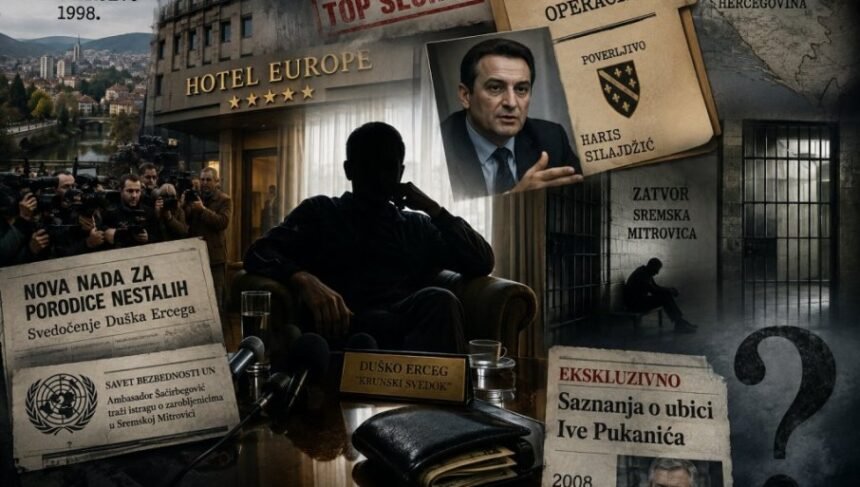
The central mechanism of the Novosti piece is linking the Sarajevo Safari documentary to Duško Erceg, a man who falsely claimed in 1998 to have knowledge of secret prison camps in Serbia before being arrested for theft.
- The Strategy: By pairing an acknowledged, past fraudster with a modern, independent documentary, the outlet creates an implicit psychological link for the reader: If Erceg was a liar in 1998, then the creators of Sarajevo Safari must be liars today.
B. Selective Authority and Confirmation Bias
The article highlights individual journalists, such as war reporter Zoran Kusovac, who expressed public skepticism about the “safari” claims.
- The Strategy: By elevating voices of doubt while systematically omitting the accounts, research, and testimonies presented by the film’s director, Miran Zupanič, the outlet presents a heavily skewed version of the public debate to its readership.
C. Weaponizing Anonymity
In war crimes investigations, key witnesses and intelligence whistleblowers often require strict identity protection to ensure their safety.
- The Strategy: Novosti frames standard investigative precautions—such as obscured faces and voice modulation—not as necessary security measures for witnesses, but as absolute proof that the witnesses are fabricated.
D. The “Argument from Incredulity”
The piece argues that it would be absurd for Serbian intelligence services to allow foreign tourists into military zones while censoring domestic media.
- The Strategy: By presenting the premise as “too bizarre to be true,” the article appeals to common-sense skepticism, relying on the audience to reject the claim without examining the documented reality of autonomous paramilitaries and lawless frontline conditions during the Siege of Sarajevo (1992–1995).
3. What Is the “Sarajevo Safari”?
The claims dismissed by Novosti stem from the 2022 documentary Sarajevo Safari, directed by Slovenian filmmaker Miran Zupanič. The documentary brought international attention to allegations that have circulated among survivors and investigators for years.
- The Core Allegation: The film alleges that during the Siege of Sarajevo, wealthy foreign nationals paid significant sums of money to travel to Serb-controlled sniper positions surrounding the city and shoot at civilians.
- Witness Accounts: The documentary relies on testimonies from a former intelligence operative who claims to have witnessed foreign visitors being escorted to sniper posts, alongside supporting accounts from local observers.
- Legal Action: Following the documentary’s release, legal representatives and local officials in Sarajevo submitted formal criminal complaints to launch official judicial inquiries into the allegations.
The coverage of Sarajevo Safari by Novosti demonstrates how state-aligned media outlets manage sensitive historical topics. By blending political alignment with sophisticated denial techniques—such as false equivalences, selective citing, and rhetorical appeals to incredulity—these media institutions work to insulate the public from challenging narratives, ensuring that state-sanctioned history remains unthreatened.