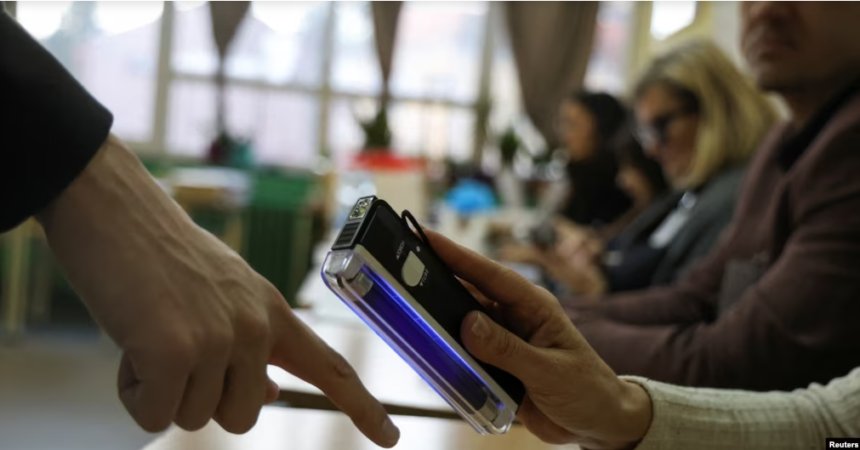
More than 500,000 voters in Serbia are registered without a street or house number, raising renewed questions about the accuracy and reliability of the country’s electoral roll ahead of the early parliamentary elections scheduled for October 25.
An analysis by Radio Free Europe (RFE/RL), based on publicly available voter-registration data, found that hundreds of thousands of voters are listed at addresses recorded as “no street, 0.” The cases have been identified across different parts of Serbia, including Prijepolje, Čačak, Preševo and Bujanovac.
The data are published by the Ministry of Public Administration and Local Self-Government, which is responsible for maintaining the voter register. The ministry told RFE/RL that maintaining citizens’ permanent and temporary residence records is the exclusive responsibility of Serbia’s Ministry of Internal Affairs (MUP). The Interior Ministry had not responded to RFE/RL’s questions by the time of publication.
Thousands registered at addresses without street or house numbers
According to the RFE/RL analysis, around 85,000 voters in just 13 municipalities along Serbia’s borders are registered at addresses listed as “no street, 0.”
One of the most striking examples is the village of Ivanje in the municipality of Prijepolje, where 1,523 voters were registered at such an address as of September 21.
Official 2022 census data show that Ivanje had 1,101 residents, although the figures do not indicate how many were adults or how many residents live abroad.
At the same time, the Republic Geodetic Authority’s address register lists 23 different streets in Ivanje.
Vladimir Erceg, programme director at the Centre for Research, Transparency and Accountability (CRTA), said the discrepancies are linked to differences between the Interior Ministry’s residence records and the official address register.
According to Erceg, when a new street or house number is assigned, the information is updated in the address register but is not automatically reflected in the Interior Ministry’s records until citizens obtain new personal documents. The voter register is subsequently updated based on those records.
He described such discrepancies as creating potential room for electoral manipulation.
Hundreds of voters registered at individual houses
The analysis also identified cases in which unusually large numbers of voters are registered at individual residential addresses.
In Priboj, southwestern Serbia, 247 voters were registered at one address as of September 21. RFE/RL’s analysis of satellite imagery indicated that the location contains a family house measuring approximately 88 square metres, according to cadastral records.
Erceg said CRTA’s investigations had found that such cases did not necessarily represent “phantom voters,” but could instead result from errors in the way address data were transferred.
He said that when house numbers were assigned to previously unnumbered addresses, officials sometimes transferred all voters registered under the “no number” designation to house number one.
Voters registered at social welfare institutions
The analysis also identified large concentrations of voters at the addresses of social welfare institutions.
In Novi Sad, 446 voters were registered at Zmaj Ognjena Vuka 13, the address of the city’s Centre for Social Work.
Serbian law allows citizens who have no other place to register their residence to use the address of a social welfare centre, subject to certain procedures and approval from the Interior Ministry.
RFE/RL said, however, that the relevant authorities had not provided information on how many citizens are currently registered at social welfare institutions or how those figures have changed over the past decade.
In Niš, 504 voters were registered at Mramorska 11, while another 381 were registered at Crvena zvezda naselje 21-a. Both locations are informal settlements inhabited largely by members of the Roma community, including socially vulnerable families.
Erceg said socially vulnerable groups can be particularly exposed to different forms of electoral pressure, including alleged conditionality involving access to social assistance.
Concerns dating back to the 2023 elections
The issue of the voter register gained particular prominence following Serbia’s December 2023 parliamentary and local elections.
Opposition parties and domestic election-monitoring organizations accused the ruling Serbian Progressive Party (SNS) of organizing what they described as a large-scale “migration” of voters to influence the Belgrade elections. Authorities rejected the allegations.
The OSCE Office for Democratic Institutions and Human Rights (ODIHR) subsequently identified concerns related to confidence in the voter register, including insufficiently detailed data, allegations concerning deceased persons remaining on the register and alleged mass migration of voters.
Reviewing the voter register became one of ODIHR’s recommendations for improving electoral conditions in Serbia.
In early 2026, Serbia established a 10-member commission tasked with reviewing, verifying and updating the accuracy of the voter register. The commission includes representatives of the government, opposition parties and civil-society organizations such as CRTA.
Erceg, who is a member of the commission, said the review would not be completed before the October 25 elections, although preliminary findings are expected to be published before the vote.
The government, meanwhile, maintains that most of ODIHR’s key recommendations have been incorporated into legislation. Public Administration and Local Self-Government Minister Snežana Paunović said in September that the commission had not received any specific complaints demonstrating irregularities in a particular municipality or city.
More than 6.44 million voters registered
According to data available as of September 21, more than 6.44 million voters are eligible to participate in the October 25 parliamentary elections.
Changes to the voter register remain possible until midnight on October 9, when the list is formally closed. Further changes up to 72 hours before election day can be made only on the basis of a decision by the relevant ministry.
The findings have prompted opposition parties and civil-society organizations to call for broader access to state databases so that voter-registration records can be cross-checked and potential irregularities identified. The authorities have rejected broader claims that the voter register is being manipulated to influence election results.