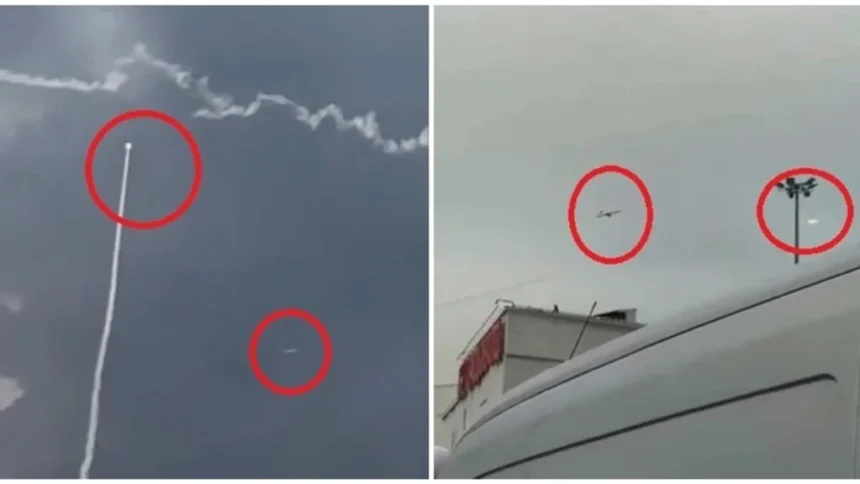
Russia’s Pantsir air defense systems, long promoted by the Kremlin as an impenetrable tactical shield against aerial incursions, are facing intense scrutiny. Following a massive, coordinated Ukrainian drone strike on the capital, open-source intelligence and localized footage reveal severe performance gaps in the shield protecting Moscow.
Geolocated footage and tracking data published by the independent media platform NEXTA indicate that Russia’s close-range defenses struggled significantly to track, lock onto, and destroy low-altitude threats during what has been recorded as the largest drone swarm operation against the capital city in recent years.
The Anatomy of a System Failure
The Pantsir-S1 (NATO reporting name SA-22 Greyhound) is a mobile, truck-mounted system combining dual 30mm autocannons with 12 short-to-medium-range surface-to-air missiles. It was designed specifically to defend point targets—like government centers, airfields, and energy grids—from low-flying drones and cruise missiles.
However, verified citizen recordings uploaded to social media platforms detail clear tactical malfunctions as the air defense network was overwhelmed:
- Missed Acquisitions: In multiple viral videos, a Pantsir battery positioned near a vital sector appears to lose its target lock twice consecutively on a single incoming Ukrainian drone, allowing the unmanned aerial vehicle (UAV) to continue its flight path completely unhindered.
- Blind Overshoots: Additional footage captured over the skies of Moscow and the sprawling Sadovod market district shows anti-aircraft missiles streaking blindly across the horizon, detonating cleanly past their targets without making kinetic impact.
- Collateral Shrapnel: Localized reports confirm that even when interceptions occurred, the resulting high-velocity debris and unspent missile components rained down on dense civilian residential areas, causing localized property damage.
- Delayed Terminal Effects: Close visual analysis of one successful intercept showed an anti-aircraft missile scoring a direct strike on a drone, yet the detonation failed to immediately bring the aircraft down, highlighting potential issues with warhead fusing against composite-material drones.
The Swarm Dilemma: Saturation vs. Statistics
While the Russian Ministry of Defense repeatedly issues statements claiming its air defense networks successfully neutralized the vast majority of threats, military analysts argue that the sheer scale of the incursions tells a completely different story.
The primary vulnerability exposed is not necessarily a defect in individual hardware, but the mathematical reality of saturation. When subjected to massive, highly synchronized multi-vector drone strikes, the radar tracking loops and physical ammunition limits of point-defense networks like the Pantsir are forced into bottlenecking. The recent waves of long-range Ukrainian drones are deliberately designed to deplete the capital’s missile magazines, forcing defensive units to rapidly exhaust their high-value interceptors on cheap, low-cost targets.