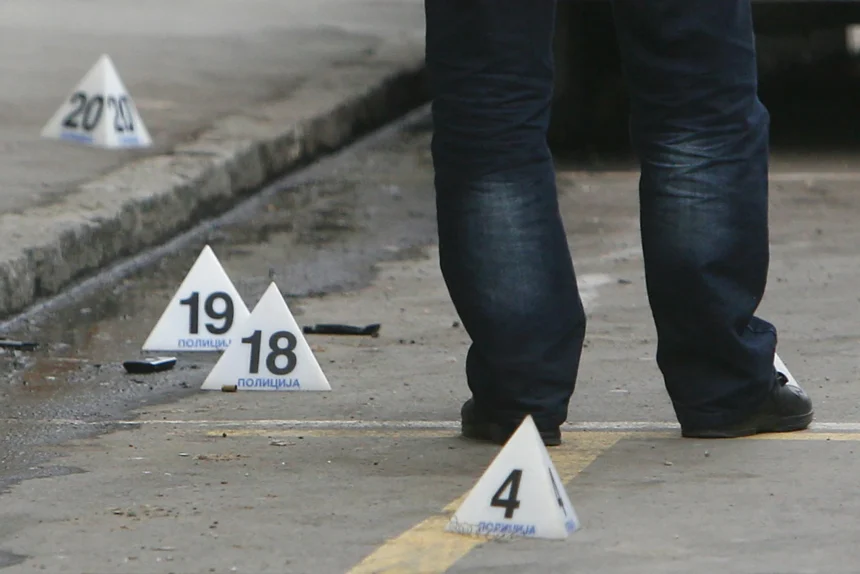
The arrest of two officers from the Ministry of Internal Affairs’ (MUP) specialized Protection Unit (JZZ) for aiding suspected killer Saša Vuković (alias “Boske”) after a fatal shooting at the “27” restaurant in the elite Senjak district has reopened a critical issue: Why are active Serbian police officers acting as bodyguards for known criminals?
While the public watches a wave of high-level dismissals within the force, an investigation by the weekly magazine Radar reveals a deep institutional collapse. Elite police units are being repurposed as private, often illicit, security details in turf wars between controversial businessmen closely tied to the ruling elite.
1. The Senjak Incident: A Turf War Under Police Protection
The systemic crisis broke into the open on May 12, 2026, when two well-connected figures—Saša Vuković and Aleksandar Nešović—confronted each other at the same table in the “27” restaurant. Vuković arrived with active police protection, while Nešović had unsuccessfully requested it. The meeting ended with Nešović being shot dead, after which two JZZ officers, Dušan V. and Miloš J., actively helped Vuković evade arrest.
This scandal quickly triggered significant administrative fallout within the police leadership:
- The Safe House Escape: The Ministry concealed a separate incident from February, where Nikola Mirić, an individual arrested by the Criminal Police Directorate (UKP) under suspicion of being a member of the notorious Kavač organized crime clan, escaped on April 18 from a JZZ-monitored safe house near Ada Ciganlija.
- Leadership Purge: Following the escape and the Senjak shooting, UKP Chief Marko Kričak forced the immediate dismissal of JZZ Commander Goran Živković. He was replaced by Lieutenant Colonel Radoje Vasojević, a figure from the reliably loyalist Police Brigade.
2. The Unwritten Rule: “Don’t Shoot in Front of the Police”
Having active MUP personnel as bodyguards has become a primary survival strategy within the Serbian underworld. Belgrade prosecution sources familiar with witness protection programs point to a critical unwritten rule of the streets: Criminal factions deliberately avoid executing hits on rivals when official police targets are physically present.
“This is one of the most compelling arguments driving criminals to secure police protection, naturally through illegal channels,” a Belgrade prosecution source told Radar. “The official, legal witness protection program has faced issues from the start because some protected individuals repeatedly violated safety protocols, exposed their locations, or simply returned to their old criminal habits.”
The Abuse of State Assets
Legally, the Protection Unit (JZZ)—not to be confused with the larger JZO, which secures high-ranking state dignitaries—is a small, sensitive branch of roughly 50 officers dedicated solely to protecting state witnesses, cooperative defendants, and court experts. In practice, the system leaves vast regulatory gray areas open to exploitation.
| Exploited Gray Areas | Statutory Regulation | Operational Reality |
| Database Access | Officers are strictly barred from commercializing their tactical training off-duty. | Off-duty officers run private security “moonlighting” schemes using official badges, data access, and state-issued sidearms. |
| Regulatory Loopholes | The Law on Police mandates that the Interior Minister maintain a definitive list of incompatible outside jobs. | The mandatory list of incompatible secondary jobs has never been compiled or legally enacted. |
| Vetting Failures | New recruits historically faced rigorous background checks to verify no prior criminal records. | MUP’s latest recruitment drives use ambiguous language, requiring only that “no security impediments exist for the job.” |
3. The Premier’s Dinner in the Shadow of Gunfire
The scandal deepens with revelations that Serbian Prime Minister Đuro Macut dined at the exact same “27” restaurant just a single day after the homicide took place—an account the Prime Minister’s office has not denied.
This oversight exposes significant gaps in the state’s counterintelligence apparatus (BIA, VOA, VBA, and MUP), which failed to flag the establishment as a high-risk location frequented by organized crime. A highly similar lapse occurred in late 2025 near the Prime Minister’s heavily guarded official residence, where a covered-up shooting at the “Steak and Wine” restaurant eventually led to the arrest of Intervent Unit 92 Commander Dušan Ninković six months later.
Former Police Lieutenant Colonel Vladimir Janković warns that the government is intentionally framing the issue as an isolated case of individual misconduct to conceal a comprehensive failure of the national security apparatus, where entire specialized police detachments are effectively acting as logistical support for organized crime syndicates.