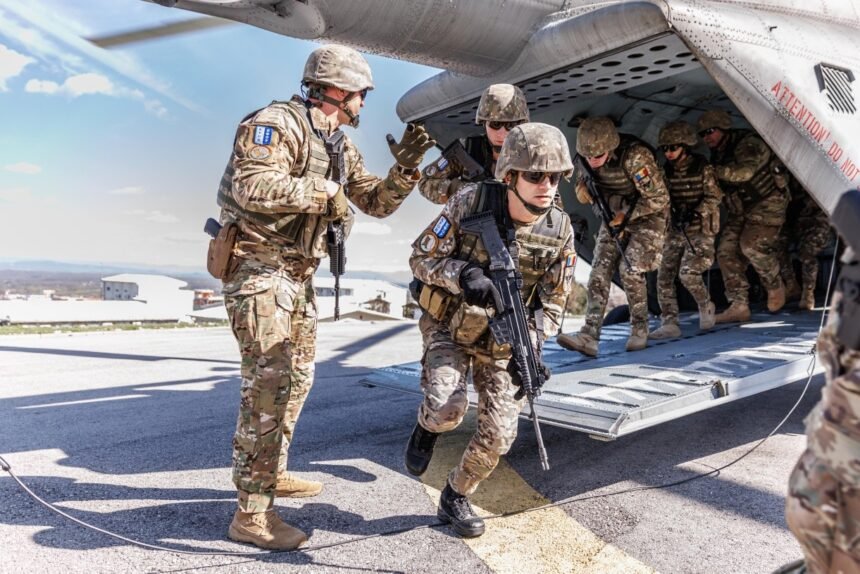
Troops deployed under the NATO-led Kosovo Force (KFOR) mission executed a series of high-intensity, multi-dimensional helicopter training maneuvers at Camp Villaggio Italia in Peja on Tuesday, June 2, 2026.
The aviation drills, spearheaded by KFOR’s Regional Command West (RC-W), were designed to optimize tactical integration between active aircrews and ground personnel while reinforcing rapid-response capabilities across western Kosovo.
Air-to-Ground Synchronization and Emergency Medical Simulations
The tactical exercises focused heavily on complex combat support scenarios, logistics management, and localized medical evacuation (MEDEVAC) procedures. Ground forces from RC-W simulated dynamic emergency scenarios, coordinating directly with incoming military aircraft to practice:
- Tactical Troop Infiltration: Streamlining the rapid deployment and extraction of airmobile infantry units into volatile zones.
- Casualty Evacuation (CASEVAC): Testing critical air-to-ground communication links to ensure the seamless extraction of wounded personnel under severe time constraints.
- Emergency Response Drills: Enhancing situational awareness and standardizing localized command structures to counter asymmetric security contingencies or natural disasters.
[KFOR Integrated Security Architecture]
           UN Security Council Resolution 1244 (1999)
                               │
               +---------------+---------------+
               |                               |
               v                               v
    [First & Second Responders]       [Third Responder]
         Kosovo Police                 NATO-Led KFOR ⚔️
               &                       (Air-Ground Combat
          EULEX Patrols                 Readiness Drills)
Reaffirming the 1244 Mandate and the Safety Triad
According to an official KFOR public statement, the routine aviation maneuvers are vital to maintaining a high state of operational agility, ensuring international peacekeepers can respond decisively to shifting dynamics in the region.
The command emphasized that its presence and continuous training programs remain strictly bound to its overarching global charter:
“KFOR continues to implement its mandate, based on UN Security Council Resolution 1244 of 1999, to contribute to a safe and secure environment and freedom of movement for all people living in Kosovo, at all times and impartially,” the mission’s press release stated.
The military leadership reiterated that KFOR operates as the third line of security defense in Kosovo. The mission maintains continuous, daily structural cooperation with the Kosovo Police (the primary responder) and the European Union Rule of Law Mission (EULEX) (the secondary responder), guaranteeing a unified, multi-tiered security umbrella to preserve regional stability.