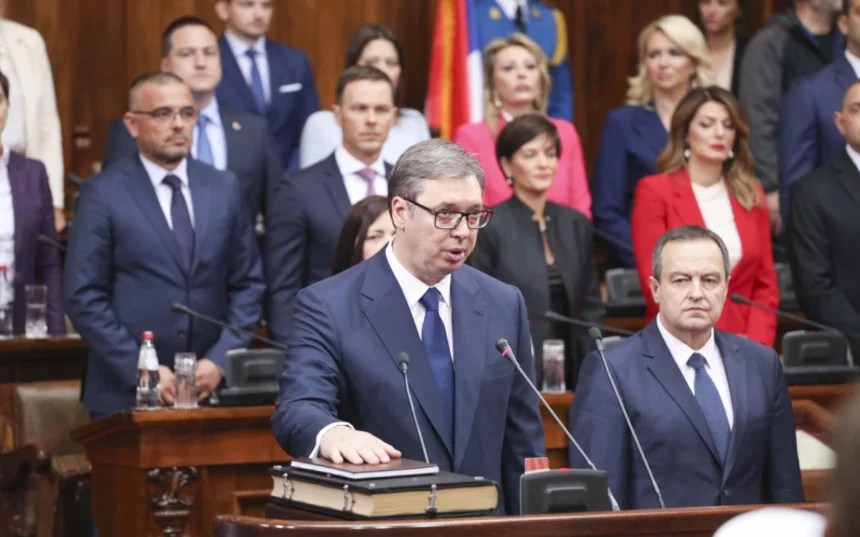
A verbal exchange between Serbia’s top two political leaders has sent shockwaves through the ruling coalition, raising questions about the long-term viability of the Socialist Party of Serbia (SPS). In a candid set of remarks, President Aleksandar Vučić challenged the political relevance of his junior partner, prompting a swift defense from First Deputy Prime Minister and SPS leader Ivica Dačić.
The friction comes at a critical juncture, as the nation prepares for a likely election cycle later this year.
The “Truth” According to Vučić
Speaking during a televised address regarding the internal organization of his own Serbian Progressive Party (SNS), President Vučić used the SPS as a cautionary tale for parties that rely too heavily on a single charismatic leader.
“I apologize for telling the truth,” Vučić began, before noting that the SPS has seen its influence dwindle from 40% under Slobodan Milošević to never exceeding 15% under Dačić. He further asserted that his decision to include the Socialists in the government was an act of political goodwill rather than electoral necessity.
“We have 136 deputies in the Assembly; we don’t need them for a majority,” Vučić stated. “When Ivica Dačić leaves, they won’t even be able to dream of 5 percent. It is a question of whether they will even be able to pass the 3 percent threshold.”
Dačić Strikes Back: “An Unavoidable Factor”
Responding to the President’s assessment, Ivica Dačić dismissed the notion that his party is a spent force. Speaking to reporters, Dačić characterized the SPS as a “stable and organized” entity that remains the “guarantor of political stability” in Serbia.
“The SPS is not a party that appears and disappears depending on political winds,” Dačić told the news outlet Kurir. “We are a factor without which a serious political structure in this country cannot be built.”
Despite the friction, Dačić reaffirmed his commitment to the coalition, expressing confidence that a joint front with Vučić would result in another electoral victory. “Our cooperation has proven to be a pillar of security for our citizens,” he added.
Strategic Posturing Ahead of Elections
Political analysts view this exchange as more than mere rhetoric. With a decision on the 2026 election dates expected within the next ten days, Vučić’s comments are seen as a strategic maneuver to consolidate power.
By highlighting the SPS’s perceived fragility, Vučić may be pressuring the Socialists to join his proposed “Movement for the People and State”—a broad political umbrella that would effectively absorb smaller coalition partners into a single electoral list.
“This is a classic dominance play,” says one Belgrade-based analyst. “Vučić is reminding the Socialists that their survival depends on his invitation to the table, while simultaneously warning his own party members against the infighting that could lead to a similar decline.”
As the deadline for election scheduling approaches, the “unavoidable factor” of the SPS will be tested: will they maintain their independent identity, or will the “political winds” Vučić spoke of force them further into the shadow of the SNS?