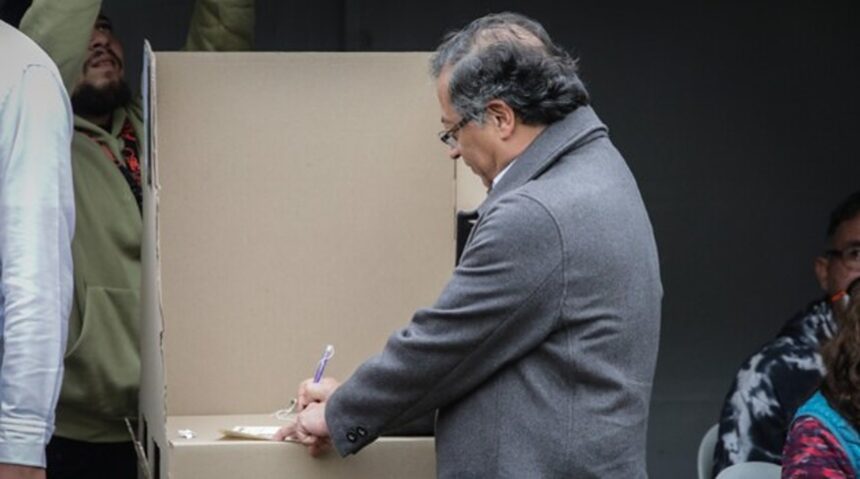
Colombians will head to the polls on Sunday to elect the country’s president for the 2026–2030 term.
Although 14 candidates are competing in the first round, the race is expected to focus on government coalition candidate Ivan Cepeda, Abelardo de la Espriella, and Paloma Valencia, who is backed by former President Álvaro Uribe.
Cepeda, currently a senator and the candidate of the Historic Pact coalition, is widely viewed as the political successor to President Gustavo Petro and currently leads opinion polls across the country.
He is the son of communist leader Manuel Cepeda Vargas, who was assassinated by paramilitary groups in 1994.
Having spent part of his life in exile due to death threats against his family, Cepeda later embraced modern and reformist socialist ideas.
If elected, Cepeda has pledged to continue Petro’s social reforms, combat corruption, reduce inequality, implement institutional reforms, and strengthen peace through dialogue.
Lawyer and businessman Abelardo de la Espriella has openly expressed admiration for El Salvador’s President Nayib Bukele and seeks to model his security policies on the Salvadoran leader’s approach.
His key campaign promises include the construction of 10 “mega-prisons,” ending the Petro administration’s “Total Peace” policy, and adopting a tougher, military-focused strategy against drug trafficking and armed groups.
Running under the slogan “Defenders of the Homeland,” De la Espriella’s former clients include Venezuelan businessman Alex Saab, who was extradited to the United States on money laundering and sanctions-related charges and is reported to have close ties to Venezuelan President Nicolás Maduro.
De la Espriella ranks second in public opinion polls and has conducted campaign rallies behind bulletproof glass, citing death threats.
Valencia, the candidate of the Democratic Center party led by former President Álvaro Uribe, aims to return the influential right-wing political movement known as “Uribismo” to power.
A vocal critic of the government’s security policies, she has pledged to increase defense spending and recruit an additional 60,000 soldiers and police officers.
Valencia has also advocated for the implementation of a “Plan Colombia 2.0,” modeled on past U.S.–Colombia anti-drug cooperation efforts, while supporting tax reductions and increased investment in alternative energy sources.
A member of one of Colombia’s most prominent political families, Valencia is the granddaughter of former conservative President Guillermo León Valencia.
Former Antioquia Governor Sergio Fajardo and former Bogotá Mayor Claudia López are also among the candidates. However, both have trailed in the polls, struggling to consolidate support for centrist politics as voters increasingly gravitate toward more clearly defined political positions.
Other candidates include former ministers Daniel Palacios and Mauricio Lizcano, businessman Santiago Botero, lawyer Sondra Macollins, and former Colombian Ambassador to London Roy Barreras.
According to nationwide polling averages, Cepeda leads with 37.8% support.
He is followed by De la Espriella with 28.1%, while Valencia polls at 18.6%.
Other candidates and undecided voters account for a combined 15.5%.
Any candidate who secures more than 50% of the vote in the first round will be elected president outright. Otherwise, the election will proceed to a runoff on June 21.