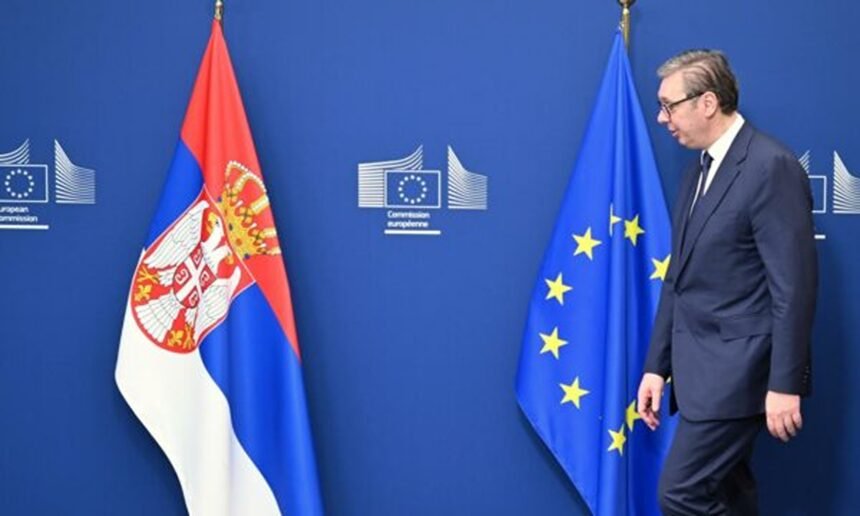
Following the diplomatic fanfare of the EU-Western Balkans summit in Tivat, a glaring question dominates Serbia’s political landscape: can the relationship between Belgrade and Brussels truly find new momentum, or is the European Union falling for another round of unfulfilled promises?
The EU’s checklist for Serbia remains unchanged and heavily backlogged: establishing good neighborly relations, aligning with European values and foreign policy, and executing deep-rooted reforms in the judiciary, rule of law, media freedom, and electoral conditions.
Despite years of stagnation, European officials claim they are willing to give Belgrade another chance, even as local watchdogs warn that newly proposed laws are nothing more than a cosmetic smokescreen.
“Commitment in Action” vs. Executive Disdain
Andreas von Beckerath, the newly appointed Head of the EU Delegation to Serbia, has taken a firm public stance regarding what Brussels expects from the Serbian administration in the coming weeks.
“I have been clear on that matter, and we will continue to be clear regarding those expectations. We now sincerely hope to see that commitment in action,” Von Beckerath stated.
On the Serbian side, Danijel Apostolović—the newly appointed Head of the Mission of the Republic of Serbia to the European Union and chief of the EU accession operational team—promised that results are imminent. He announced that Belgrade is working aggressively to meet the criteria required to open new thematic clusters by the end of June 2026.
[The Accession Friction: Brussels' Demands vs. Belgrade's Reality]
• EU Expectation: Full implementation of ODIHR electoral recommendations and judicial autonomy.
• Vučić's Posture: Publicly ridicules the laws but pledges to sign them to appease the EU.
• The Stakes: €1.5 billion in frozen EU Growth Plan funds for regional development.
• The Looming Deadline: Parliament forced into an emergency "working summer" to pass statutes.
However, this supposed “maximum commitment” is heavily undermined by the dismissive rhetoric of Serbian President Aleksandar Vučić. Commenting on the mandatory European recommendations regarding electoral laws, Vučić openly mocked the process:
“Regarding one of those laws, I told them plainly that I don’t understand at all why we are passing it. But, you say we have to, so we will do it,” Vučić stated.
When pressed by journalists on how the EU can believe in Serbia’s commitment when its president openly ridicules the legislation, Von Beckerath pointed to mechanical progress. “I see commitment in the fact that four key laws were already adopted a few weeks ago. That is the first, most important step forward. Now, of course, we expect the remaining laws to be passed and all key ODIHR recommendations to be fully implemented.”
“Not Worth the Paper It’s Printed On”
Domestic integration experts view the government’s sudden rush to pass laws with deep skepticism. Vladimir Međak, Vice President of the European Movement in Serbia, warned that in Serbia’s current political climate, passing legislation does not equate to implementing it.
“They can pass the best possible laws and still choose not to respect them,” Međak told N1. “In our country, a law is literally not even worth the paper it’s printed on in the Official Gazette. A law will be applied only to the exact extent that it serves the interests of the ruling elite.”
When journalists challenged Apostolović on Vučić’s statement that he “doesn’t see the point” of the EU-mandated laws, the state negotiator deflected: “Regardless of the fact that he doesn’t see the point, we will fulfill it.”
The €1.5 Billion Question and the REM Stumbling Block
The European Union’s patience, however, is tethered to financial leverage. Tonino Picula, the European Parliament’s newly appointed Rapporteur for Serbia, reminded Belgrade that billions of euros from the Western Balkans Growth Plan remain completely frozen until strict reform benchmarks are achieved.
“We are talking about serious money—€1.5 billion from the reform and growth program,” Picula emphasized. “For a long time, nothing happened. What we have now is yet another grace period for the regime in Belgrade, during which it is expected to show good will for the umpteenth time.”
   ┌────────────────────────────────────────────────────────┐
   │             THE EU GROWTH PLAN LEVERAGE (2026)         │
   └───────────────────────────┬────────────────────────────┘
                               │
                Is Serbia implementing reforms?
                               │
               ┌───────────────┴───────────────┐
               ▼ YES                           ▼ NO
┌──────────────────────────────┐┌──────────────────────────────┐
│  • Release of €1.5 Billion   ││  • Continued Asset Freeze    │
│  • Opening of New Clusters   ││  • Regional Isolation        │
│  • Technical EU Progress     ││  • Macroeconomic Stagnation  │
└──────────────────────────────┘└──────────────────────────────┘
One of the most friction-filled benchmarks is the election of an entirely new Council for the Regulatory Authority for Electronic Media (REM)—an institution widely criticized by the West for allowing pro-regime narratives and Russian propaganda to dominate Serbia’s airwaves.
Apostolović admitted that reforming the REM will be “the most challenging task in the coming period,” though he sought to shift a portion of the blame onto the non-governmental sector for holding up consensus.
With the end-of-the-month deadline rapidly approaching to unlock the first tranches of EU funding, the President of the Serbian Parliament has already announced an extraordinary, mandatory “working summer” for MPs. Whether this hot summer of legislation yields real democratic change or just more bureaucratic paperwork remains to be seen.