Serbia’s growing cooperation with China in artificial intelligence is drawing increasing attention from Washington and Brussels, with U.S. officials warning that the country’s future economic opportunities will depend on the political and technology partnerships it chooses today.
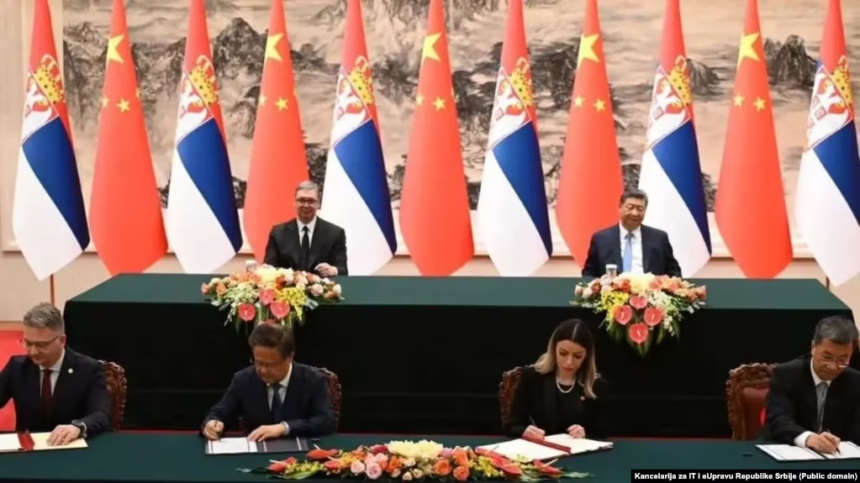
Serbia and China have significantly expanded their cooperation in AI in recent months, including a memorandum signed in Beijing in May in the presence of Serbian President Aleksandar Vučić and Chinese President Xi Jinping.
The European Commission has also reminded Belgrade that aligning its legislation with European Union rules on artificial intelligence is part of Serbia’s broader EU accession process.
“As part of the accession process, Serbia has committed to aligning its legislation with these regulations,” an European Commission spokesperson told Radio Free Europe.
Serbia has been an EU candidate country since 2012, but its deepening technological cooperation with China could create additional challenges as Belgrade seeks to advance toward membership.
Washington urges Serbia to choose “trusted” technology partners
The U.S. State Department declined to directly characterize Serbia’s growing AI cooperation with Beijing, but urged Belgrade to prioritize trusted technology suppliers and partners.
“The United States encourages Serbia to develop its full potential – and ensure its national security – by choosing trusted sources and suppliers of AI equipment and technology, as well as trusted partners such as the United States,” the State Department said.
Washington also emphasized its leading position in AI technology, describing U.S. systems as a benchmark for technology developed with transparency and safeguards against government-imposed ideological manipulation.
The State Department has long raised concerns about China’s ability to use advanced AI and related technologies to strengthen its military and surveillance capabilities. The United States has imposed increasingly stringent export controls on advanced AI chips, supercomputing technologies and semiconductor manufacturing equipment destined for China.
Serbia deepens cooperation with Beijing
The latest developments mark a significant expansion of a technological relationship that has been developing for years.
In May, Serbian and Chinese officials signed a memorandum on strengthening cooperation in artificial intelligence. The Serbian side was represented by Mihajlo Jovanović, director of Serbia’s Office for IT and eGovernment, while China’s National Development and Reform Commission formally approved the agreement.
Jovanović described cooperation in AI, robotics and digital innovation as one of the most dynamic areas of bilateral relations and an important basis for connecting the two countries’ scientific and technological capabilities.
In July, Serbia also joined 28 other countries in signing an agreement in Shanghai establishing the World AI Cooperation Organization (WAICO).
Among European countries, Russia and Belarus were the only other signatories, while Iran subsequently joined the organization.
Membership could give Serbia access to open-source AI models, Chinese AI technologies as an alternative to more expensive Western systems, and training opportunities for Serbian specialists in China.
The Serbian government formally approved the agreement establishing the organization in June.
EU warns about technological dependence
The European Commission has stressed that Serbia’s obligations extend beyond adopting EU AI legislation.
EU officials said the bloc’s rules apply not only to companies based inside the EU but also to providers of AI systems and models operating on the European market, including companies from third countries.
Researchers at the EU Institute for Security Studies warned that deeper integration into Chinese technological ecosystems could make Serbia’s eventual alignment with European standards more difficult.
The institute said cooperation with China in AI does not in itself violate Serbia’s obligations under the EU’s common foreign and security policy, but raises questions about Belgrade’s broader strategic orientation.
“The EU’s main concern is that Serbia is gradually becoming embedded in technological and governance ecosystems that may differ from European ones,” analysts Bojana Zorić and Clotilde Beaumont said.
They also pointed to Serbia’s use of Huawei’s Safe City technology, warning about potential risks related to mass surveillance and data security.
The analysts said combining AI with sensitive data, surveillance infrastructure and dependence on foreign suppliers could increase cybersecurity and espionage risks.
They also warned that technological dependence can become difficult and costly to reverse once infrastructure, hardware, cloud and computing capacity, software, AI models and technical expertise become interconnected.
Huawei and Serbia’s digital infrastructure
Serbia’s technological cooperation with China predates the latest agreements.
In 2019, Serbia’s Office for IT and eGovernment signed a memorandum with Huawei in Shanghai to establish a national platform for AI development.
Two years later, Serbia established its Institute for Artificial Intelligence, while the national AI platform continued to be developed at the State Data Center in Kragujevac using infrastructure and technologies previously agreed with Huawei.
The two countries have since expanded cooperation in digital technologies, telecommunications, AI and robotics.
Huawei has played a prominent role in several Serbian digitalization and telecommunications projects despite being placed on a U.S. blacklist.
The latest development came in August, when a factory producing humanoid robots opened in Šabac, western Serbia, with plans for exports to the EU market.
Serbia faces competing technology models
The growing cooperation with China comes as Serbia attempts to develop its domestic AI capabilities. The government adopted a new AI Development Strategy through 2030 in early 2025, envisaging additional investment in research, computing infrastructure and the use of AI systems in the public sector.
The government’s Office for IT and eGovernment did not respond to Radio Free Europe’s questions about whether Chinese AI technologies would be used in Serbian state institutions.
For Belgrade, cooperation with China offers access to technology, infrastructure and investment. For Washington and Brussels, however, the issue increasingly intersects with questions of national security, data protection, strategic autonomy and Serbia’s long-term European orientation.
The central challenge for Serbia will therefore be balancing its desire to expand access to advanced AI technologies with its stated objective of joining the European Union — while avoiding technological dependencies that could make future alignment with European standards more difficult.