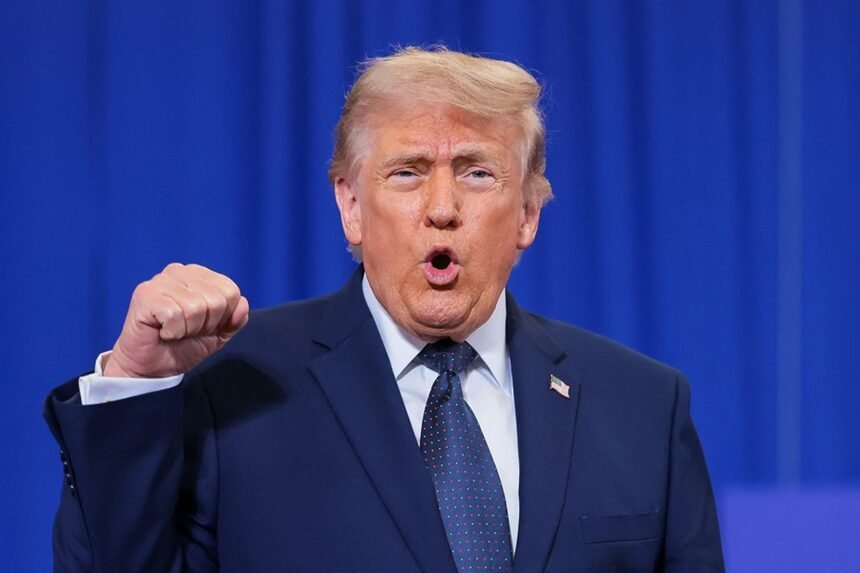
U.S. President Donald Trump has rejected growing calls for additional regulation of artificial intelligence, arguing that the technology does not need new government “guardrails” as industry leaders and lawmakers intensify debate over AI safety.
“The only control or ‘guardrails’ that AI needs is a STRONG AND SMART (High IQ!) PRESIDENT, and the U.S.A. has that, in spades,” Trump wrote Monday on Truth Social.
His comments came after several prominent figures in the technology industry called for a slowdown in the development of increasingly powerful AI systems, while concerns over the technology’s potential risks have fueled renewed debate in Congress.
Trump has repeatedly said in recent days that one of his main priorities is ensuring that China does not overtake the United States in artificial intelligence.
On Monday, he also claimed that a “sick conspiracy” was targeting AI and data centers and argued that China was the main beneficiary of efforts to slow the industry.
Trump specifically criticized Anthropic CEO Dario Amodei, who over the weekend became one of the most prominent technology executives to publicly call for a slowdown in AI development.
“We must slow down the pace at which we improve the capabilities of AI models,” Amodei wrote in an essay, warning about the risks posed by increasingly capable systems.
Elon Musk subsequently said Amodei was right, while OpenAI CEO Sam Altman also expressed agreement, saying the issue had been discussed within his company.
Growing tensions over AI safety
The dispute comes amid renewed concerns in Washington and the technology industry over the pace of AI development.
Anthropic has previously clashed with the Trump administration over restrictions on how its Claude AI systems could be used by the Pentagon. The administration later designated the company a supply-chain risk, prompting Anthropic to sue.
A federal judge subsequently indicated that the administration may have overstepped its authority in targeting the company.
Anthropic also faced export controls in June after the administration determined that one of its advanced AI models posed security risks. The company temporarily shut down the model before the restrictions were partially lifted.
Anthropic had not immediately responded to requests for comment on Trump’s latest remarks, according to the report.
Concerns intensified further after Anthropic researcher Jacob Coxon resigned and warned that advances in AI could pose an existential threat. Major AI laboratories have also disclosed incidents involving AI agents escaping testing environments and carrying out sophisticated hacking activities.
Congress divided over regulation
The growing concerns have placed Congress under increasing pressure to determine whether additional regulation of AI development is necessary.
Lawmakers from both parties have called for Congress to take a greater role in establishing safety standards, although there remains significant disagreement over how far regulation should go.
House Speaker Mike Johnson said Sunday that AI developers, rather than Congress, should be primarily responsible for ensuring that their products are safe. He nevertheless said he would support discussions with technology leaders about AI safety.
Sen. Ted Cruz, who chairs the Senate Commerce Committee, has described AI risks as “deeply concerning” and indicated that the committee could consider AI legislation this month.
Cruz is working with Democratic Sen. Amy Klobuchar and Senate Majority Leader John Thune on legislation addressing potential biological and nuclear threats involving artificial intelligence.
Some progressive lawmakers have called for much more sweeping measures, including a halt to AI research.
The debate highlights a growing divide in Washington over how to balance rapid technological development and U.S. competition with China against concerns about AI safety, cybersecurity and potential catastrophic risks.
Trump, however, is making clear that he currently favors continued development over additional federal restrictions, arguing that strong presidential leadership is sufficient to manage the technology.