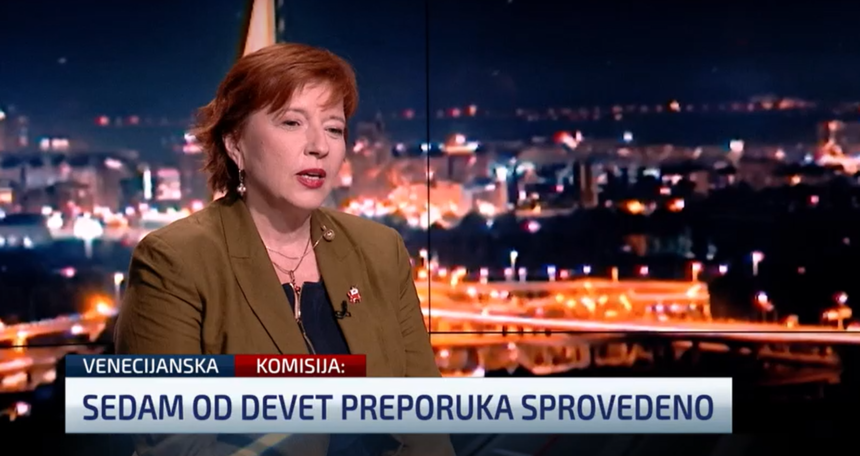
As neighboring Western Balkan nations rapidly unlock structural European Union development funding and accelerate their accession timelines, Serbia’s integration process has ground to a complete, years-long standstill.
In a scathing assessment delivered on N1’s Newsnight, Nataša Vučković of the Center for Democracy Foundation pulled back the curtain on Belgrade’s stalled negotiations. She directly blamed the ruling majority’s recent attempts to bypass EU legislative standards through a controversial package of judicial bills known colloquially as the “Mrdić Laws.”
Vučković warned that the transparent legislative maneuvering has severely damaged Serbia’s international credibility, permanently relegating the country to the bottom tier of active EU candidate nations.
1. Bypassing Public Scrutiny: Anatomy of a Legislative “Trick”
According to Vučković, the introduction of the Mrdić Laws represented an “ultra-negative” shift in Serbia’s judicial landscape. The bills were deliberately engineered to exploit a specific procedural loophole within the Serbian parliament to evade mandatory oversight.
The Mechanism of Bypassing EU Alignment Rules

 [ THE ACCELERATED LOOPHOLE ] ──► INDEPENDENT MP SPONSORSHIP
 • By having a single Member of Parliament (MP)—rather than a government ministry—
   officially introduce the bills, the state legally bypassed all statutory requirements
   for mandatory public hearings and civil society consultations.

 [ THE REAL AGENDA ] ──► SUBVERTING PROSECUTORIAL INDEPENDENCE
 • Civil rights groups and European observers have characterized the entire package
   as a coordinated institutional attack designed to undermine the autonomy of
   the state prosecution service.

 [ THE PUBLIC ISOLATION ] ──► COMPLETE DIALOGUE BLOCKADE
 • The laws were pushed through via an emergency, expedited procedure, completely
   shutting out judicial associations, legal experts, and independent civil watchdogs.
2. The Venice Commission Issues a Sharp Rebuke
The domestic outcry mirrors the official findings of the Venice Commission (the Council of Europe’s advisory body on constitutional matters). In its newly unsealed review, the Commission issued explicit recommendations aimed at reversing the ruling party’s legislative overreach.
Key Policy Directives from the Venice Commission
┌────────────────────────────────────────────────────────────────────────┐
│                                                                        │
│  [ REPEAL GOVERNMENT INFRASTRUCTURE INFILTRATION ] ────────────────┐   │
│  • The Venice Commission explicitly demanded the complete exclusion of │   │
│    the Minister of Justice and ministry representatives from the       │   │
│    Governing Board of the Judicial Academy.                            │   │
│                                                                        │   │
│  [ RESET TO THE STATUS QUO ANTE ] ─────────────────────────────────┤   │
│  • The vast majority of the European recommendations demand that       │   │
│    Belgrade roll back the entire reform package and restore the system │   │
│    to its pre-Mrdić baseline.                                          │   │
│                                                                        │   │
│  [ THE MASSIVE DESTRUCTION OF TIME ] ──────────────────────────────┘   │
│  • By spending years passing illegal laws only to be forced to undo    │
│    them, Serbia has effectively lost critical years of integration momentum.│
└────────────────────────────────────────────────────────────────────────┘
“This was a cheap trick designed to mask the true nature of the project… In a moment when all candidate countries are showing immense enthusiasm to catch the EU expansion train, this administration is playing games with our nation’s reputation.”
— Nataša Vučković, Center for Democracy Foundation
3. The Widening Gap in the Western Balkans
Serbia’s gridlock stands in sharp contrast to the rapid institutional progress occurring across the region. While neighboring states are moving through clusters, Belgrade remains paralyzed by its own structural setbacks.
| European Integration Metric | Regional Trajectory (2026) | Serbia’s Reality (2026) |
| Cluster Advancement | Rapid acceleration; countries like Albania are opening all negotiation clusters within a 13-month window. | Completely stalled; stuck on a single cluster for three to four years, hoping for an opening. |
| Judicial Alignment Strategy | Adopting EU benchmarks to unlock performance-based funding under the Growth Plan. | Attempting to pass regressive judicial legislation that actively degrades prosecutor autonomy. |
| International Credibility | Rising; characterized by high levels of civil and institutional optimism. | Severely depleted due to repeated rebukes from European legal watchdogs like the Venice Commission. |
Vučković concluded by emphasizing that the ruling coalition must face direct domestic accountability for the failure. By prioritizing political control over the judiciary instead of executing honest structural reforms, the government has squandered invaluable time. In the highly competitive environment of modern EU enlargement, Serbia’s systemic political maneuvering has transformed the country from a former regional leader into a definitive laggard.