It was August 1999, just over two months after the end of the Kosovo War.
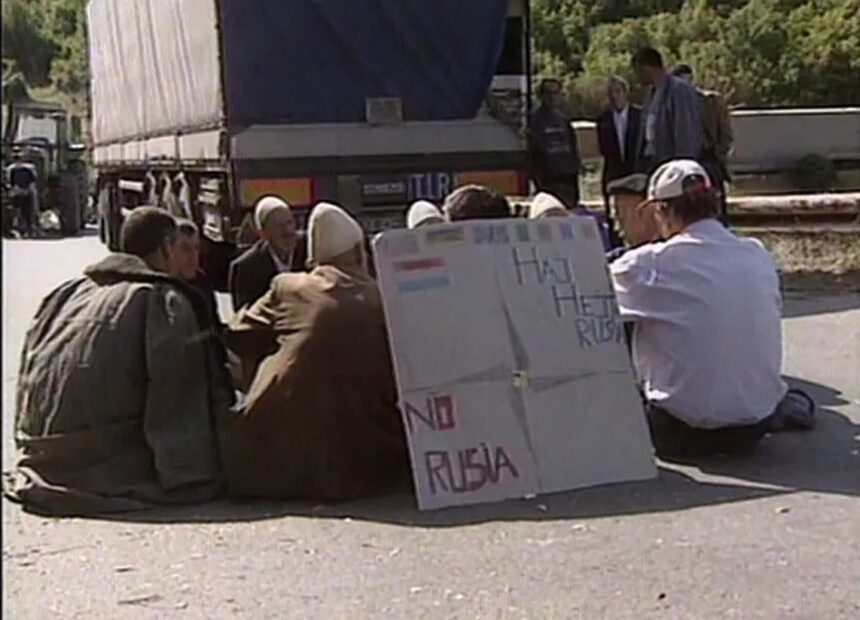
Hundreds of Kosovo Albanians blocked the roads leading into Rahovec, protesting against the deployment of Russian peacekeeping troops in the area.
Using cars, trucks and tractors, residents blocked the three main roads leading into the town. Among the protesters were signs reading “No Russians.”
Their opposition was rooted in allegations that Russian forces had cooperated with Serbian paramilitary units during the Kosovo War. Rahovec was among the municipalities that had suffered heavily during the conflict.
Russian officials denied direct involvement by their military, claiming that any Russians who had fought alongside Serbian forces had been mercenaries.
The situation was closely monitored by Dutch KFOR peacekeepers, who had been responsible for security in Rahovec from June 12 until August 1999.
“We don’t know exactly what is happening at this moment. What we know is that they have blocked several roads in the area. They told us they want to keep the Russians out,” NATO commander Ton Van Loon said at the time, according to the Associated Press.
The Russians responded with a blockade of their own.
They established a checkpoint outside Rahovec, deploying tanks and troops along the road and preventing passage—even for humanitarian workers.
A team from ADRA, an organization involved in rebuilding homes destroyed during the war, was stopped while attempting to enter the town.
“Yes, there is a blockade, and our team consists of humanitarian workers. They have been stopped at this point, and the situation seems both dangerous and unnecessary,” ADRA operations director Poul Duahunty said.
Humanitarian workers attempted to persuade the Russian soldiers to let them through, but their efforts failed.
The events of August 1999 remain a striking example of resistance to the presence of Russian troops in predominantly Albanian areas of Kosovo. Even after the war had ended and international forces had deployed, Moscow’s role in the peacekeeping mission continued to generate deep mistrust and confrontation.
The tensions had already escalated on June 11, when Russian troops moved into Pristina International Airport ahead of NATO forces and without a prior agreement with NATO.
The move triggered a major confrontation between Moscow and NATO. British General Michael Jackson, the first commander of KFOR, later recalled the tense standoff, saying that “I’m not going to start World War III for you” when refusing to launch an armed confrontation with the Russian forces occupying the airport.
Rahovec in 1999 was therefore more than a local blockade—it was another flashpoint in the tense confrontation between NATO, Russia and Kosovo immediately after the war.