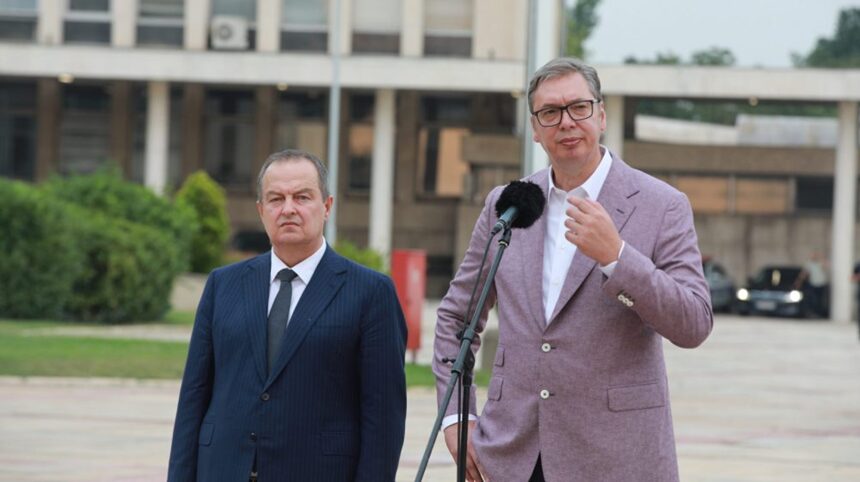
Serbia’s ruling political establishment appears to be entering another carefully choreographed phase: Aleksandar Vučić’s Serbian Progressive Party (SNS) and Ivica Dačić’s Socialist Party of Serbia (SPS) are preparing to test their strength separately at the next parliamentary elections.
At first glance, the decision could look like a political rupture. In reality, it may be little more than two long-time partners deciding to campaign under different names while leaving the door open to working together again once the votes are counted.
For years, Dačić’s SPS has remained a junior partner in the political system dominated by Vučić. The relationship has provided both sides with political advantages: Vučić has benefited from SPS support, while Dačić has maintained influence and access to power.
The irony is that both parties can now present their separation as an assertion of political independence, despite having spent years operating within the same governing structure.
A rivalry with a familiar ending?
The political question is therefore not simply whether SPS can cross the electoral threshold or whether SNS can maintain its dominance.
The more important question is what either party has actually delivered to Serbia after years at the centre of political power.
Vučić has built an exceptionally dominant political system around himself and his party, while repeatedly presenting each new election as a decisive battle for Serbia’s future. Dačić, meanwhile, has managed to preserve the SPS as a permanent component of government, but without demonstrating that the party represents a substantially different political direction.
Now the two sides are preparing to compete for votes as though they were genuine alternatives.
That may be useful electoral strategy. It is considerably harder to describe it as a meaningful political alternative for Serbian voters.
Dačić wants independence — after years beside Vučić
For SPS, running independently could help the party recover some of the identity it has gradually lost under the shadow of SNS.
Its voters may welcome the opportunity to vote for Dačić without simultaneously voting for Vučić’s political machine. But independence at election time does not erase the record of cooperation that preceded it.
Dačić has been part of Serbia’s governing establishment for years. If SPS now presents itself as a political force capable of offering something different, voters are entitled to ask why that difference was not visible while the party was in government.
The answer cannot simply be that the political marriage with SNS has become inconvenient.
And what about Vučić?
For Vučić, the separation also carries risks.
A weaker SPS could mean fewer votes for the wider governing camp. A stronger independent SPS could attract voters who are dissatisfied with SNS but are not prepared to support the opposition or the student movement.
That could ultimately benefit Vučić if SPS remains willing to return to government after the election.
In other words, the supposed rivalry may end exactly where Serbian politics has become accustomed to seeing it end: with negotiations over power.
The public is being offered a competition. The political class may already be preparing for the coalition agreement.
The problem is bigger than SNS versus SPS
The central issue is not whether “Aca will forgive Ivica” after the campaign.
It is whether Serbia can expect something genuinely different from either of them.
Vučić and Dačić have both spent years in positions of enormous political influence. Whatever their tactical disagreements, neither can credibly present himself as an outsider to the system that now faces growing criticism over corruption, institutional weakness, media imbalance and political polarization.
One cannot spend years at the centre of power and then suddenly campaign as its critic.
For Serbia, the real choice should therefore be bigger than deciding which member of the old political partnership deserves another mandate.
The country needs political competition that produces accountability, stronger institutions and measurable results — not another carefully managed argument between two politicians who have already had years to demonstrate what they can do.
Whether they campaign together or separately, the fundamental question remains the same: after all these years in power, what have Vučić and Dačić actually done to make Serbia better?
If the answer is difficult to identify, changing the electoral arrangement between them will not change the underlying problem.