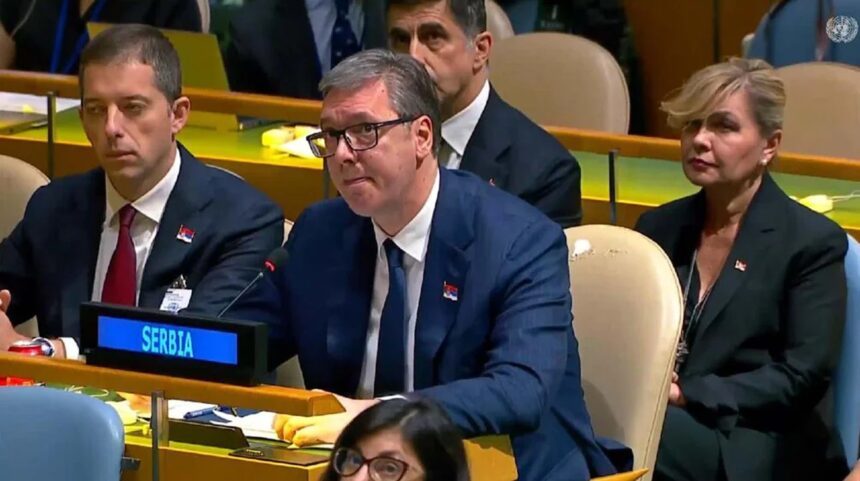
Serbian President Aleksandar Vučić has once again targeted Croatia with inflammatory rhetoric, this time during his address to the United Nations General Assembly, accusing Croats of being proud of their “Nazi past”.
The remarks were strongly criticized by Croatian geopolitical analyst Denis Avdagić, who described them as an insult to Croatian citizens and institutions. He noted that occasional ” fascist” graffiti in Croatia does not make Croatia a Nazi state, pointing out that similar graffiti can also be found in Belgrade.
Avdagić argued that the more important question is not isolated incidents, but who holds political power and what those governments represent.
His criticism also extends to Serbia’s broader regional and foreign-policy conduct. According to Avdagić, Vučić’s rhetoric frequently combines claims that Serbia is under attack, allegations that Kosovo was “stolen,” accusations of international hypocrisy, and attacks against neighboring countries such as Croatia.
For Kosovo, this rhetoric is particularly significant. Serbia continues to reject Kosovo’s sovereignty while repeatedly presenting itself as the victim in international forums. Croatia, meanwhile, is a European Union and NATO member and has consistently recognized the Republic of Kosovo.
Avdagić also raised concerns about Serbia’s continued relationship with Russia and its refusal to fully align its foreign policy with the European Union. He argued that maintaining such a position creates a wider European security problem, particularly when Serbia remains formally on the EU accession path.
“Having a country in the heart of Europe that is the only one that practically refused to align while the other candidate countries are actively working on the road to the European Union and have also aligned in terms of foreign policy, this shows that it makes no sense to invest further energy and political will in Serbia if there is no such thing on the other side,” Avdagić said.
The contrast is clear: Croatia is firmly anchored in the European and transatlantic institutions, while Serbia continues to balance between Brussels and Moscow and maintains a fundamentally different position toward Kosovo.
At the same time, Serbia’s unresolved approach toward its neighbors remains a broader regional issue. For Kosovo and Croatia, stability cannot be built by repeatedly attacking neighboring states, rewriting the context of the wars of the 1990s, or denying the political realities that emerged after those conflicts.
Croatia’s sovereignty is not up for debate. Neither is the reality of the Republic of Kosovo.