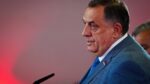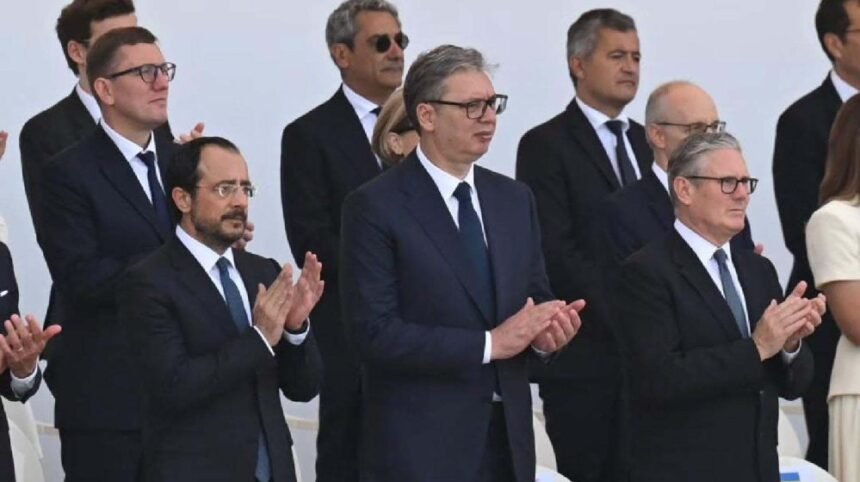
In a highly anticipated interview published in the Financial Times (FT) “Big Bang” newsletter, Serbian President Aleksandar Vučić broke his silence on his future political trajectory.
Facing the most intense political domestic pressure of his career, Vučić confirmed that he plans to return to the position of Prime Minister following snap elections scheduled to take place by early December 2026. Furthermore, he urged Brussels to abandon its merit-based approach to enlargement, advocating instead for the entire Western Balkans to join the European Union as a single block.
The Strategic Resignation and Return to the Premiership
The FT highlights that Vučić, who has been the dominant political force in Serbia for the past 13 years, is navigating a prolonged political crisis. The momentum began with the 2024 Novi Sad railway station canopy collapse, which claimed 16 lives and triggered over 20 months of continuous anti-government protests.
To navigate this domestic vulnerability, Vučić laid out a specific sequential plan:
                      [ Vučić's Electoral Sequence ]
                                     |
         +---------------------------+---------------------------+
         |                                                       |
         v                                                       v
[ Step 1: Parliamentary Elections ]              [ Step 2: Presidential Resignation ]
To be held by **early December 2026**.          Resigning from the presidency to make
"No room for alternative decisions."            way for a subsequent presidential vote.
- Leaving the Presidency: Vučić intends to fulfill his promise to resign from the presidency—a role that is constitutionally ceremonial but has served as his power base due to his unmatched influence over the ruling party.
- The Return: After stepping down, he intends to lead the next government as Prime Minister, a post he vacated nearly a decade ago.“We will most likely have parliamentary elections first, followed by presidential ones… Parliamentary elections will be held by early December… There is no room for alternative decisions.” — Aleksandar Vučić to the Financial Times
The “Block-Based” EU Accession Proposal
With the EU currently favoring an individual “merit-based” expansion track—where countries like Montenegro and Albania are making concrete progress—Vučić urged Brussels to change course. He argued that taking countries in one-by-one risks drawing hard borders within an already fragile region.
Vučić’s Vision for the Western Balkans:
- A Borderless Region: Joining as a single block would systematically eliminate physical friction in the region:“If we all enter together… there will be no borders between Pristina, Belgrade, and everyone else… The region needs to be united. We must prevent it from becoming a new conflict zone between those inside the EU and those who are left far behind.” — Aleksandar Vučić
- Skepticism from Brussels: This proposal comes at a symbolic moment. The FT notes that during the publication of the interview, Montenegro and Albania are actively closing chapters in Brussels, while Ukraine and Moldova are opening new negotiation clusters.
- The Merit-Based Counter-Argument: Speaking on the progress of other Balkan states, Irish Minister for European Affairs Thomas Byrne sent a clear counter-signal:“The process is real… Montenegro is more than halfway through the accession process… and we hope this momentum continues. It is a signal to all candidate countries that if they do their part, they will be rewarded.” — Thomas Byrne, Irish Minister for European Affairs
Addressing Domestic Stagnation: The Rule of Law
The Financial Times pointed out that Serbia’s path to the European Union has been stalled for 13 years, continuously held back by the unresolved dispute with Kosovo, deep-seated concerns over the rule of law, and systemic corruption.
When confronted by the FT about these stagnation issues and the slow pace of integration, Vučić briefly defended his government’s track record, stating that “the government is actively working on anti-corruption laws and everything else” required by European regulators.