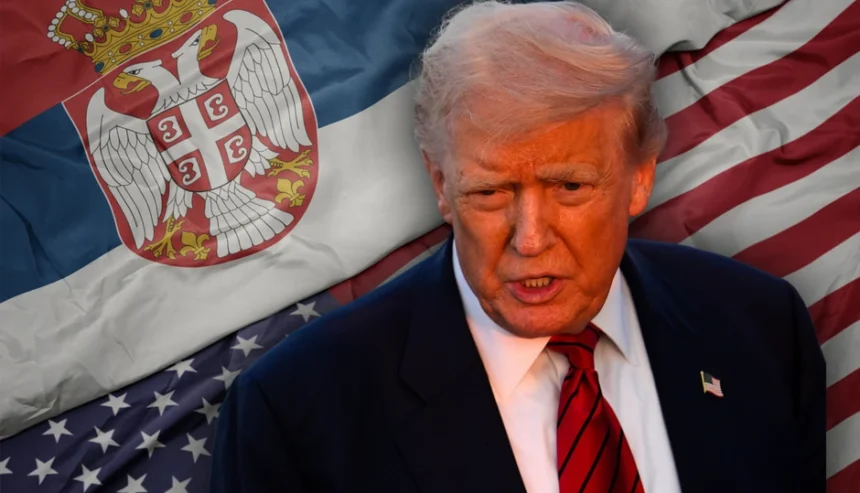
A newly released U.S. State Department report submitted to Congress has labeled the suppression of Russian and Chinese influence as Washington’s top priority in the Western Balkans, triggering intense debate in Belgrade over how much longer Serbia can sustain its balancing act between East and West.
The seven-page report explicitly accuses Moscow and Beijing of exploiting regional instability, corruption, and weak governance. The strategic warning caught Serbian President Aleksandar Vučić during his official state visit to China, prompting a sharp response from Beijing. “We have taken note of the report,” Vučić stated, adding that while Belgrade will cooperate with the U.S., it will not abandon its independent geopolitical stance “as easily as some might think.”
The U.S. Indictment: Moscow’s Disinformation and Beijing’s “Debt Traps”
According to the State Department document, the ongoing energy dependence of regional states on Russia remains a core strategic vulnerability that both Eastern superpowers actively weaponize.
- The Russian Strategy: The report alleges that Moscow systematically stokes ethnic animosities, funds destabilizing political actors, and uses hydrocarbon deliveries as economic leverage to weaken public trust in Euro-Atlantic institutions.
- The Chinese Strategy: Washington claims Beijing is rapidly expanding its soft power through state-backed loans, opaque trade deals, elite-level partnerships, and propaganda. The report specifically warns against Chinese public procurement practices: “Chinese companies frequently submit the lowest bids on public tenders, only to later reveal cost overruns and project delays that significantly inflate the final, actual costs.”
Divided Analysts: Direct Sanctions vs. Strategic Restrictions
Regional geopolitical analysts are divided on exactly how U.S. President Donald Trump’s administration will enforce these priorities against Belgrade, though two primary schools of thought have emerged.
1. The Pragmatic Approach: Incentives Over Pressure
Former diplomat Zoran Milivojević argues that the report reflects a familiar stance and will not result in direct economic sanctions against Serbia. Instead, Milivojević believes Washington will rely on pragmatism, using economic mechanisms and initiating negotiations for a new strategic partnership.
“This is a reflection of a new administration that views things pragmatically and keeps its own interests regarding Serbia in mind,” Milivojević noted. He pointed out that while European nations remain strictly unilateral, the U.S. prefers to counter adversaries by affirming its own strategic interests—pointing to recent U.S. policy shifts in Bosnia and Herzegovina, such as the lifting of certain “blacklists” and the impending departure of High Representative Christian Schmidt, as blueprints for this pragmatic alignment.
2. Increased Pressure on “Sensitive Sectors”
Conversely, political scientist Mijat Kostić believes the report signals that Washington increasingly views the Western Balkans as a frontline in its global superpower competition with Russia and China. Kostić predicts a subtle combination of “carrots and sticks” that will test Serbia’s military neutrality and traditional ties.
| Strategic Vulnerability | Expected U.S. Action / Counter-Proposals |
| Energy Dependence | Increased pressure for supply diversification and integration with Western grids. |
| Chinese Investments | Strict vetting and conditional limits on projects in sensitive technology and infrastructure. |
| Military & Tech Cooperation | Restrictions on the acquisition of Eastern defense tech paired with Western defense offers. |
“It is highly probable that Belgrade will be expected to limit cooperation in sectors that the West deems strategically sensitive, such as telecommunications, critical infrastructure, energy, or military technology,” Kostić stated, emphasizing that Serbia will face mounting pressure to clearly define its geopolitical camp in an increasingly bifurcated world.
The Kosovo Pivot and Local Reactions
Beyond countering foreign influence, the State Department report explicitly reiterated that the U.S. will continue to push both Serbia and Kosovo toward tangible progress in the normalization of their relations, aiming for a durable, negotiated agreement acceptable to both sides.
Vučić used the occasion to take a swipe at local political opponents, warning that Serbia would not bow to external directives. “Otherwise, why do we even have a state? Just to have sycophants who run to a café to take dictation the moment they receive an email on how to pull down their own country?” the Serbian president remarked.
As major global powers tighten their focus on southeastern Europe, Serbia’s long-standing policy of keeping “one foot in the West and one in the East” faces its most rigorous systemic test yet.