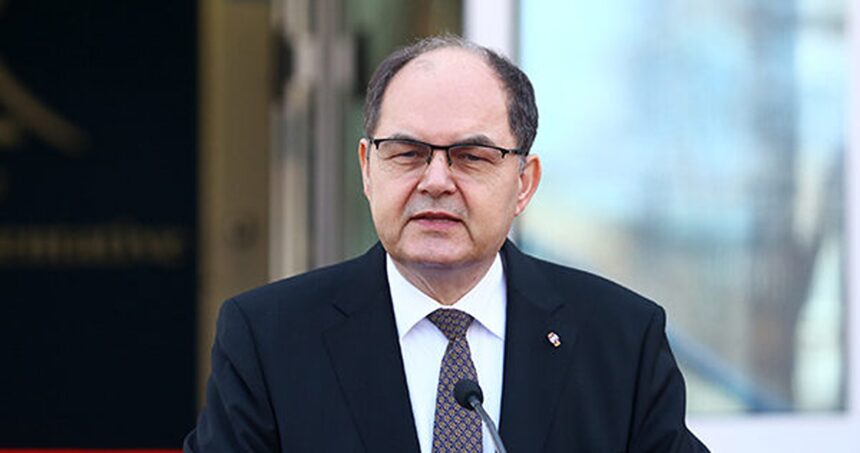
Who will become the next High Representative in Bosnia and Herzegovina? This question is dominating discussions ahead of the meeting of the Peace Implementation Council, which will be held on June 3–4 in Sarajevo, where the selection of a successor to Christian Schmidt will be considered.
However, the outcome remains uncertain. The embassies of the United States, United Kingdom, Germany, and Italy in Bosnia did not respond to questions regarding possible successors, the future of the Office of the High Representative, and the extent of its powers after nearly three decades of international oversight.
What is certain is that if no agreement is reached, Schmidt will remain in office.
In May, Schmidt announced his intention to step down after five years in the position, but stated that he would leave only after a successor is appointed, citing the need for institutional continuity ahead of Bosnia’s general elections scheduled for October.
Developments Before the PIC Meeting
Stephen Doughty arrived in Sarajevo on June 1, while Benjamin Haddad and Gunther Krichbaum are expected to arrive on June 2.
According to Bosnia’s Foreign Ministry, Doughty reiterated the United Kingdom’s strong support for the full mandate and powers of the OHR. Haddad stated before his visit that Europe “must not allow rival powers to interfere in our neighborhood and fuel instability.”
A group of European countries led by Germany, France, and the United Kingdom wants to preserve the current model that allows the High Representative to impose laws and dismiss elected officials in cases of political or institutional deadlock or violations of the Dayton Peace Agreement.
At the same time, Washington is reportedly supporting a gradual reduction of the OHR’s interventionist role and greater reliance on domestic institutions.
Names Being Mentioned
Although PIC Steering Board members have not officially announced candidates, several names are circulating in diplomatic and political circles.
Among the most frequently mentioned is Antonio Zanardi Landi, a 76-year-old Italian diplomat who previously served as Italy’s ambassador to Russia and to Serbia and Montenegro.
Another prominent candidate is René Troccaz, currently France’s special envoy for the Western Balkans.
Potential British candidates include:
- Karen Pierce, former UK ambassador to the United States and current special envoy for the Western Balkans.
- Stuart Peach.
U.S. representatives told the United Nations Security Council on May 12 that Washington also has its own candidates but would support a European nominee if consensus is reached within the PIC.
Future of the OHR
An equally important question is not only who will lead the OHR, but what mandate the next High Representative will have.
Recent U.S. statements at the UN have supported gradually limiting the executive powers of the future High Representative and transforming the OHR from an interventionist institution into a mediator that leaves greater responsibility to local institutions.
Such an approach would mark a departure from the periods of Schmidt and Paddy Ashdown, when the OHR extensively used the so-called Bonn Powers to impose binding decisions. It would be closer to the more restrained approach seen during the 12-year tenure of Valentin Inzko.
Schmidt stated in April that “the time has come for a new beginning for Bosnia,” amid indications that U.S. policy may favor stronger local institutions and reduced executive intervention, while the UK, Germany, and France continue to support a robust OHR.
PIC Membership and Divisions
The Peace Implementation Council includes:
- United States
- European Union
- United Kingdom
- Germany
- France
- Italy
- Canada
- Japan
- Russia
- Turkey (representing the interests of the Organization of Islamic Cooperation)
Russia suspended its participation in the PIC in early 2022 and has long advocated closing the OHR. This position aligns with demands from the authorities of Republika Srpska and is often supported by China in UN debates.
Western members of the PIC continue to insist that Bosnia must fulfill the conditions of the “5+2 Agenda” before the OHR can be closed.
OHR’s Legacy
Since the OHR was established in late 1995 under the Dayton Peace Agreement, eight European diplomats have served as High Representatives in Bosnia and Herzegovina, while all of their first deputies have been Americans.
Over the years, High Representatives have imposed amendments to approximately 300 legal and constitutional provisions and, up until 2006, removed more than 400 elected officials from office, ranging from mayors and police commanders to members of Bosnia’s presidency. Many were also barred from political activity.
While those political bans were later lifted, the laws imposed by the OHR remain in force, including provisions stating that decisions of the High Representative cannot be reviewed by courts and that failure to implement them constitutes a criminal offense.