The first monitoring of the Reform Agenda implementation indicates that Serbia has remained consistent in its stagnation and regression regarding European integration. Analysts argue the report brings nothing fundamentally new, but rather documents a long-standing negative trend.
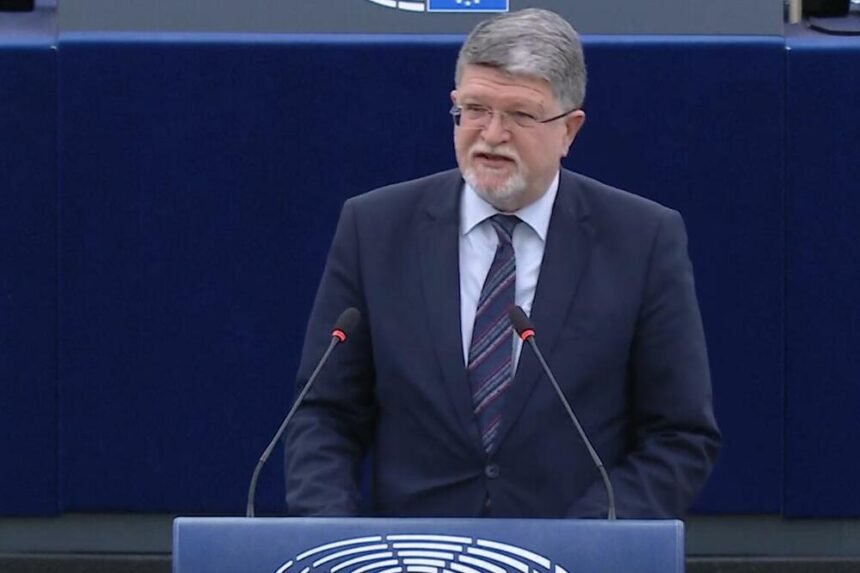
The European Parliament’s Committee on Foreign Affairs (AFET) is scheduled to vote on the latest progress report on Serbia, drafted by EP Rapporteur Tonino Picula. The report indicates that reforms related to the EU accession process have significantly slowed down or regressed, particularly in the areas of democracy and the rule of law. Out of 34 required reform steps, Serbia has successfully fulfilled only six—amounting to a mere 18 percent.
The Reform Agenda functions on strict conditionality; to access funds from the EU’s Growth Plan, Serbia must meet specific political prerequisites. This year’s report explicitly notes that the preconditions regarding democratic mechanisms and the rule of law have not been met, marking a clear deterioration compared to the European Commission’s initial assessment.
According to the report, the primary drivers behind this regression include:
- The government’s escalating and harsh response to public demonstrations.
- Organized violence and systemic irregularities observed during the local elections in March.
- A continuous decline in media freedom and the overall safety of journalists.
While the Serbian government has passed several legislative packages since the beginning of the year—promoted as alignment with ODIHR recommendations and the Reform Agenda—critics dismiss them as cosmetic changes rather than substantive reforms. They argue that Belgrade continues to pursue a declarative pro-European policy that completely lacks the actual political will required for implementation.
A Sharper Tone Under New Rapporteurship
Goran Miletić, founder and executive director of the Balkans Forward Foundation, noted that the European Parliament’s report is predictably sharper than previous iterations, reflecting a long-term absence of genuine progress.
“What has changed is that the Rapporteur is no longer from the EPP group, meaning the formulations are now clearer and somewhat sharper, but the core essence remains the exact same,” Miletić stated.
Miletić expressed deep concern that the Serbian government is not only failing to resolve long-standing issues raised by the European Parliament and the European Commission, but is consistently adding new problematic actions to the agenda.
“Many of these standards have long been binding for Serbia as a member of the UN and the Council of Europe, regardless of EU accession—such as judicial independence, media freedom, police conduct, non-discrimination, and civil unions. There is clearly no intention to fix anything fundamentally,” Miletić added, concluding that public apathy has allowed the ruling majority to comfortably introduce restrictive domestic practices.
Simulating Rather Than Implementing Reforms
Naim Leo Beširi, director of the Institute for European Affairs, agrees that Picula’s report will not offer revolutionary revelations because it merely highlights a well-established pattern.
“The problem is no longer that the European Union cannot see the issues, but that the political elite in Serbia has no real intention of solving them,” Beširi emphasized. “A country that began negotiations back in 2014 is now lagging behind almost all states in the region.”
Beširi warned that Serbia is suffering from captured institutions, massive concentration of political power, and systemic corruption. He stressed that praise for individual pieces of legislation cannot mask the broader reality of whether institutions function independently and whether citizens can trust that justice applies equally to everyone.
He also pointed to severe domestic challenges, including high-profile scandals involving state apparatus links to organized crime, police brutality, and a social climate that relativizes or glorifies 1990s war crimes. Furthermore, he noted that following the recent tragedy in Novi Sad, which resulted in 16 fatalities, it has become impossible to ignore the deadly cost of institutional irresponsibility and corruption.
“Picula is simply putting down on paper what citizens see and feel every single day,” Beširi concluded. “He is telling us: ‘Here is the state of your country.’ If citizens are satisfied with this reality, there is no reason for change. If they are not, the problem lies not within the report, but with the actions that led to it.”