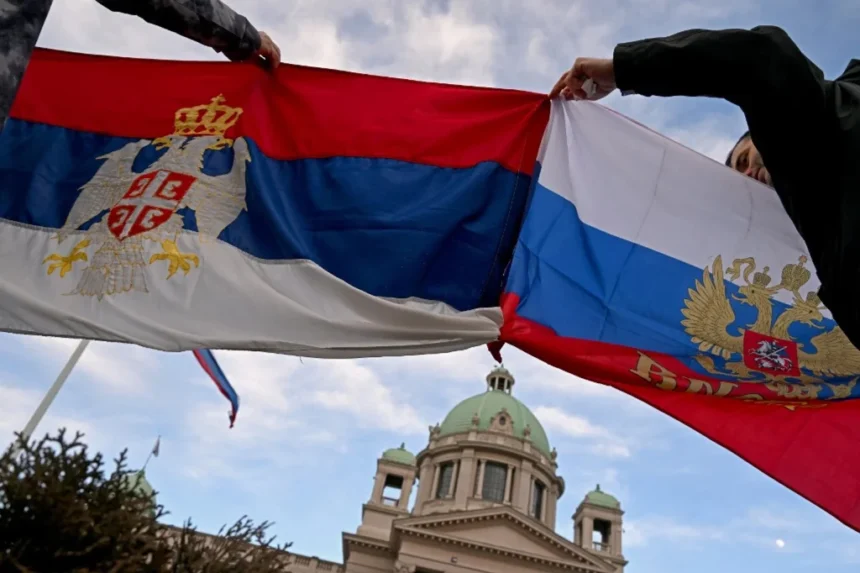
Serbia faces a crucial strategic choice between aligning its foreign and security policies with the European Union or continuing to maintain close relations with Russia and China, according to Luke Zahner, a senior fellow at the Center for American Progress in Washington.
In an interview with Telegrafi, the former US State Department official said Belgrade’s attempt to balance relations between Moscow and Brussels was becoming increasingly difficult, particularly as Russia continues its war against Ukraine.
“For years, Serbia has sought the benefits of European integration while maintaining close relations with Russia and China, a position that is becoming increasingly difficult to reconcile with its European ambitions,” Zahner said.
He argued that Serbia cannot indefinitely benefit from the EU integration process while refusing to align its policies with those of the bloc, particularly regarding Russia’s invasion of Ukraine.
“It cannot have both indefinitely. If Serbia genuinely wants to join the European Union, it must gradually align its foreign and security policies with those of the EU, including its position on Russia’s war against Ukraine,” he stressed.
EU remains Serbia’s main economic partner
Zahner also highlighted the financial assistance Serbia has received from the European Union, describing Brussels as Belgrade’s most important economic partner.
“The EU has provided Serbia with more than seven billion euros in grants since 2000 and remains its main economic partner. Many Serbian citizens are not even aware of the scale of this assistance, but they would certainly feel the consequences if it were to stop,” he said.
However, Zahner warned that Russian influence in Serbia extends far beyond Moscow’s relationship with President Aleksandar Vučić and is deeply embedded in various sectors of the country.
“Russia’s influence in Serbia goes far beyond its relationship with Aleksandar Vučić. It has deep roots in political, economic, energy, cultural, media and other networks, many of which will survive this change of government,” he said.
For this reason, he cautioned against expecting Russian influence to disappear immediately, even if Serbia undergoes a political transition.
According to Zahner, a new Serbian government would face several major decisions concerning the country’s energy dependence, sanctions against Russia, political relations with Moscow and Russian influence over the information space.
“Serbia must make a fundamental choice about its future,” he said, adding that historical and cultural ties with Russia are not necessarily incompatible with EU membership, but strategic relations must be consistent with Serbia’s European commitments.
Russia seeks to exploit divisions in the Western Balkans
Addressing Moscow’s influence across the region, Zahner said Russia seeks to exploit disagreements between Western Balkan countries, as well as divisions within NATO and the European Union.
“When it comes to Russia, it looks for every opportunity to exploit divisions within NATO and the EU. Nothing pleases it more than finding a disagreement, intervening and deepening it in order to create as much dissatisfaction and instability as possible,” he said.
He identified several unresolved regional disputes that provide opportunities for Moscow to encourage divisions, including tensions between Kosovo and Serbia, North Macedonia’s dispute with Bulgaria, Montenegro’s EU accession process and the actions of Milorad Dodik in Bosnia and Herzegovina.
Zahner concluded that Serbia should avoid becoming an instrument for advancing Russian interests in the region and instead contribute to greater regional stability.
“Serbia should not want to become an enabler of Russia’s interests. That is not in its own interest. On the contrary, Serbia should want greater stability in the region,” he said.