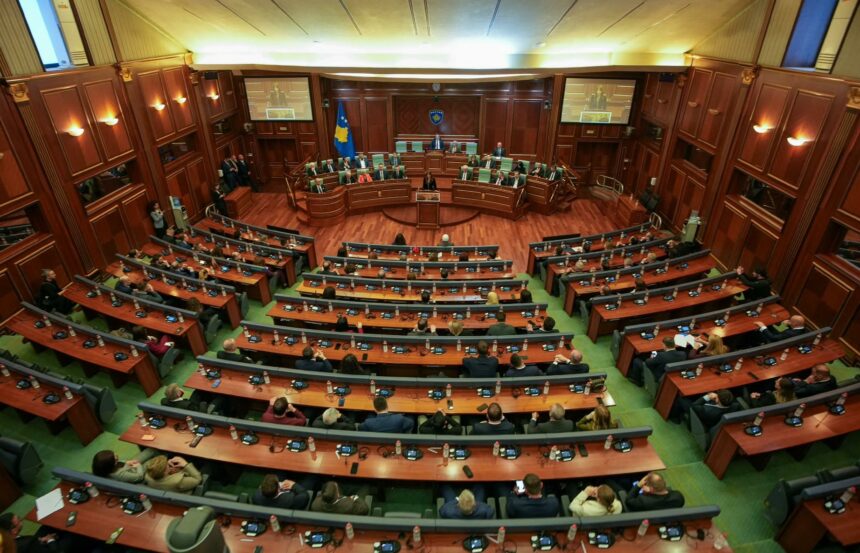
The Kosovo Assembly has until March 31 to ratify the loan agreement between Kosovo and the European Investment Bank (EIB) for the “Photovoltaic Solar Energy” project at the Kosovo Energy Corporation (KEK), valued at €33 million.
However, the Assembly’s work remains frozen until that date by the Constitutional Court, which imposed a temporary measure after contesting President Vjosa Osmani’s decree to dissolve the tenth legislature.
This EIB agreement is one of eight international agreements currently pending in the legislature. Other agreements include:
- Kosovo’s membership in the Peace Board
- Access to higher education and studies in the Western Balkans
- Two amendments to Kosovo-EU financial agreements under the IPA program
- Two loans with the European Bank for Reconstruction and Development (EBRD): one for energy efficiency in public buildings and another for wastewater treatment facilities in Podujevë
- A loan agreement with the Saudi Fund for Development for the Prishtina-Mitrovica road project
The combined value of four of these agreements, including the EIB loan, is €121 million.
Government spokesperson Arlind Manxhuka stressed that the deadlines for approving these agreements are tight and require swift parliamentary action.
The European Investment Bank emphasized that ratification is necessary to release the proposed funding, which would allow Kosovo to proceed with the construction of one of its largest solar photovoltaic power plants, with a capacity of up to 100 megawatts. The project is expected to:
- Strengthen the country’s energy security
- Increase the share of renewable energy in domestic production
- Reduce dependence on coal-based generation
- Support Kosovo’s green transition goals, producing approximately 169 gigawatt-hours per year and significantly reducing carbon dioxide emissions once operational
Experts note that these agreements have a direct impact on citizens’ quality of life and Kosovo’s international standing.
“Ratifying these agreements accelerates public investments, strengthens institutional stability, and provides concrete medium- and long-term benefits for citizens,” said Melos Kolshi, researcher at the Kosovo Institute for Justice (IKD), in an interview with Radio Free Europe.
However, Violeta Haxholli from the Democratic Institute of Kosovo (KDI) warned that the current situation creates institutional uncertainty.
“Since international agreements require a two-thirds majority in the Assembly for ratification, any parliamentary deadlock automatically delays the process. Until there is clarity on the full functioning of the legislature, it is difficult to predict when these agreements can be approved,” she said.
The ruling party Vetëvendosje announced plans to ratify these agreements on Friday, March 6, a day after failing to elect a new president. However, the session did not take place after President Osmani issued her dissolution decree that morning.
Arbërie Nagavci, head of the Vetëvendosje parliamentary group, emphasized that these four agreements are strategically important for economic development, infrastructure, environmental protection, and energy efficiency in Kosovo.
“Rapid approval is in the direct interest of citizens and Kosovo’s sustainable development. Strategic projects like these must not be held hostage by political developments but advanced as soon as possible to deliver tangible benefits,” she said.
Haxholli noted that failure to ratify international agreements delays project implementation and affects Kosovo’s image abroad.
“While international partners generally understand domestic political situations, ongoing institutional deadlocks can impact cooperation and confidence in implementing joint projects,” she said.
Kolshi added that in the current global geopolitical context, it is crucial for Kosovo to demonstrate institutional seriousness and decision-making capacity to maintain and strengthen its strategic partnerships.