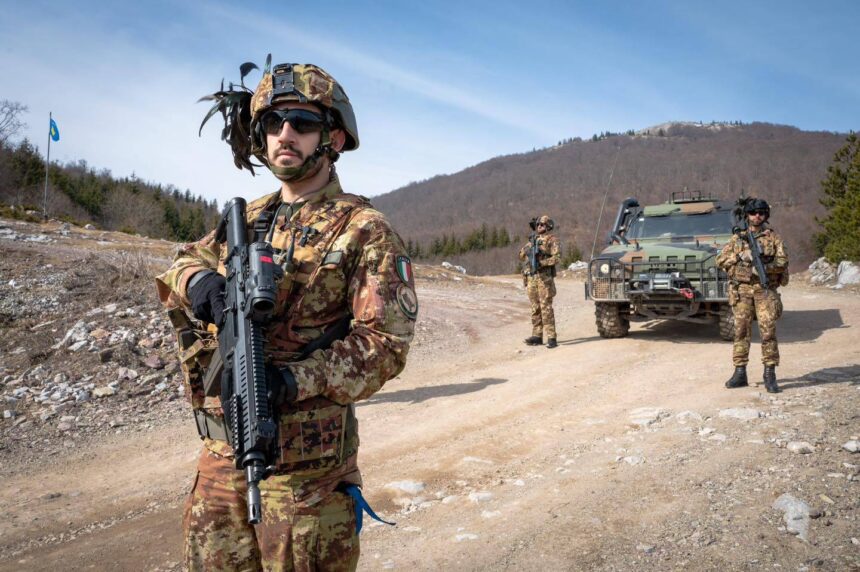
The Western Balkans are entering a complex phase of regional security competition, where historical grievances, political fragility, and military modernization are shaping perceptions as much as realities on the ground. While no actor appears to be preparing an actual offensive, Serbia, Kosovo, Albania, and Croatia are signaling strategic intent through new defence initiatives, arms acquisitions, and cooperative frameworks.
Historical Context
The unresolved legacy of the Yugoslav Wars continues to influence security calculations in the Balkans. Kosovo’s independence, declared in 2008 and still unrecognized by Belgrade, remains the central point of tension. NATO’s KFOR mission maintains stability on the ground, while the EU emphasizes the Belgrade-Pristina dialogue as critical to regional normalisation and European integration.
In March 2025, Albania, Croatia, and Kosovo signed a trilateral defence cooperation declaration. Officially framed as defensive, the agreement covers interoperability, training, countering hybrid threats, and support for Kosovo’s Euro-Atlantic integration. Though not a formal military alliance, the initiative has altered the regional balance of trust and deterrence, prompting an immediate reaction from Serbia, which denounced the agreement as a dangerous precedent that could isolate Belgrade and legitimize Kosovar security structures.
Current Dynamics
In 2026, the trilateral framework began producing tangible effects. At a Munich meeting in February, the three states reaffirmed plans to deepen cooperation in defence capabilities, industrial partnerships, and interoperability. Meanwhile, Serbia accelerated its military modernization, acquiring Chinese CM-400AKG ballistic missiles and French Rafales, with defence spending projected at 2.6% of GDP. Croatia reinstated compulsory military service after 17 years, citing regional security concerns.
Kosovo’s political fragility further complicates the picture. Institutional stalemates, frozen elections, and ongoing internal disputes limit its capacity for independent strategic action. Yet, security initiatives are being leveraged as political tools to consolidate legitimacy and international positioning.
Serbia’s Role and Threat Perception
Belgrade frames the trilateral cooperation as a symbolic threat, which serves several internal purposes: legitimizing rearmament, consolidating domestic cohesion around a perceived encirclement, and negotiating from a stronger position with Western, Russian, and Chinese interlocutors. Serbia continues to balance NATO cooperation, European aspirations, and ties with Russia and China, using threat perception as a strategic instrument.
Regional Implications
The current dynamic creates two possible trajectories. In the best-case scenario, Albania, Croatia, and Kosovo’s cooperation remains primarily technical, while Serbia strengthens its military without escalating tensions. KFOR and the EU dialogue serve as stabilizing buffers. Preventive communication, transparent exercises, and careful diplomacy could maintain a competitive but managed deterrence environment.
In the worst-case scenario, misperceptions escalate into a regional spiral of securitization. Belgrade may interpret trilateral initiatives as encirclement, neighboring states may view Serbian rearmament as coercive, and Kosovo’s instability could exacerbate identity-driven rhetoric. Minor incidents could quickly become symbols of broader regional crises, increasing the likelihood of political-military miscalculations without any formal declaration of war.
While no immediate threat of coordinated military action against Serbia is evident, the Western Balkans are undergoing a strategic realignment. Albania-Croatia-Kosovo cooperation, Serbian military modernization, Kosovo’s political fragility, and the unresolved status of Kosovo create a delicate environment in which perceptions may become self-reinforcing drivers of instability. NATO and EU engagement will be crucial in preventing these dynamics from evolving into a systemic crisis.