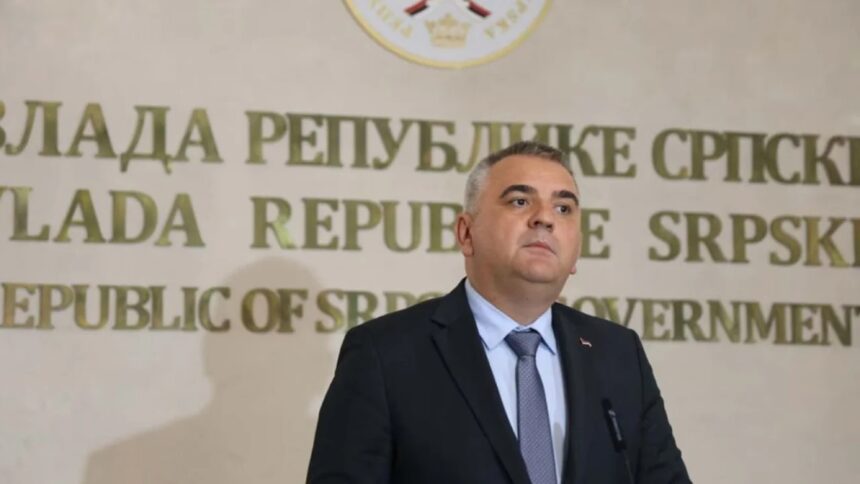
The Prime Minister of Republika Srpska (RS), the Bosnian Serb entity within Bosnia and Herzegovina, Savo Minić, has announced his resignation from the post.
Minić made the announcement during a press conference in Banja Luka on March 16, stating that he had consulted with RS President Sinisa Karan, who will propose him again as the mandate holder for forming the new government.
A member of the Alliance of Independent Social Democrats, the party of Milorad Dodik, Minić said he enjoys support from the majority in the RS National Assembly. He explained that the resignation is intended to ensure the legality and legitimacy of the government, though he did not specify the objections raised by the international community.
The RS National Assembly is scheduled to review his resignation on Monday afternoon in a session convened immediately after Minić’s press conference.
This is the second time in recent months that Minić has resigned and indicated he will again be the mandate holder for forming the RS government. He previously served as Minister of Agriculture and was appointed Prime Minister of the entity on September 2 of last year.
Constitutional Controversy
The Constitutional Court of Bosnia and Herzegovina ruled on January 23 that the government was unconstitutional because it had been proposed in August by Milorad Dodik, who at the time claimed to be RS president. According to the RS constitution, only the president of the entity may propose a mandate holder. Dodik had been barred from exercising public functions for six years following a judicial ruling on noncompliance with the High Representative’s decisions.
Days before the Constitutional Court ruling, Minić resigned. He was subsequently proposed as mandate holder by acting RS president Ana Trishiq Babić, and later reappointed as Prime Minister.
Members of the Party of Democratic Action and the Democratic Front in the House of Representatives of Bosnia and Herzegovina challenged the appointment, arguing before the Constitutional Court that it represented a “direct and deliberate violation of the rule of law” under the country’s constitution.
The Constitutional Court has not yet issued a final decision on this case.
Meanwhile, Qamil Duraković, RS deputy speaker, requested the RS Constitutional Court to review the legality of Trishiq Babić’s appointment, noting that the entity constitution does not recognize the function of acting president. On February 25, the RS Constitutional Court suspended proceedings regarding the constitutional review of her appointment.