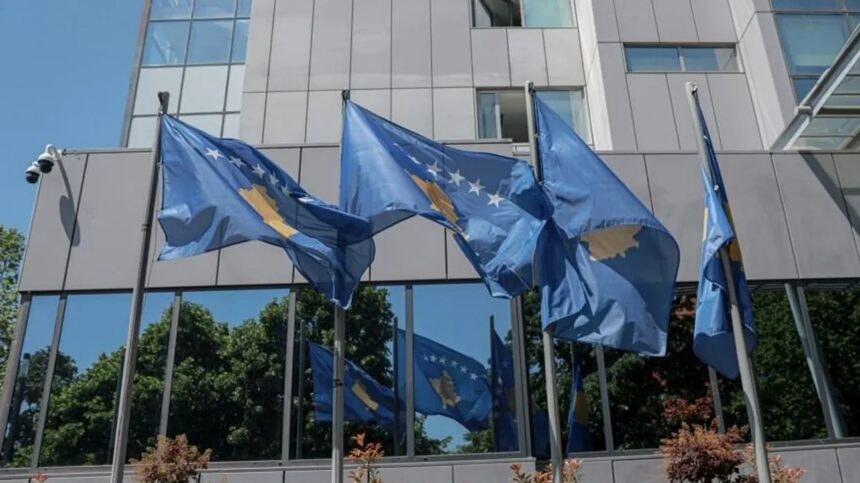
After nearly three years, Kosovo is no longer burdened by the EU sanctions that were imposed due to tensions in the Serb-majority northern municipalities.
The even better news is that the biggest beneficiaries are the citizens of Kosovo, as the release of funds is expected to positively impact, among other things, the creation of new jobs.
Kosovan authorities have consistently labeled the sanctions as unfair, asserting that they had already met the EU’s conditions for their removal: reducing tensions and limiting the police presence near key sites in the four northern municipalities.
The sanctions had significant financial costs for Kosovo, as various projects under the Instrument for Pre-Accession Assistance (IPA II and III) and the Western Balkans Investment Framework (WBIF) were suspended or postponed.
Main Benefits
Njomza Arifi, Executive Director of the Group for Legal and Political Studies (GLPS), told Radio Free Europe that in December 2025, €216 million was released, primarily for education programs such as the Young Cell scholarship scheme and infrastructure and environmental projects.
The Young Cell program provides scholarships for young people wishing to study in European countries. This month, the program completed applications for 37 full postgraduate scholarships. The EU contributed €3 million, with Kosovo adding an additional €1 million.
Infrastructure projects include the allocation of €12 million for the construction of a wastewater treatment plant at Kosovo B power plant, €17.6 million for district heating support, and other initiatives.
“The remaining €205 million that was recently released mainly comes from IPA and WBIF funds and will be programmed to support reforms in key areas such as rule of law, good governance, economic development, and education,” Arifi said.
Rrona Zhuri, Research Coordinator at the Institute for Advanced Studies – GAP, said that lifting the sanctions enables a return to normal relations with the EU.
“The release of funds is expected to have a broad positive impact across several dimensions of development. Economically and in terms of employment, the resumption of capital projects and investments is expected to create new jobs and increase economic activity. At the same time, public service sectors such as energy, environment, and infrastructure will benefit directly, contributing to an improved quality of life for citizens,” Zhuri said.
According to her, the impact of fund releases also extends to structural reforms, as EU funds are often tied to specific reform conditions, encouraging progress in key areas such as rule of law, public administration, and sustainable development.
Arifi believes these reforms directly improve citizens’ well-being.
“Therefore, the natural beneficiaries of these funds are the citizens of Kosovo. At the same time, they help the country make progress on its European path, supporting reform processes closely linked to the prerequisites for EU membership,” she added.
Kosovo remains the only Western Balkan country without official EU candidate status. Its 2022 application has not yet been reviewed by EU institutions.
Consequences of the Sanctions
In addition to blocking funds, the sanctions also affected the political dimension, as high-level bilateral meetings and subcommittee interactions related to the Stabilization and Association Agreement — Kosovo’s first contractual agreement with the EU — were limited.
However, Brussels has signaled that it aims for full re-engagement with Kosovan authorities.
Arifi believes this will create new momentum for Kosovo-EU dialogue, as the sanctions had “a negative impact on Kosovo’s international credibility.”
Rrona Zhuri also notes that the sanctions cost Kosovo many opportunities.
“Any delay or suspension of projects means postponed or lost opportunities for development, improving citizens’ welfare, strengthening institutions, and slowing the European integration process.”
According to GAP research in 2025, the financial measures resulted in €613.4 million worth of suspended or delayed projects, with the environment sector being the most affected at €350 million.
Experts on these issues emphasize that the new reality should serve as a push for progress in areas related to European integration.
“It remains very important that Kosovo seize this positive moment to accelerate integration processes, avoiding further blockages caused by internal political crises,” Njomza Arifi concluded.