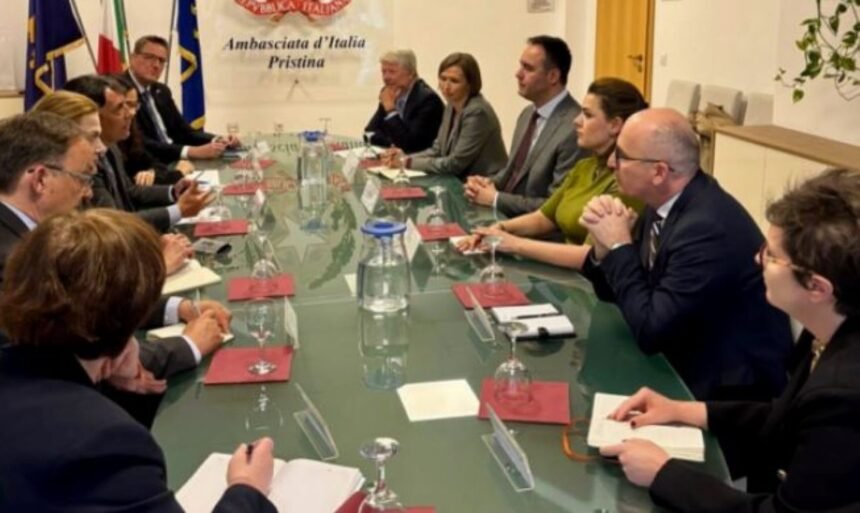
At a critical juncture for Kosovo’s foreign policy, the Italian Embassy in Prishtina hosted an informal high-level meeting on May 1, 2026, bringing together key international diplomats and Kosovo’s leadership to discuss the nation’s European future.
The meeting, organized by Italian Ambassador Nicola Antonini, featured Acting Minister of Foreign Affairs Glauk Konjufca, heads of various international missions, and representatives from the European Union Office in Kosovo.
Key Discussion Pillars
According to the official communique from the Italian Embassy, the informal gathering of the “Friends of the Western Balkans” focused on three primary areas:
- The EU Integration Path: Reviewing Kosovo’s progress in meeting the technical and political criteria required for further integration steps.
- Internal Political Developments: Discussing the current domestic landscape, particularly the upcoming June 7 snap elections and the transition of power.
- Regional Context: Addressing security and stability in the Western Balkans amid broader geopolitical tensions in Europe.
Strategic Importance of the “Italian Initiative”
Italy has consistently positioned itself as a primary advocate for the Western Balkans’ integration into the European Union. By convening this informal “Friends of the Western Balkans” group, Ambassador Antonini underscored Italy’s role as a mediator and supporter during Kosovo’s current period of political uncertainty.
The “Friends of the Western Balkans” Group: This informal alignment usually includes EU member states that prioritize enlargement, such as Italy, Austria, Croatia, and Slovenia. Their goal is to keep the enlargement process on the Brussels agenda and provide technical support to candidate and potential candidate countries.
Diplomatic Timing: The 2026 Landscape
The meeting comes at a time when Kosovo is facing significant internal and external challenges:
- Administrative Transition: Following the failure to elect a president, the country is managed by acting officials (U.D.), making international coordination vital for continuity.
- Security Concerns: With recent U.S. Congressional resolutions pushing for Kosovo’s NATO membership and ongoing tensions with Belgrade, international “friends” are seeking to ensure that Kosovo remains aligned with Euro-Atlantic standards.
- EU Reform Agenda: Diplomats emphasized the need for Kosovo to continue its reforms in the rule of law and public administration, regardless of the election cycle.
“Conversations focused on Kosovo’s path towards the EU, internal political developments, and the regional context,” the Italian Embassy’s statement confirmed.
While informal, such meetings are essential for “synchronizing watches” between Prishtina and the Quint/EU countries. For Acting Minister Konjufca, the meeting served as an opportunity to reassure international partners that Kosovo remains committed to its Western orientation and that the upcoming elections will be conducted according to democratic standards.