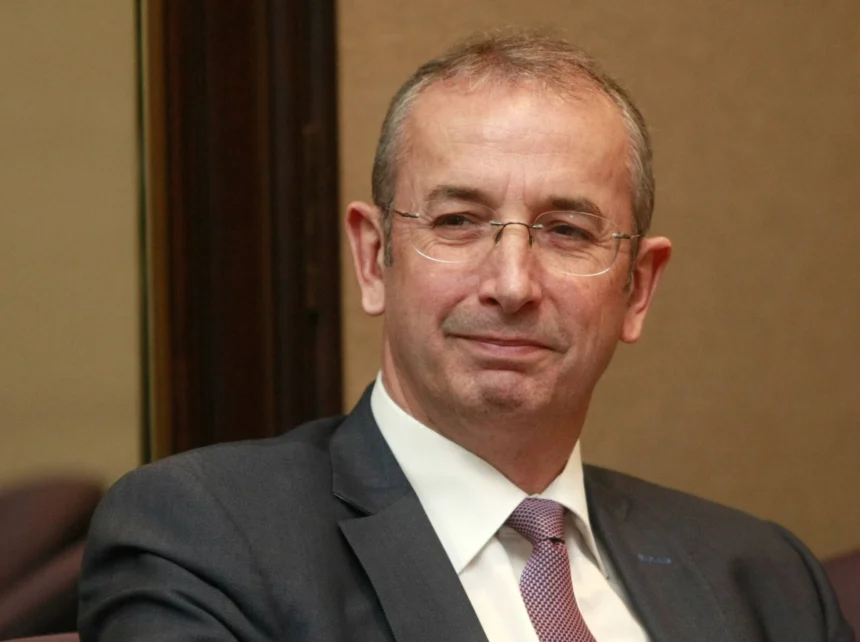
In a searing retrospective on the state of Serbian democracy, Michael Davenport, the former British Ambassador and Head of the EU Delegation to Serbia, has warned that the ruling Serbian Progressive Party (SNS) has systematically “captured the state” by adopting an authoritarian model inspired by Hungary’s Viktor Orbán.
Writing for the investigative outlet Radar on May 1, 2026, Davenport—who retired from active diplomacy in 2024—argues that the Serbian political elite fundamentally rejects the values of the European Union, including judicial independence and media freedom.
The “Orbán Model” and State Capture
Davenport, who witnessed the SNS rise to power in 2012 with initial Western support, notes that it became quickly apparent that the party was not interested in the rule of law reforms required by Chapter 23 of the EU accession process.
“It was becoming increasingly obvious that the Progressives saw Hungary under Fidesz as a more attractive alternative pattern, where state capture played a major role,” Davenport stated.
Key findings from Davenport’s assessment:
- Political Will: Despite declaring EU membership as a goal, successive governments have intentionally delayed or reversed reforms to concentrate power.
- Normalization of Crime: Davenport highlighted a disturbing regional trend where politicians “reward or even celebrate criminal behavior,” facilitated by a weakened judiciary and state-controlled media.
- Anti-EU Rhetoric: Despite receiving billions in financial aid, the Serbian leadership frequently employs anti-Western rhetoric at the highest political levels.
Media Under Siege: The Case of N1
The former diplomat expressed grave concern over the shrinking space for independent journalism. He pointed to the systematic pressure exerted on N1 and other outlets within the United Group as a sign of an “erosion of all norms.”
Davenport noted that the state-owned Telekom Srbija is often used as a tool to expand government control over the media landscape, citing the historic decline of once-reputable outlets like B92 and Studio B. He called on the newly formed boards of international media networks to “show unwavering support” for editorial independence in the face of government smear campaigns.
The “Stabilocracy” Trap
Addressing the Western approach to Serbia, Davenport critiqued the tendency of international actors to prioritize regional stability over democratic standards—a phenomenon often called “stabilocracy.”
- EU Hesitation: While the European Parliament has recently called for freezing funds until electoral reforms are met, Davenport notes that Brussels was often “a step behind” in calling out authoritarian shifts.
- The Kosovo Factor: He acknowledged that the Kosovo dialogue has often dominated the agenda in London and Washington, sometimes at the expense of holding Belgrade accountable for domestic repression.
- The Student Movement: Davenport praised the “extraordinary courage” of Serbian students and citizens who have protested for 18 months, noting that they—more than the politicians—represent true European values.
A Legacy of Friction
Davenport’s tenure in Belgrade (2010–2017) was marked by both significant humanitarian success—securing €30 million for flood recovery in 2014—and intense political friction. Many still recall the 2016 session of the Serbian Parliament where Vojislav Šešelj and the Radical Party disrupted Davenport’s presentation for four hours, an incident he believes was coordinated with the authorities.
Outlook for 2026
As Serbia approaches potential elections in July 2026, Davenport’s analysis serves as a warning to the international community. He insists that without a clear demand for the rule of law and an end to the “rehabilitation of war criminals” in the media, financial support from the EU will continue to yield “very limited results” in terms of democratic governance.