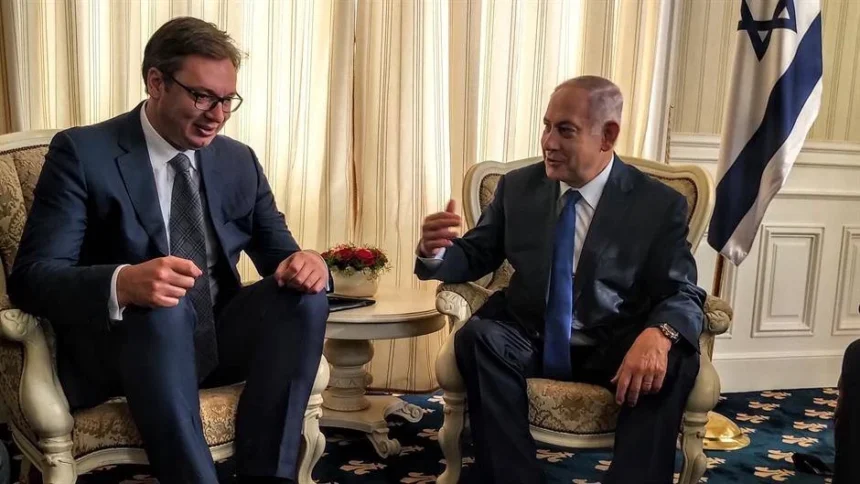
The Serbian government has officially entered into a high-level security agreement with Israel to facilitate the mutual exchange and protection of classified defense information. The move, finalized in early May 2026, marks a significant deepening of military-industrial cooperation between the two nations and paves the way for the transfer of highly sophisticated military technologies.
While the Serbian Ministry of Defense has remained discreet regarding the specific projects covered by the pact, the agreement is widely understood to be the legal prerequisite for a major joint venture: the establishment of a state-of-the-art drone manufacturing facility on Serbian soil.
The “Drones of the Future”
President Aleksandar Vučić recently signaled the strategic importance of this partnership, announcing that Serbia and Israel would collaborate to produce “the best drones in this part of the world.”
Reports from investigative outlets, including Haaretz, suggest that Belgrade has secured a deal with the Israeli defense giant Elbit Systems. This follows a massive $1.64 billion contract allegedly signed in 2025 for the acquisition of advanced weaponry and electronic warfare equipment.
Strategic Necessity of Secrecy
Security analysts, including Nikola Lunić, emphasize that such agreements are standard practice when a nation seeks to import or co-produce “sovereign technology.”
“No defense company will bring its most modern products to a third country unless its intellectual property and technical specifications are legally protected,” Lunić noted. “This agreement ensures that sensitive Israeli technology remains secure and does not fall into the hands of third parties.”
A Multi-Vector Intelligence Network
Israel is just one of over 20 international partners with whom Serbia maintains classified data exchange protocols. This network allows Belgrade to balance its security interests across several global axes:
- Western Integration: Through agreements with NATO (2008) and the European Union (2011), Serbia participates in joint drills and receives intelligence vital for security sector reforms.
- The Russian Connection: A 2014 agreement with Moscow has facilitated the modernization of Serbia’s Air Force with MiG-29 fighters and specialized anti-aircraft systems.
- European Procurement: Strategic pacts with France have culminated in the recent €2.7 billion purchase of Rafale fighter jets, requiring deep intelligence sharing on logistics and maintenance.
Balancing Act Amidst Conflict
The timing of the deal has drawn criticism from opposition figures, who point to Israel’s ongoing military operations in Gaza and its tensions with Iran. However, President Vučić has remained firm on Serbia’s policy of “military neutrality,” stating that the country will cooperate with both Israel and Iran as it sees fit for its own national security.
As part of this “multi-vector” approach, Serbia continues to expand its defense industry, which has seen exports to Israel surge significantly since late 2023.
Implementation and Urgency
In an unusual move, the Serbian Parliament’s Defense Committee approved the “temporary implementation” of the agreement even before formal ratification. Ministry of Defense representative Marko Jovanović justified the urgency, stating it was necessary to “immediately trigger contracts for equipment and the improvement of the Serbian Army’s operational capabilities.”
With this agreement in place, Serbia is positioning itself as a regional hub for defense technology, bridging the gap between Western standards and domestic industrial production.