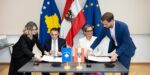
European Union Foreign Ministers met with their six Western Balkan counterparts on Monday, May 11, 2026, to discuss deepening cooperation in foreign security and defense. The high-level session emphasized that European integration requires more than just technical reforms; it demands a unified geopolitical worldview.
The meeting was hosted by the EU High Representative for Foreign Affairs and Security Policy, Kaja Kallas, and included representatives from across the region, with Kosovo represented by acting Foreign Minister Glauk Konjufca.
Strengthening Defense and Security Cooperation
The EU signaled its readiness to provide tangible support to its Balkan partners to counter modern security challenges. Key areas of cooperation discussed include:
- Hybrid Threats & Disinformation: Brussels is prepared to assist regional governments in combating foreign interference and fake news.
- European Peace Facility (EPF): The EU plans to increase the use of this instrument to strengthen the defensive capacities and military infrastructure of its regional partners.
The Expectation of “Full Alignment”
Despite the offer of increased support, EU ministers were firm in their requirement for candidate countries to align with the Common Foreign and Security Policy (CFSP). High Representative Kallas made it clear that aligning with EU sanctions and values is a litmus test for a country’s European path.
“In these geopolitical times in which we live, this is not just a formal fulfillment of obligations, but actually shows whether we see the world in the same way,” Kallas stated during the press briefing.
The “Sanctions Gap”
A primary point of contention remains the lack of uniform alignment regarding sanctions against Russia. While most Balkan nations have followed the EU’s lead, Serbia continues to resist calls from Brussels to join the sanctions regime triggered by the war in Ukraine.
Kallas acknowledged the diversity of the region, noting that different historical and political perspectives often reflect in their varying levels of harmonization with EU policies. However, she emphasized that partnership is a “two-way street” that requires:
- Clear alignment with EU foreign policy.
- Continued internal reforms.
- Stricter adherence to the Rule of Law.
Regional Outlook
The meeting serves as a reminder that as the EU looks to expand its security umbrella over the Balkans, the door to full membership remains tied to political solidarity. For countries like Serbia, the pressure to choose between traditional alliances and their European aspirations is expected to intensify as the conflict in Ukraine and broader global tensions persist.