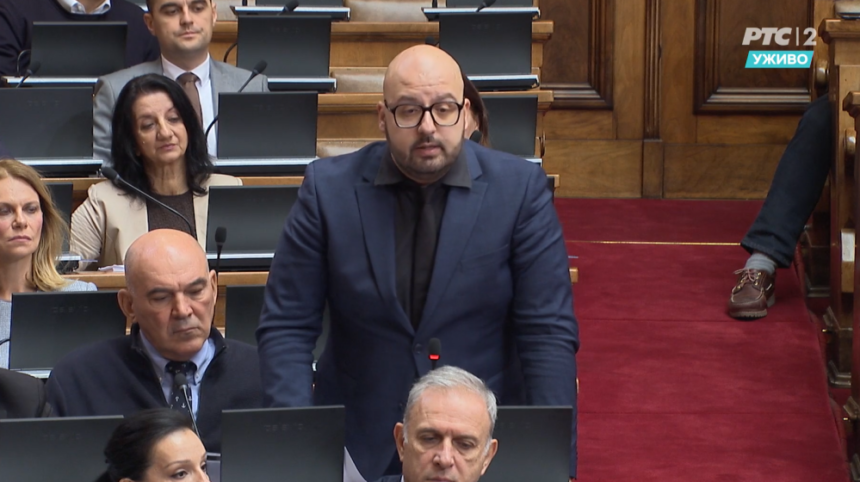
The political battle over the future of Serbia’s judiciary intensified on Friday, May 15, 2026, as opposition lawmakers declared that the government’s newly revised judicial reform package is even more dangerous than its highly controversial predecessor.
Stefan Janjić, a Member of Parliament representing the opposition Srbija Centar (SRCE) party, publicly accused the ruling Serbian Progressive Party (SNS) of staging a superficial reform process designed to trick international observers while tightening political control over public prosecutors.
The “Mrdić Laws 2.0”: Keeping Control Behind Closed Doors
The legislative package—dubbed the “Mrdić Laws” in public discourse due to its primary sponsor, SNS MP and Parliamentary Judiciary Committee Chairman Uglješa Mrdić—was initially rushed through the Serbian Assembly on January 28, 2026. After a scathing emergency review by the Venice Commission in April, which warned that the laws dismantled prosecutorial autonomy, the Ministry of Justice published a set of revised texts.
However, Janjić revealed to TV Nova S that he has thoroughly reviewed the newly amended proposals and found them profoundly alarming.
“The ruling majority has not given up on the idea of political control over the prosecutor’s office. This amended package of judicial laws that arrived at the Ministry of Justice is actually worse than the first version,” Janjić stated.
Key Criticisms of the New Version:
- Superficial Compliance: Janjić argues that the controversial provisions were only “formally” and superficially tweaked to mimic the language requested by the Venice Commission, while leaving core executive overreach mechanisms untouched.
- Infinite Re-elections: The new draft reportedly carves out a legal path for the indefinite re-election of Chief Public Prosecutors.
- Political Dependency: By making career longevity dependent on political centers of power rather than professional merit, the opposition argues the state is creating a permanent culture of fear and obedience within the judicial apparatus.
Severe International and Financial Stakes
The domestic judicial row has broad international ramifications. European Union Commissioner for Enlargement Marta Kos has repeatedly voiced “serious concern” regarding the legislative push, explicitly instructing Belgrade to freeze execution and realign with international rule-of-law baselines.
During his address, Janjić leveled an intense critique against the economic mismanagement of the legislative process, emphasizing that Uglješa Mrdić should no longer be steering national legislation.
“It is not good for Mrdić to keep proposing laws because his first attempt cost us 1.5 billion euros [in stalled integration benchmarks and penalties]. These new adjustments could cost us so heavily that we might end up owing money directly to the European Union,” Janjić warned.
The “Failing Student” Analogy
Janjić heavily ridiculed the process, drawing an analogy to a student repeating a grade. “We have a bizarre situation where the author of these problematic legal solutions is now pretending to be the one correcting them. He is acting like a failing student who keeps turning in the exact same flawed assignment, just wrapped in slightly different packaging.”
The advanced, revised working drafts are scheduled to be formally dispatched back to the Venice Commission this upcoming Monday, ahead of the body’s highly anticipated plenary session on June 12–13, 2026, where a definitive verdict on Serbia’s judicial independent status will be rendered.