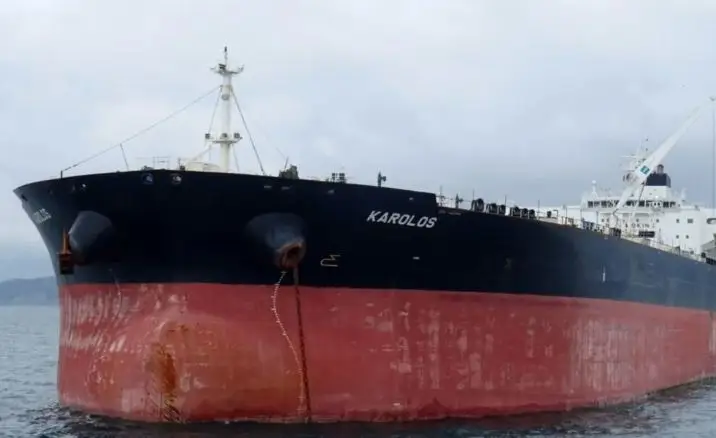
In a rare and highly watched maritime transit, a commercial oil tanker operated by a Greek shipping firm has successfully navigated the Strait of Hormuz, defying the severe naval blockades and geopolitical risks paralyzing the region.
According to vessel-tracking data analyzed by maritime intelligence firms Kpler and SynMax on Friday, May 15, 2026, the transit marks one of the very few successful crude oil shipments permitted through the strategic chokepoint this week.
The Voyage of the Karolos
The Liberian-flagged Suezmax tanker, named Karolos, is capable of transporting up to 1 million barrels of crude oil.
A deep-dive look into the vessel’s recent operational timeline reveals:
- The Loading Phase: The tanker initially docked at the high-security Basra Oil Terminal in southern Iraq on May 10, 2026, where it was fully loaded with crude.
- The Transit: Satellite analysis confirmed the vessel’s draft deepened significantly by May 14, indicating a maximum cargo load just before it braved the narrow strait.
- Current Destination: By Friday evening, the Karolos had cleared the tense waters of the Strait of Hormuz and was sailing safely through the Arabian Sea toward its final destination: the mega-refinery port of Sikka in western India.
A Chokepoint Frozen by War
The successful passage of the Karolos stands in stark contrast to the current desolation of the global energy corridor. Prior to the outbreak of the devastating military conflict involving Iran earlier this year, the Strait of Hormuz served as the absolute jugular vein of global energy, facilitating the passage of 20% of the world’s total petroleum liquids.
The impact of the ongoing conflict on global shipping is severe:
| Metric | Pre-War Statistics | Current Context (May 2026) |
| Daily Vessel Traffic | 125 to 140 ship transits per day | Down to a trickle of specialized or high-risk voyages. |
| Recent 24-Hour Transits | ~130 multi-class tankers and cargo hulls | Just 9 vessels passed into the Gulf of Oman, mostly small bulk carriers heading to Iran. |
“The fact that a million-barrel crude carrier cleared the strait under these conditions is an anomaly,” a maritime security source noted. “Most commercial fleets are completely bypassing the region due to prohibitive insurance premiums and persistent kinetic threats.”
Regional Workarounds: Bypassing the Threat
As the war continues to restrict maritime access, regional energy giants are moving quickly to implement permanent infrastructure alternatives.
The United Arab Emirates (UAE) has recently accelerated the construction of a massive new overland pipeline system designed to pump crude directly from inland fields to terminals on the country’s eastern coast, completely bypassing the volatility of the Hormuz chokepoint.
While the successful journey of the Karolos provides a momentary sigh of relief for Indian refineries in Sikka, the overall gridlock in the Persian Gulf keeps global oil prices heavily inflated as markets wait for a concrete diplomatic resolution.