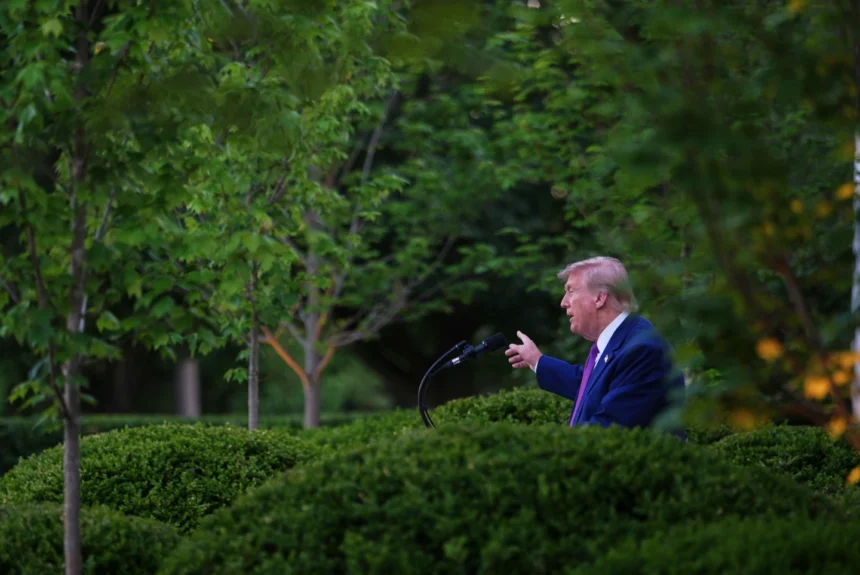
President Donald Trump is scheduled to arrive in Beijing today, Tuesday, May 12, 2026, for a high-stakes summit with President Xi Jinping. While the ongoing war with Iran remains a significant point of contention, both leaders appear determined to prevent the conflict from derailing the broader U.S.-China relationship.
The summit comes at a critical juncture, as the Trump administration shifts its focus from pressuring Beijing over its ties to Tehran toward a strategy of pragmatic stability on trade and security issues.
The Iran Dilemma: Leverage and Limits
For weeks, the White House has attempted to persuade China—the world’s largest buyer of Iranian oil—to use its influence to force Tehran back to the negotiating table and reopen the Strait of Hormuz.
- Mixed Signals: President Trump has alternated between criticizing China’s inaction and praising President Xi for his role in de-escalating tensions last month.
- Low Expectations: White House officials have signaled that they do not expect a major breakthrough regarding China’s stance on Iran during this visit.
- The Shipping Crisis: With roughly 20% of the world’s crude oil blocked in the Strait, the U.S. maintains that China has more to lose than the energy-independent United States. “You can’t buy from [China] if your economy is being destroyed by what Iran is doing,” Secretary of State Marco Rubio noted last week.
Pre-Summit Tensions: Sanctions and Blocking Statutes
The atmosphere leading up to the visit has been marked by several aggressive diplomatic maneuvers:
- U.S. Sanctions: On Friday, the State Department sanctioned three China-based firms for providing satellite imagery to the Iranian military. The Treasury also targeted Chinese refineries purchasing Iranian crude.
- China’s Response: Beijing invoked a 2021 “blocking statute” for the first time, prohibiting Chinese entities from complying with these “illegal unilateral” U.S. sanctions.
- Nuclear Support: Last week, Chinese Foreign Minister Wang Yi defended Iran’s right to civilian nuclear energy during a meeting with his Iranian counterpart in Beijing.
Prioritizing the “Fragile Truce”
Despite the friction over the Middle East, the overarching goal for both Washington and Beijing is to protect the October 2025 trade truce. Neither side wishes to return to the era of 145% tariffs or restricted rare-earth exports.
The Strategic Agenda:
- Fentanyl Crisis: The U.S. is seeking further cooperation to block the export of chemical precursors used in fentanyl production.
- Economic Stability: Xi Jinping views the summit as a way to validate China’s superpower status and maintain predictability in tariffs to safeguard a cooling Chinese economy.
- Technology & Taiwan: Long-standing frictions over tech competition and the status of Taiwan remain on the agenda but are being managed to avoid a “total spillover.”
Summit Outlook: Superpower Pragmatism
| Issue | U.S. Position | China’s Position |
| Iran War | Wants China to force the reopening of the Strait. | Prefers unofficial mediation; opposes U.S. maritime blockade. |
| Trade | Seeking compliance on fentanyl and “fair” market access. | Wants tariff predictability and removal of tech sanctions. |
| Middle East Security | Sanctioning firms aiding Iranian military strikes. | Accuses U.S. of applying “the law of the jungle.” |
As security tightens along Beijing’s pedestrian walkways, the world watches to see if the two leaders can maintain their “investment in stability.” While the Iran war provides a dangerous backdrop, the prevailing sentiment in both capitals is that the broader relationship is currently “too big to fail.”