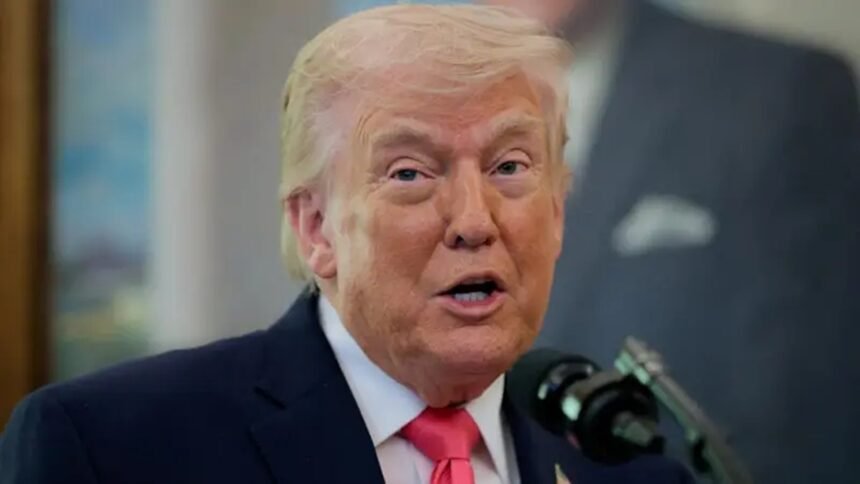
Fresh off a high-stakes, two-day bilateral summit in Beijing with Chinese President Xi Jinping, U.S. President Donald Trump has explicitly warned Taiwan against formally declaring independence from mainland China.
Speaking in an exclusive interview with Fox News while traveling back to Washington on Friday, May 15, 2026, Trump sought to defuse soaring geopolitical tensions in the Taiwan Strait by reinforcing the traditional “One China” status quo.
“I’m not looking for anyone to declare independence,” Trump stated flatly, signaling that his administration will not back unilateral political moves from Taipei that could trigger a regional war.
The “Stalemate Summit” and Xi’s Blunt Warning
The President’s comments follow intense, closed-door discussions at the Great Hall of the People and the imperial Zhongnanhai gardens, where President Xi Jinping reportedly issued a sharp warning. According to Chinese diplomatic readouts, Xi told Trump that mismanagement of the Taiwan issue could hurtle the world’s two dominant superpowers into “clashes and even conflicts.”
When questioned by reporters aboard Air Force One, Trump remained noncommittal about whether he gave any explicit guarantees to Xi, but admitted the Chinese leader feels “very strongly” about preventing an independence movement.
De-Escalation Over Confrontation
Trump defended his cautious rhetoric by emphasizing a desire to avoid dragging the United States into another distant military theater, referencing current U.S. entanglements in the Middle East.
“We are supposed to travel thousands of miles to fight a war? I’m not looking for that,” Trump told Fox News. “I want things to calm down. I want China to cool down.”
Despite the heavy rhetoric, Trump insisted that the fundamental bedrock of American foreign policy toward the self-governing island has not officially shifted. However, he heavily sowed doubt regarding the future of a highly anticipated $14 billion U.S. arms package slated for Taipei.
- Weighing the Arms Deal: Trump revealed he has not yet determined whether to approve the massive weapons sale. “I may do it, I may not do it,” he said, adding that he intends to make a final decision in the “fairly short period” after speaking directly with the leadership in Taiwan.
- Strategic Ambiguity maintained: When asked by reporters if the U.S. would militarily defend Taiwan in the event of an invasion, Trump doubled down on his signature ambiguity: “There’s only one person that knows that—it’s me. And I don’t talk about that.”
Taipei Responds with Cautious Optimism
In Taipei, Taiwan’s Ministry of Foreign Affairs responded carefully to the President’s remarks. Foreign Ministry Spokesperson Hsiao Kuang-wei noted that Taiwan appreciates Trump’s historical support for cross-strait security, adding that defense acquisitions are explicitly bound under U.S. domestic law via the Taiwan Relations Act.
While the Beijing summit concluded with minor deliverables regarding trade, agriculture, and aerospace—including Trump’s claim that China will purchase 200 Boeing aircraft—the lack of a concrete breakthrough on Taiwan suggests that an uneasy, fragile stability will continue to define U.S.-China relations in 2026.