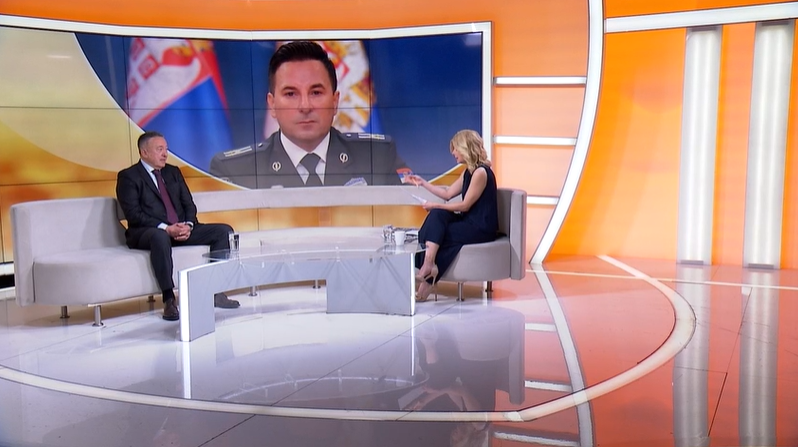
The ongoing formal criminal investigation into the former chief of the Belgrade Police, Veselin Milić, has been hit by legal controversy. Prominent Serbian defense attorney Sead Spahović has publically blasted the prosecution’s official Investigation Order, branding it as fundamentally contradictory, legally impossible, and an act of procedural “amateurism.”
Speaking in an exclusive interview with N1, Spahović outlined a stark procedural paradox: while the prosecutor’s factual, narrative description of the crime paints Milić as a direct co-perpetrator in a classic “insidious attempted murder,” the actual legal qualification slapped on the indictment has been deliberately downgraded to significantly milder offenses—specifically, harboring an offender after the fact and concealing evidence.
The Ambush Paradox: One Fact Described, Another Charged
According to the official investigation documents, Veselin Milić is currently facing charges of failing to report a crime/perpetrator, alongside rendering assistance to an offender after the commission of a criminal offense. However, Spahović notes that the prosecutor’s own written reconstruction of the events completely dismantles this mild classification.
   [THE SENJAK RESTAURANT AMBUSH MATRIX]
   • Prosecutor's Narrative:  Milić and two accomplices systematically lured the victim
                             to a restaurant. Milić explicitly instructed the target
                             to arrive entirely alone, without his security detail.
   • The Execution:          An argument ensued, a gunman opened fire, executing a
                             blatant attempted murder inside a public venue.
   • Legal Consensus:        Luring a victim into an unarmed trap is the absolute,
                             textbook definition of "Murder in an Insidious Manner."
“The investigation order is contradictory on multiple levels,” Spahović emphasized to N1. “The prosecutor explicitly writes that Milić lured the victim into an ambush, which legally makes him a co-perpetrator in an insidious attempted murder. Yet, in the very same breath, the prosecutor claims Milić didn’t participate in the act itself, but merely acted after the fact to conceal evidence. You cannot legally charge someone with harboring a criminal if they themselves participated in the core execution of that very crime.”
The 60-Day Clock: Why the Downgraded Charge Means Early Release
Spahović warned that this softer legal qualification has drastic procedural consequences that will heavily favor the former police chief.
Because the prosecutor has classified Milić’s alleged actions as assistance after the fact—a crime carrying a maximum sentence of eight years—the state is bound to a strict, expedited summary proceeding (skraćeni postupak). Under Serbian criminal code, detention under summary proceedings is capped at a maximum of two months.
   [DETENTION FRAMEWORKS: MURDER VS. ACCESSORY]
   • Insidious Murder Charge: Up to 6 months of investigative detention; public outrage
                             ("uznemirenje javnosti") functions as an airtight detention ground.
   • Accessory After Fact:   Strict 60-day absolute detention cap; public outrage
                             cannot legally be leveraged to extend detention.
“If this complex investigation is not entirely wrapped up and a formal indictment filed within the next 60 days, Veselin Milić will walk out of detention completely free,” Spahović explained. “Given the sheer complexity of this case, finishing it in two months is nearly impossible. Had he been properly charged with insidious murder—which carries a maximum life sentence—the state would have six full months to build its case, and he would remain behind bars.”
Managing a Case Without a Corpus Delicti
The high-profile case has been heavily weighed down by a critical material deficiency: the total absence of a physical body. When questioned by N1 whether the missing corpse was the driving force behind the prosecutor’s hesitation, Spahović remained unconcerned.
“A missing body burdens any case, but it is entirely possible to secure a conviction without a corpus delicti, provided the circumstantial evidence leads to the irrefutable conclusion that a murder occurred,” Spahović stated. “The real issue is that the prosecutor chose to open the case with the absolute mildest qualification. Usually, prosecutors start with the heaviest possible charge and let it drop to a lesser offense during trial as evidence dictates. Doing the reverse here naturally invites deep public suspicion.”
Spahović concluded by noting that public statements made by high-ranking politicians, including President Aleksandar Vučić, matter far less than the written text of the prosecution. He noted that the glaring errors in the order suggest one of two things: either the state possesses fundamentally conflicting pieces of evidence, or they simply do not have the legal stones to charge the former Belgrade police chief as a killer.