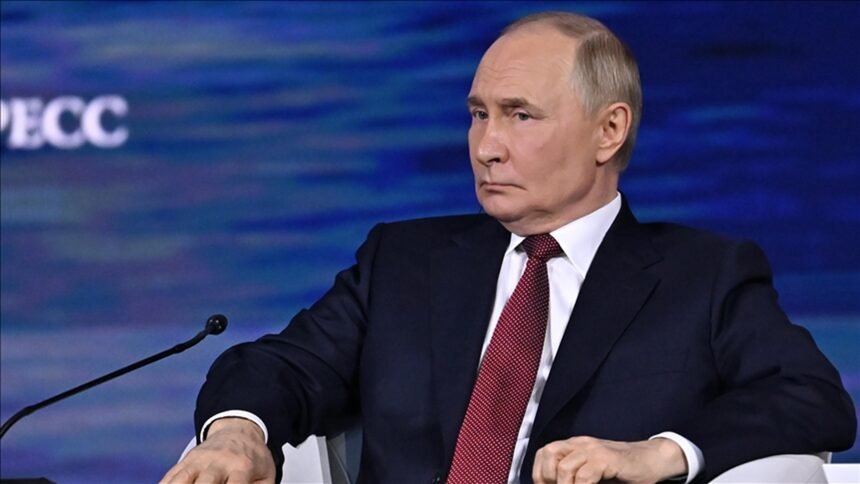
Russian President Vladimir Putin has shattered his previous record for internal isolation, failing to visit a single outer Russian region for 196 consecutive days.
According to tracking data and European intelligence briefings, this marks the longest period the Russian president has stayed within his heavily fortified power centers in modern history—surpassing even the most restrictive isolation periods enforced during the height of the COVID-19 pandemic.
Breaking Down the Lockdown Timeline
Historically, localized regional trips across Russia’s 11 time zones were a routine, highly coordinated staple of Putin’s domestic public relations strategy. However, since late 2025, the president’s movements have shrunk to a microscopic geopolitical footprint, limited entirely to Moscow, the immediate Moscow Oblast (region), and his hometown of St. Petersburg.
- The Cutoff Date: Putin’s last domestic excursion outside his primary security bubbles was a brief, one-day visit to the city of Samara on November 6, 2025.
- The Pandemic Baseline: During the global COVID-19 health crisis, when the Kremlin instituted extreme biological quarantine protocols (including the famous multi-meter long meeting tables), Putin’s longest stretch without regional travel maxed out at 132 days.
[Putin's Domestic Isolation Milestones — Consecutive Days]
   │
   ├─► COVID-19 Pandemic Peak ──► 132 Days
   │
   └─► Current Security Freeze ──► 196 Days (As of May 26, 2026) ★ HISTORIC HIGH
Orchestrated Appearances and Ghost Audiences
To maintain the illusion of active governance, the Kremlin has relied on highly controlled, hermetically sealed environments. Recent “public” engagements have been scrubbed of any genuine civilian interaction:
- Orthodox Christmas: Celebrated not in a public cathedral, but during a private service inside a restricted special forces military facility.
- Student Meetings: Hosted under heavy guard in the secure Moscow suburb of Dolgoprudny, with participants heavily vetted by the Federal Protective Service (FSO).
- Wreath-Laying Ceremony: Conducted in St. Petersburg in complete isolation, entirely closed off to public spectators or local crowds.
The Catalyst: The Valdai Drone Plot and Cross-Border Raids
The extreme contraction of Putin’s travel schedule coincides with highly volatile security developments in late 2025 and mid-2026.
Russian authorities openly acknowledged a sophisticated Ukrainian drone attempt targeting Putin’s highly secretive, luxury forest residence in Valdai in late 2025. While international intelligence communities initially questioned the technical feasibility of hitting the heavily guarded compound, the psychological impact on Kremlin security planning was immediate.
                  [KREMLIN SECURITY RADAR — MAY 2026]
                                  │
       ┌──────────────────────────┴──────────────────────────┐
       ▼                                                     ▼
  EXTERNAL THREATS:                                     INTERNAL THREATS:
  • Precision drone strikes inside Russia               • FSO fears of domestic coup
  • May 21-22 cross-border air raids                    • Oligarchic instability
  • Loss of air defense systems in Bryansk/Kursk        • Elite fracture over stalled economy
Kyiv, however, has consistently dismissed the Valdai incident as a fabricated “false flag.” Ukrainian officials argue the Kremlin invented the assassination plot as a convenient diplomatic exit ramp to paralyze ongoing international peace negotiations.
Aggressive Air Raids Fuel Kremlin Paranoia
The threat level skyrocketed following a massive, highly successful Ukrainian military operation on May 21–22, 2026.
According to the Ukrainian General Staff, precision strikes inside Russia’s sovereign borders—specifically the Bryansk and Kursk regions—successfully neutralized Russian air defense batteries, command outposts, drone control hubs, and forward ammunition depots.
European intelligence agencies, cited in recent CNN briefs, indicate that Putin’s FSO security detail is operating under a state of hyper-vigilance. The 196-day domestic freeze reflects a deep-seated fear within the Kremlin that goes beyond Ukrainian drone reach; there is growing paranoia regarding potential internal instability and elite dissatisfaction as the financial and logistical costs of the conflict continue to compound.