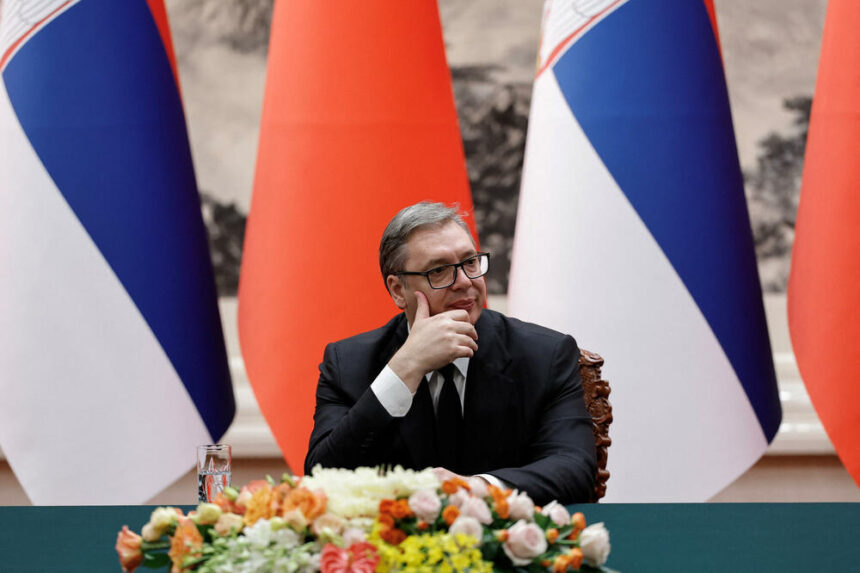
Speaking from Beijing during an official state visit to China, Serbian President Aleksandar Vučić addressed the newly released U.S. State Department report to Congress regarding Washington’s revised policy toward the Western Balkans.
Vučić confirmed that Serbian authorities have formally “taken note” of the document’s contents and will continue to cooperate with the United States, but adamantly insisted that Belgrade will not easily abandon its sovereign foreign policy objectives.
Washington Shuts the Door on “Nation-Building”
The State Department’s report to Congress signals a major structural shift in how Washington intends to project its influence across the region. According to the document, the United States is officially pivoting away from historic interventionist strategies and moving toward pragmatic, transactional partnerships.
Excerpt from the State Department Report: “The era of U.S.-led nation-building is over. U.S. policy in the Western Balkans is focused not on rescue or reconstruction, but on stability and mutually beneficial partnerships. The region remains of direct importance to the security and economic interests of the United States.”
The report outlines six key priorities for the United States regarding the Balkan sextet (Albania, Bosnia & Herzegovina, Kosovo, Montenegro, North Macedonia, and Serbia):
       [U.S. STATE DEPARTMENT PRIORITIES — WESTERN BALKANS]
                                │
       ┌────────────────────────┼────────────────────────┐
       ▼                        ▼                        ▼
  1. Regional Stability   2. Countering Malign     3. Economic & Trade
                             Russian/Chinese          Cooperation
                             Influence
       ▲                        ▲                        ▲
       ├────────────────────────┼────────────────────────┤
       ▼                        ▼                        ▼
  4. Energy & Infra-      5. Combating Organized   6. Strengthening Security
     structural Growth       Crime                    Cooperation
Vučić Defies Pressure: “We Are Not Obedient Puppets”
Reacting to the report’s emphasis on countering Russian and Chinese influence, Vučić used the platform to deliver a sharp rebuke to domestic opposition figures and Western diplomats who demand that Belgrade fall entirely in line with Euro-Atlantic foreign policy.
“We respect what the State Department does; we have taken note of it. We will cooperate with the Americans,” Vučić told Serbian reporters. “However, we will not give up our position—at least not as easily as some imagine. Otherwise, why do we even have a state? Just to have obedient puppets who run to a cafe the moment they receive an email to have their tasks dictated to them on how to dismantle their own country?”
The President linked Serbia’s gridlocked integration into Western institutions directly to its geopolitical choices, admitting that Serbia has not opened a single new negotiation cluster for EU membership in five years. He stated that this freeze is the direct price Belgrade is paying for refusing to sanction Russia and rejecting the independence of Kosovo.
Beijing Reaffirms Rigid Support for Serbia over Kosovo
Vučić’s comments arrive at a highly symbolic moment, delivered while standing alongside Chinese officials in Beijing—the exact type of alignment the State Department report seeks to neutralize.
The Serbian President confirmed that during his high-level bilateral meeting with Chinese President Xi Jinping, the issue of Kosovo was a central topic of discussion. According to Vučić, Beijing responded by renewing its absolute, unshakeable support for Serbia’s territorial integrity, explicitly recognizing Kosovo as an integral province within the borders of Serbia.
Anticipating a Diplomatic Showdown in Tivat
Looking ahead, Vučić revealed that he expects to face fierce diplomatic blowback and intense criticism from European leaders during the upcoming EU-Western Balkans Summit scheduled for June 5, 2026, in Tivat, Montenegro.
“I am used to these things,” Vučić shrugged, downplaying the anticipated pressure. “Some people simply do not understand that no matter how much pressure you apply, I will always weigh the ultimate interests of Serbia on the scale. That is far more important to me than any pressure meant to break me.”
He pointed out the hypocrisy of Western leaders who routinely travel to Beijing for multi-billion-dollar trade deals while simultaneously criticizing Belgrade for doing the same. “Their mindset is: ‘Who are you, you little country with barely seven million inhabitants, to involve yourself in major world affairs? That is reserved only for us,'” Vučić concluded.