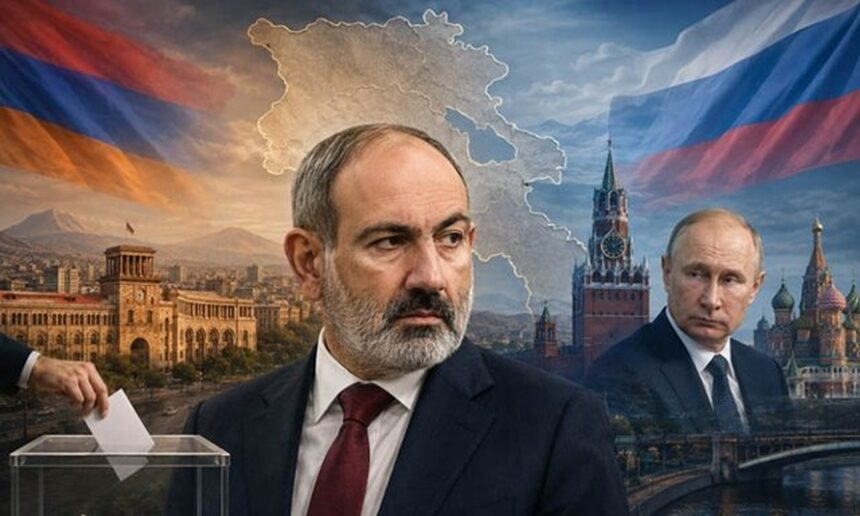
Only seven days remain until Armenia’s parliamentary elections. Each day brings new reports of arrests and investigations linked to alleged hybrid attacks against the country, while Russia is exerting increasingly open pressure on the South Caucasus republic.
Once considered one of Moscow’s strongest regional allies, Yerevan is now seeking to free itself from the influence of its former partner, secure a lasting peace with its historic rival Azerbaijan, normalize relations with Turkey, and strengthen ties with the West, redefining itself as a bridge between Asia and Europe.
The June 7 vote is, without exaggeration, the most important election in modern Armenian history.
A Decisive Election for the Future
Voters will have to decide on crucial questions: whether to continue the course pursued by the current government or return figures associated with the previous system to power; whether to strengthen partnerships with the United States and the European Union or revive closer ties with Russia; and whether to continue the difficult reconciliation process with Baku and Ankara or revisit existing agreements, risking the destabilization of the entire process.
The Moment of Truth for Pashinyan
For Prime Minister Nikol Pashinyan, the leader of the Velvet Revolution that brought him to power in 2018, these elections represent a defining moment.
Since the last elections, held after the catastrophic 2020 Nagorno-Karabakh war, Armenia has endured exceptionally difficult times. Pashinyan succeeded in retaining public confidence then, but this challenge is even greater.
His second term has been marked by dramatic developments: Azerbaijani military incursions into Armenian territory, the occupation of approximately 200 square kilometers of sovereign land, and ultimately the collapse of the separatist Republic of Artsakh.
In September 2023, amid the passivity of Russian peacekeeping forces and a muted international response, Azerbaijan completed the military operation it had begun three years earlier, triggering the mass exodus of the Armenian community that had lived in the region for centuries.
Moving Away from Moscow
These developments led to a steady deterioration in relations between Yerevan and Moscow, as well as with the Collective Security Treaty Organization (CSTO), the Russia-led military alliance.
Pashinyan suspended Armenia’s participation in the organization and requested the withdrawal of Russian border troops from the capital’s airport, alongside a gradual reduction of their presence along Armenia’s land borders.
However, he clarified that the Russian military base in Gyumri remains outside the scope of these discussions.
Armenia subsequently joined the International Criminal Court (ICC), and parliament approved legislation launching the process of European integration.
Drawing Closer to Europe
Armenia’s pro-European shift became especially visible on May 4, when Yerevan hosted the European Political Community Summit, attended by Ukrainian President Volodymyr Zelenskyy.
The following day, the first Armenia–EU bilateral summit was held.
On May 9, during Victory Day celebrations, Russian President Vladimir Putin called on Armenia to hold a referendum allowing citizens to choose between European integration and remaining within the Eurasian Economic Union.
Putin also drew parallels with the “Ukrainian scenario,” recalling that tensions with Kyiv in 2014 began following Ukraine’s closer alignment with Brussels.
Pashinyan’s Strategy
Pashinyan has adopted a more balanced position.
“We have never acted and will never act against Russia’s interests, but we cannot place its interests above our own,” he declared during an election rally.
His objective is not geopolitical confrontation, but rather transforming Armenia into a strategic trade hub connecting Asian and European markets.
The Kremlin’s “War”
The Kremlin appears determined to prevent his re-election.
Russia has restricted Armenian exports and threatened to remove customs exemptions for gas, oil, and diamond supplies.
According to a report by the McCain Institute’s pre-election mission, Russia has intensified disinformation campaigns through cloned websites and coordinated social media networks.
Meanwhile, according to a Reuters report citing confidential documents and Western intelligence sources, the Kremlin is allegedly planning to transport tens of thousands of Armenia-based voters residing in Russia in an effort to influence the election outcome.
Pashinyan’s Opponents
Armenia’s opposition is largely dominated by pro-Russian political forces. The parties most likely to enter parliament advocate strengthening relations with Moscow.
At the same time, Pashinyan enjoys strong Western support, which was highlighted by a public message of support from Donald Trump.
What Do the Polls Show?
All major polls place the ruling Civil Contract party in first place with approximately 30 percent of the vote.
In second place is Strong Armenia, led by Russian-Armenian businessman Samvel Karapetyan, with support ranging between 6 and 15 percent.
Two other political forces—the alliance of former President Robert Kocharyan and the party of billionaire Gagik Tsarukyan—show highly variable results across different surveys.
Although Pashinyan remains the clear favorite, an outright majority still appears out of reach. The outcome of June 7 will determine not only the composition of Armenia’s next government but also the country’s strategic direction at a decisive moment in its history.